
 by
by

For the past two months, I have been fighting to get Google to de-index a website that uses my exact legal name as its domain: dennisyu.io. It is a site built for one purpose: to destroy my professional reputation.
The site was created by Lane Houk, the same person behind the Signal Genesys platform, an SEO service I paid $10,500 for that failed to deliver results. It is designed to look like an official background check or research report, with sections titled “Legal Issues & Court Cases,” “Business Ethics Allegations,” and “Risk Assessment.” It presents fabricated and unverified claims of fraud, extortion, and criminal behavior as though they are verified findings.
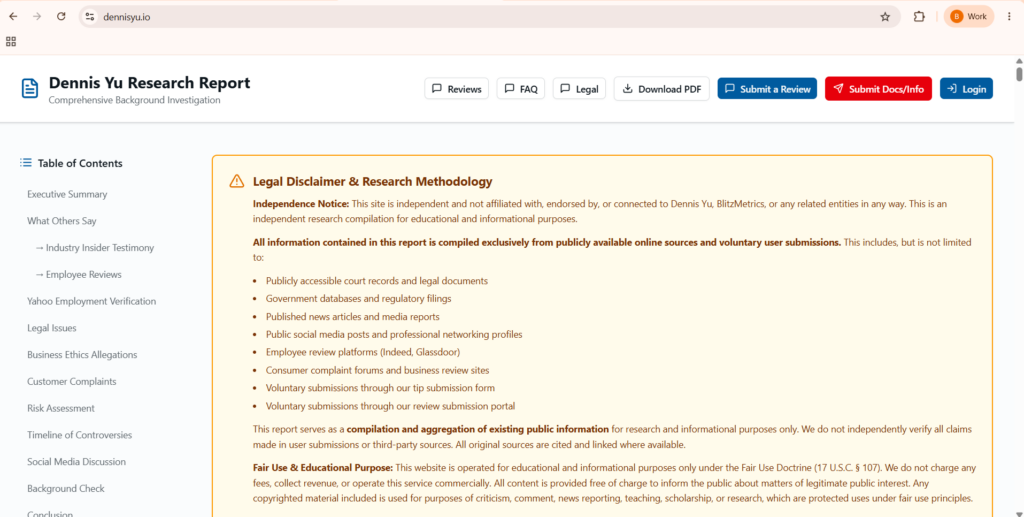
While the site appears in some Google results when searching my exact name, it has no real authority. It does not rank for broader industry terms, it has no backlink profile from credible sources, and when you ask ChatGPT or other LLMs about Lane Houk, the results reflect the documented evidence, not his attack pages. This is the difference between gaming a few vanity queries and building genuine topical authority. His own site gets roughly 6 organic visits per month according to Ahrefs, which tells you everything about the methodology behind these pages.
Filing the request
On April 6, 2026, my operations team filed a legal removal request with Google on my behalf, arguing the site constitutes malicious impersonation and defamation.
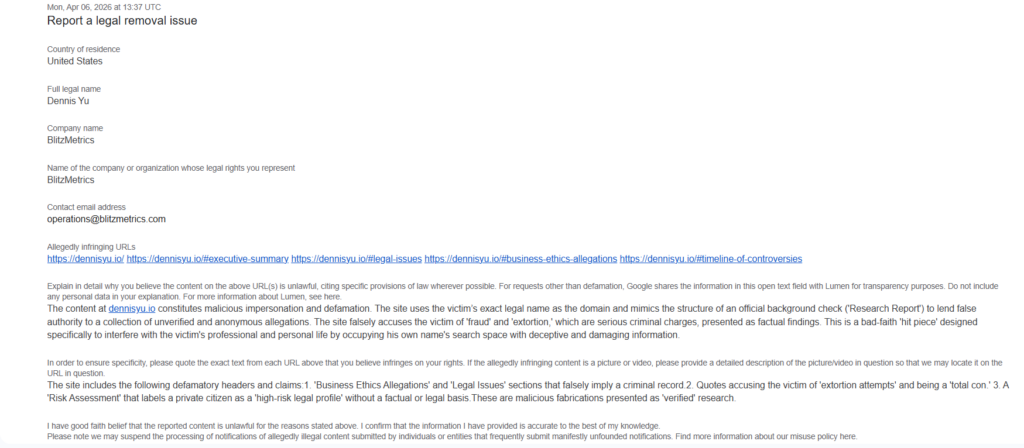
Google’s first response flagged that the submission came from Pakistan, because a member of my operations team filed it from her location overseas.
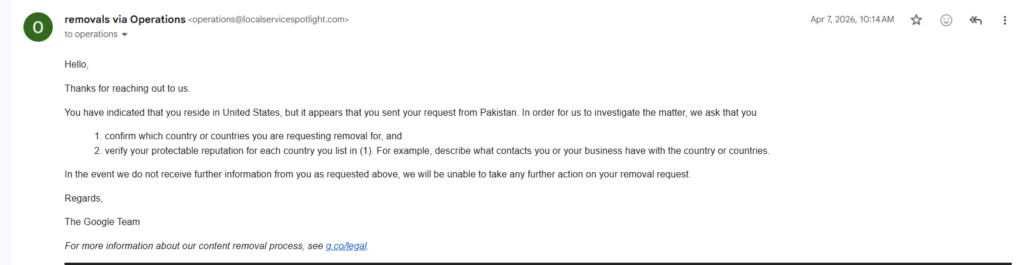
We clarified that I am a US resident and the actual subject of the complaint, and that my team member was acting as an authorized agent.
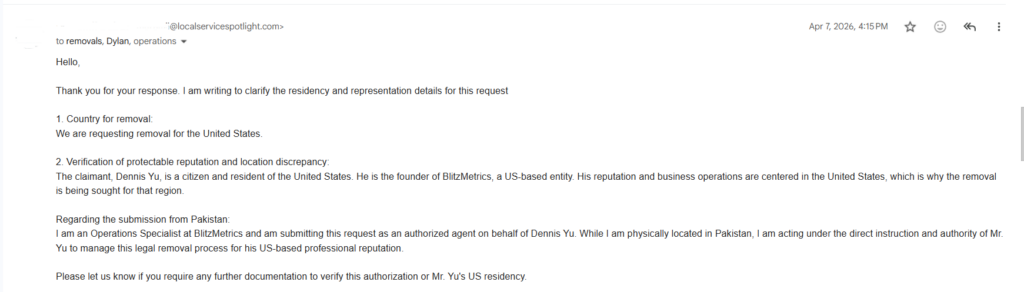
Google told me to contact the webmaster
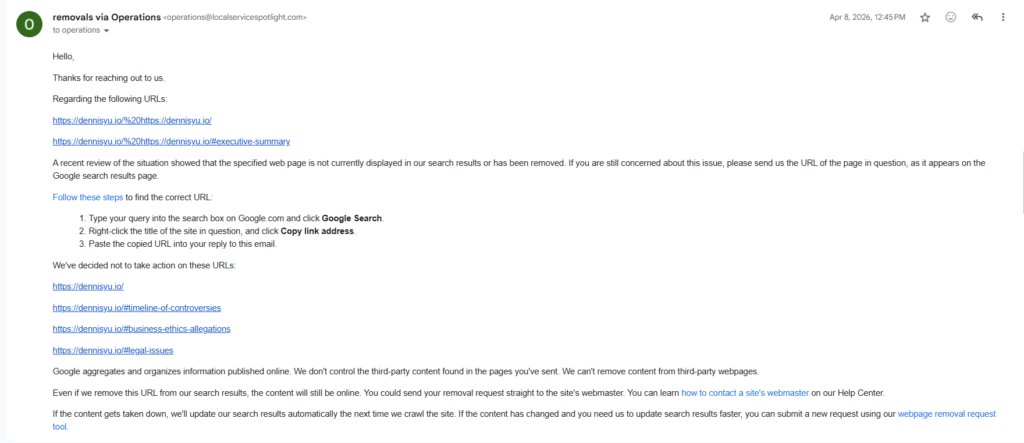
On April 8, Google declined to act on several of the URLs, stating it does not control third-party content and suggesting I contact the site’s webmaster directly. That response completely missed the point. The “webmaster” is the person who built the site to attack me.
This is not the first time Lane has resorted to intimidation when confronted with facts. When I documented the Signal Genesys failure, he responded with threatening messages instead of addressing the evidence.
On April 14, my operations team submitted a detailed escalation. We provided five specific Google search queries with direct redirect URLs and annotated screenshots proving the site was appearing for name-specific searches and broadcasting defamatory snippets within Google’s own search results.

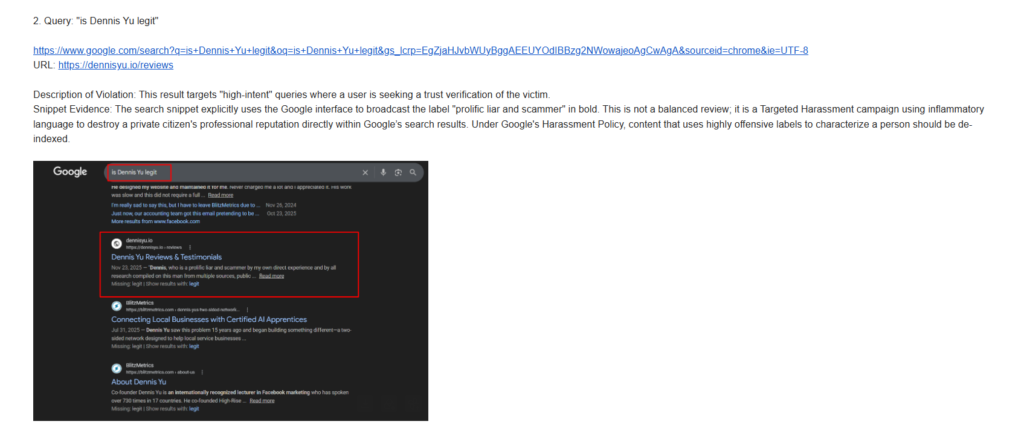

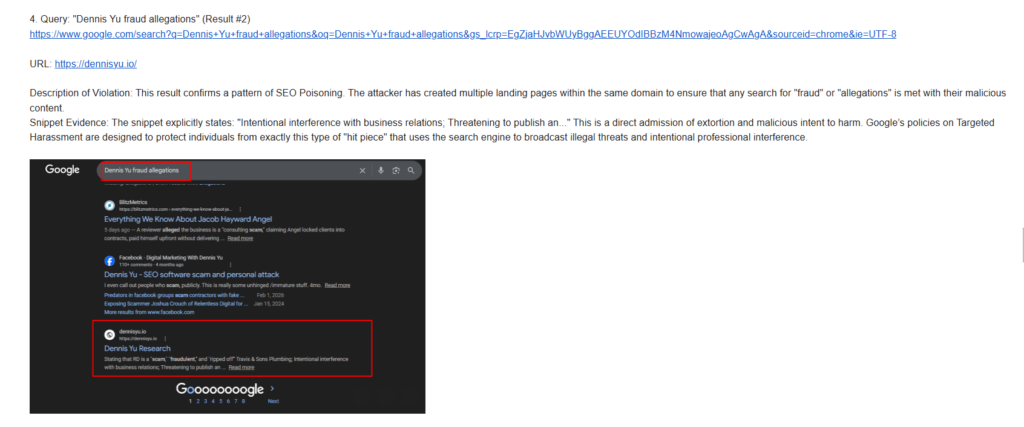


We framed the request not as a standard content dispute, but as a violation of Google’s own safety policies on targeted harassment, malicious impersonation, and doxxing. The site is a textbook case of someone attempting to game search results for a specific person’s name with malicious content.
Weeks of silence
Despite the detailed evidence, Google never confirmed a manual review. My team sent follow-up emails on April 20, April 25, May 2, and May 9. None received a substantive response.


On May 15, I personally emailed Google to verify my identity and US residency. I explained that BlitzMetrics is a US company with US clients, employees, and contractors. I regularly speak, publish, and teach to US audiences at universities, conferences, and with corporate clients. My professional reputation and the harm from this site are concentrated entirely in the United States.

Google said they couldn’t find the content
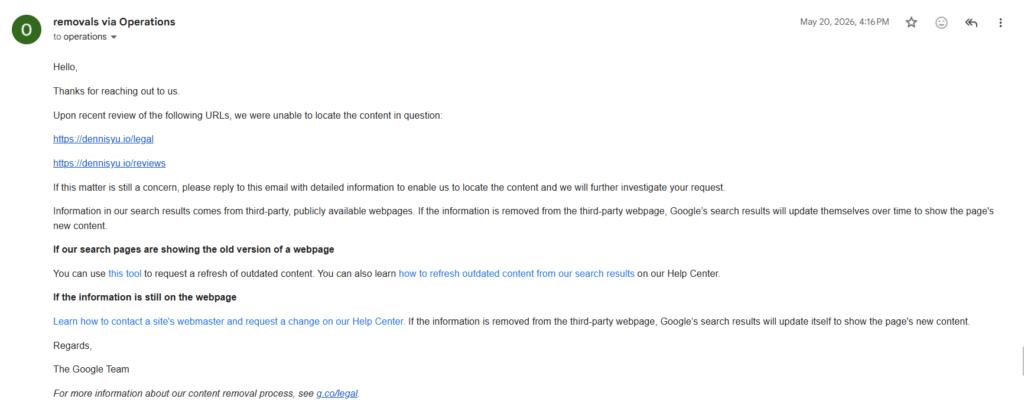
On May 20, Google responded again, this time claiming it was “unable to locate the content” on two of the reported URLs.
On May 31, my team replied with fresh, timestamped screenshots proving both pages were fully live and indexed. We suspect the site may have used cloaking tactics during Google’s review. The screenshots showed pages displaying mock legal tables, false criminal charge claims, and an open submission form inviting anyone to post inflammatory accusations against me.
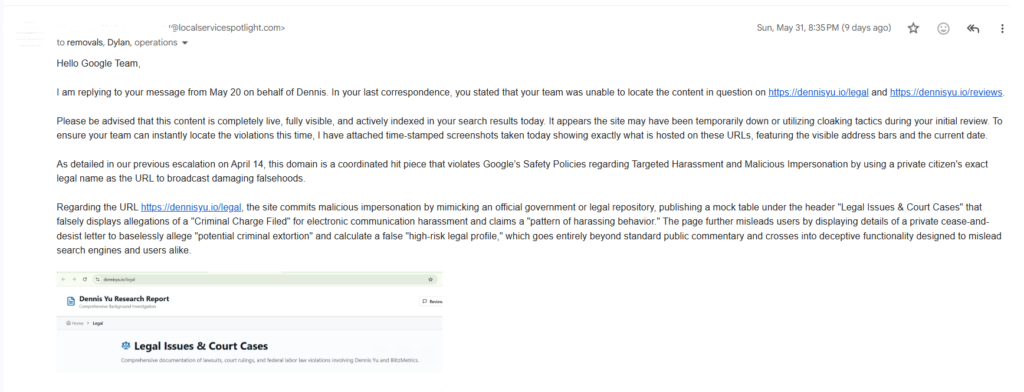
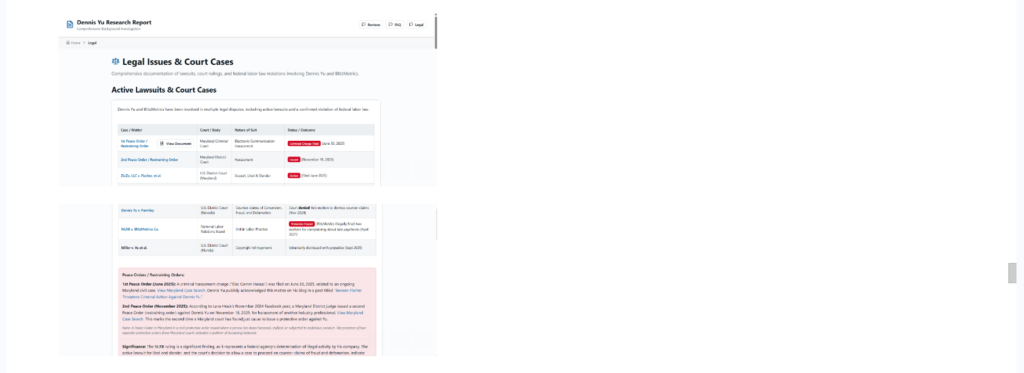
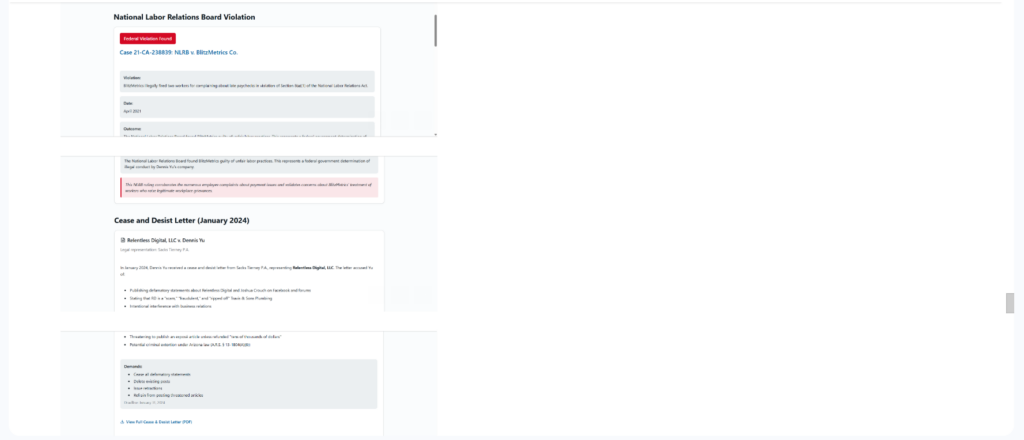
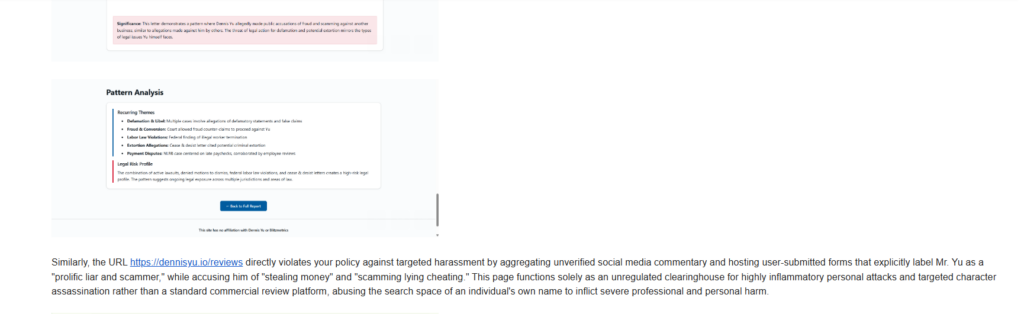
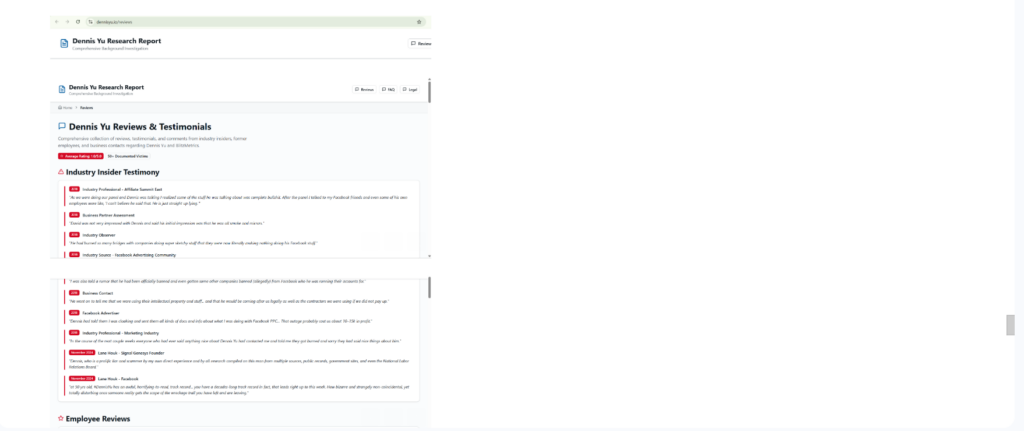
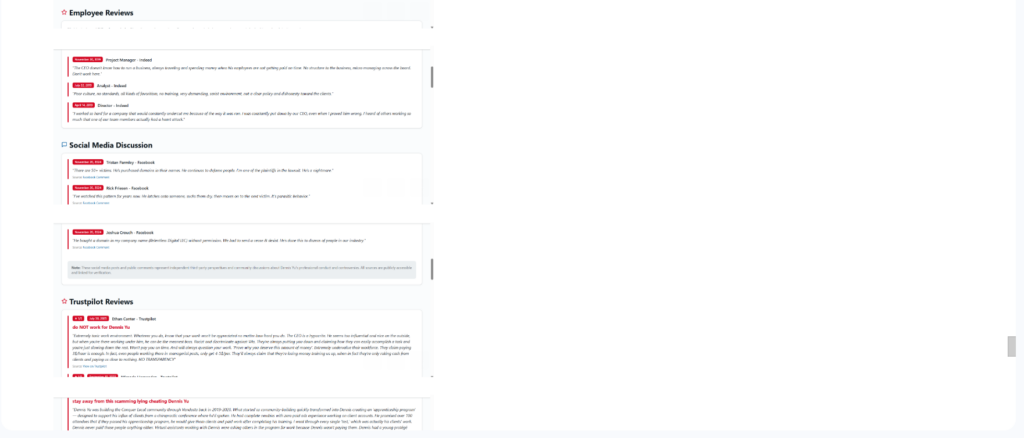


Ironically, Lane’s own legal history includes a $584,800 mortgage foreclosure he never disputed. He only challenged the bank’s paperwork. Yet his attack site presents fabricated legal tables as if they are authoritative records.
Where things stand
As of early June 2026, the case remains unresolved. Google has not confirmed any manual review or escalation to its Trust and Safety team.
This experience raises uncomfortable questions about how platforms handle weaponized SEO attempts. When a bad actor builds an entire domain around someone’s legal name specifically to game name searches, standard responses about “third-party content” and “contacting the webmaster” are meaningless. The webmaster’s explicit intent is harassment, and Google’s search index is the vehicle.
Lane operates under multiple brands, including Quantum Agency, a white-label SEO service with the same pattern of overpromising and underdelivering. Building attack sites is just another tactic from someone whose own platforms consistently fail to demonstrate real expertise.
Every potential client, partner, or collaborator who searches my name may encounter a site engineered to look authoritative while broadcasting unverified allegations. And the platform that surfaces it has, so far, declined to intervene.
Why this ultimately fails
If you want to understand why sites like dennisyu.io fail to build real authority, and why Google and LLMs can increasingly distinguish between genuine expertise and manufactured signals, watch Episode 1 of The Marketing Mechanic on entities. When you understand how entities work, you will see exactly why attack sites built on thin content and zero real authority do not rank where it matters, while documented, factual content does.
I am sharing this story because I know I am not the only one dealing with this. If Google’s own policies on harassment and impersonation mean anything, they need to be enforced, not just for me, but for anyone targeted by this kind of attack.
Originally published .
Dennis Yu
Dennis Yu is the CEO of Local Service Spotlight, a platform that amplifies the reputations of contractors and local service businesses using the Content Factory process. He is a former search engine engineer who has spent a billion dollars on Google and Facebook ads for Nike, Quiznos, Ashley Furniture, Red Bull, State Farm, and other brands.
Dennis has achieved 25% of his goal of creating a million digital marketing jobs by partnering with universities, professional organizations, and agencies. Through Local Service Spotlight, he teaches the Dollar a Day strategy and Content Factory training to help local service businesses enhance their existing local reputation and make the phone ring.
Dennis coaches young adult agency owners serving plumbers, AC technicians, landscapers, roofers, electricians, and believes there should be a standard in measuring local marketing efforts, much like doctors and plumbers must be certified. He has appeared on 353 podcasts with 619 credited episodes — see the full list of his podcast appearances.