
 by
By Dennis Yu
The short answer
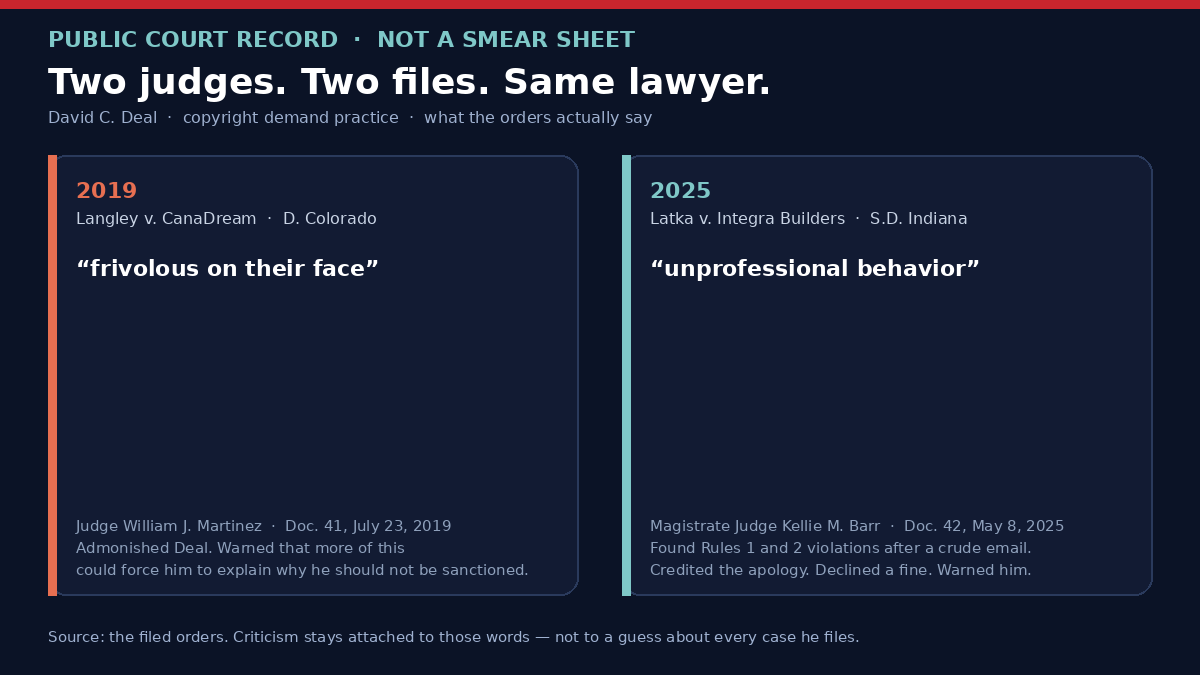
David C. Deal is a Charlottesville, Virginia copyright lawyer who represents photographers in copyright matters — his firm claims more than 500 clients and 3,500 copyright cases. Twice, six years apart, a federal judge put his own conduct in writing. In 2019, Judge William J. Martinez in Colorado denied his motion, called its arguments “frivolous on their face,” and admonished him personally. In 2025, Magistrate Judge Kellie M. Barr in Indiana found that his email to opposing counsel violated Rules 1 and 2 of the Seventh Circuit Standards for Professional Conduct, after he missed a court deadline and failed to send the court a required copy. Neither cited order imposed sanctions. These are specific findings in two cases, not a complete disciplinary history or a current state-bar status report. The discussion below gives page citations and the limits of each finding.
This page is the complete examination: what happened in each case, the procedural rules involved explained in plain English, what the judges did not find, the counterweight in Deal’s broader record, and the full source register so you can check every claim yourself. Facts are sourced; assessments are labeled as assessments. Where I give an opinion, it says so.
Check the original evidence
Read the complete 2019 Langley order, Document 41 and 2025 Latka order, Document 42. The 2019 admonition is on pages 13–14, with the limitation in footnote 8. The 2025 email is on page 2, the finding on page 4, and the warning and decision declining sanctions on page 5.
The evidence collection includes the relevant court pages, redacted correspondence received by Dennis Yu, and dated AI screenshots with the exact prompts and verification limits. Identifying information about the young agency owner and business is withheld. Court findings, correspondence and AI answers are different kinds of evidence; an AI repeating a statement does not independently establish it.
The two orders at a glance
| Langley v. CanaDream Corp. | Latka v. Integra Builders LLC | |
|---|---|---|
| Court | U.S. District Court, District of Colorado | U.S. District Court, Southern District of Indiana |
| Order | Doc. 41, July 23, 2019 | Doc. 42, May 8, 2025 |
| Judge | William J. Martinez | Kellie M. Barr, Magistrate Judge |
| What Deal did | Filed a Rule 12(b)(6) motion to dismiss counterclaims using evidence-demanding, fact-arguing submissions | Sent opposing counsel an insulting email; missed a settlement-demand deadline; omitted a required court copy |
| What the judge found | Motion arguments “frivolous on their face”; improper purpose; a judge-specific practice requirement ignored | Email violated Seventh Circuit Standards for Professional Conduct, Rules 1 and 2 |
| Outcome | Motion denied; Deal admonished; warned of a possible future show-cause order on sanctions | Apology accepted; sanctions declined; formal warning issued |
| What the judge did NOT do | Did not sanction him; did not find the underlying copyright claim frivolous; imposed no fine; did not decide the copyright claim | Did not sanction him; did not disbar or suspend him; made no finding of copyright fraud; closed the show-cause matter, not the lawsuit |
The timeline
April 26, 2019 — The Fourth Circuit decides Brammer v. Violent Hues Productions, 922 F.3d 255: Deal, arguing for photographer Russell Brammer, wins reversal of a fair-use ruling. His best-known result, and real evidence of litigation capability.
July 23, 2019 — Three months later, Judge Martinez issues the Langley order: frivolous motion, personal admonition.
March–May 2025 — The Latka sequence: missed March 3 deadline, March 12 late service without the court copy, May 7 show-cause hearing with an apology, May 8 order with conduct findings and a warning.
September 24, 2026 — Deal writes to me or copies me in an email exchange, including “I encourage you to stick to TikTok marketing conferences.” Redacted excerpts and their context are presented in my profile of Deal. I am a party to that exchange, not a neutral observer of it — which is exactly why this page sticks to court documents for everything about the two cases.
2019: a motion the judge dismantled
Photographer Jason Langley sued CanaDream Corporation over a website photograph. Deal, for Langley, moved to dismiss CanaDream’s counterclaims. Judge Martinez denied the motion (Doc. 41, pp. 9–14) and criticized Deal personally:
“frivolous on their face”
Judge Martinez, describing the dismissal arguments, p. 13
“will not be further tolerated”
Judge Martinez, on the improper use of the motion, p. 14
“admonishes Mr. Deal for filing a frivolous motion”
Judge Martinez, p. 14
Item by item:
1. The arguments answered the wrong question. A motion under Rule 12(b)(6) tests whether the pleaded allegations state a legally sufficient claim; at that stage, well-pleaded facts are assumed true for that limited purpose (pp. 9–10). Deal instead demanded evidence and presented his own factual account. On one counterclaim, the judge said the arguments appeared to be an attempt “simply to get his side of the story into the record” — not a proper purpose for that motion.
2. He ignored the judge’s own practice requirement. Footnote 7 (p. 14) records that Deal submitted material outside the pleadings without the statement Judge Martinez’s Revised Practice Standard III.D.3 requires, addressing whether the motion should be converted into one for summary judgment.
3. The sanction warning — and its limit. The order warned that further abuse of the judicial process would result in an order to show cause why he should not be sanctioned (p. 14). No sanction was imposed. Footnote 8 is precise about scope: the admonition arose solely from Deal’s frivolous motion arguments — it was not a finding about CanaDream’s allegations, and it did not declare the photographer’s underlying infringement claim frivolous.
4. What else the order did. The court also rejected CanaDream’s settlement-enforcement request because it missed an essential term, imposed no fine, and did not decide the copyright claim (pp. 8–9, 14–15). Both sides lost something in this order; the personal admonition, however, was Deal’s alone.
The detail that makes it worse: the arguments he never made
On page 11, the judge identified possible defects in CanaDream’s counterclaims that Deal had not raised, and declined to decide them. Read that slowly. Potentially useful, legally relevant arguments existed. The motion missed them, and offered a list of unanswered factual questions instead — at a stage where factual questions are not the test. That is the difference between losing a motion and having a judge describe the work itself as frivolous.
The rule he skipped, in plain English
Rule 12(d) covers what happens when a 12(b)(6) motion presents material outside the pleadings and the court does not exclude it: the motion must be treated as one for summary judgment under Rule 56, and all parties must get a reasonable opportunity to present pertinent material. That conversion is why Judge Martinez’s practice standard requires the statement Deal omitted. The checklist a careful lawyer runs before filing is unglamorous: What exact issue can the court decide now? What facts may it consider? What is the strongest legally relevant argument? Does the request comply with this judge’s requirements? The 2019 motion failed that checklist in a published order.
My assessment: this is embarrassing criticism of a lawyer’s work product — sloppy, ill-judged advocacy in this motion. It does not establish dishonesty, and it does not prove permanent incompetence. It establishes that in this filing, aggression substituted for procedural discipline, and a federal judge said so in unusually sharp language.
2025: an ugly email reaches the judge
Six years later, in Latka v. Integra Builders LLC, the problem was not a motion. It was conduct around a settlement demand and an email (Doc. 42, p. 2):
The deadline sequence. The plaintiff’s settlement demand was due March 3, 2025. It was not served. At a March 10 conference, the court told Deal the deadline had been missed and ordered service by March 12. He served opposing counsel on March 12 — but did not send the required courtesy copy to the judge’s chambers. Opposing counsel forwarded it. Two compliance failures, back to back, in the same week.
The email. The order reproduces what Deal wrote to opposing counsel:
“you are a liar or uniformed about basic information in this case. Both are unacceptable.”
Deal’s email, as reproduced in the order, p. 2 (the order prints “uniformed”; the spelling is preserved)
The order also reproduces his language questioning whether the opposing client “has the balls” to deny matters under oath (p. 2). The court found the email failed to treat opposing counsel civilly and courteously and contained disparaging personal remarks, acrimony, and offensive language.
The standard he violated. Judge Barr expressly found noncompliance with Rules 1 and 2 of the Seventh Circuit Standards for Professional Conduct (pp. 4–5). These are court-applicable professional standards — not a Virginia State Bar disciplinary ruling, not a suspension, not a disbarment.
The process, and how it ended. The court ordered Deal to show cause. He submitted a written response admitting professional-conduct violations, apologized at the May 7, 2025 hearing, and admitted his emotions had gotten the better of him. Defense counsel did not seek sanctions. On May 8, Judge Barr credited the apology and the acceptance of responsibility, and wrote the outcome plainly:
“will not impose sanctions”
Judge Barr, p. 5
She formally warned him against further unprofessional behavior in the case or the district, and closed the show-cause matter — not the lawsuit. Precision matters here in both directions: the deadline and copying failures were the background; the express conduct findings concerned the email. And nothing in this order is a finding of copyright fraud.
Two sourcing notes, because they matter: the email quotation comes from the filed order, not from an independently obtained original email; and the hearing account comes from the judge’s order, not from a hearing transcript.
The professional standard, explained
The Seventh Circuit standards require courtesy in written and oral dealings with other counsel, forbid offensive conduct and personal disparagement, and tell lawyers not to act out a client’s ill feelings. They connect civility with resolving disputes efficiently. Their preamble also says the standards themselves should not become a basis for litigation or penalties — and the Latka order separately discusses the court’s inherent authority to regulate its own proceedings. Courtesy rules and the legal power to punish are related but distinct; Judge Barr’s findings rest on the standards, and her restraint on sanctions was her own stated choice.
My assessment: calling opposing counsel a liar and taunting his client’s courage is crude, belittling language — schoolyard bluster that does no evidentiary work. It does not show ownership of a photograph, lack of permission, a date of use, or the value of a claim. An apology after a show-cause order explains leniency; it does not make the original choice good advocacy. And there is no sound basis to claim the apology was fake simply because it followed judicial scrutiny.
The firm’s own pitch invites a demanding standard
Deal Copyright Law presents a specialist practice built on extensive litigation experience and strong client relationships; its website reports more than 500 clients and 3,500 copyright cases. Those are the firm’s own claims — not audited totals, and “cases” must not be relabeled as filed lawsuits or victories. A firm that sells expertise should expect its execution to be examined. Clients are buying precision, restraint, and judgment along with determination. The more a practice emphasizes experience, the less impressive it is when its founder relies on belittling language and misses a judge’s written requirements.
A harsh assessment, with honest limits
Accuracy makes criticism stronger. Exaggeration hands the subject an easy rebuttal. So, in one table:
| Fair evaluative language, on this record | A claim this record does NOT establish |
|---|---|
| Sloppy, ill-judged advocacy in the conduct examined | He cannot handle any legal case competently |
| Crude, belittling language in the 2025 email | His whole business is an illegal extortion scheme |
| Conduct deserving scrutiny and criticism | Every demand from his firm is fabricated |
| A troubling pair of episodes, six years apart | A measured rate of misconduct across his entire career |
An insult can be contemptible without being a crime. An argument can be badly presented without proving the lawyer knows his client’s claim is false. Two cases do not establish how frequently these problems occur across a practice that claims thousands of cases — and this page does not pretend otherwise.
The broader record prevents an easy caricature
The appellate win is real. In Brammer, the website operator had removed the image after a demand, but the dispute proceeded through litigation and appeal. The Fourth Circuit reversed the fair-use ruling and remanded (922 F.3d 255, disposition at p. 20). That is evidence of real litigation capability. It is not proof of a particular damages recovery, and it guarantees nothing about any new case.
Keep court findings separate from bar status. Neither cited court order suspended or disbarred Deal. An earlier version of this article cited a September 21, 2026 directory check; that dated check should not be treated as permanent or current status. Readers can check the official Virginia Lawyer Directory for a current record. A court admonition or warning inside a lawsuit and a state-bar disciplinary ruling are different things. This page does not claim a complete disciplinary-history search.
What this means for you
If you received a demand letter from his office: the letter’s tone is not evidence. The dates are. Work the checks in order — registration timing, first publication, first use, what the actual license market for the photo looks like — in Got a Copyright Demand Letter from David Deal? Do These 7 Checks Before You Pay.
If you are a photographer considering hiring him: ask how your case will be staffed, what a motion practice budget looks like, and who checks filings against each judge’s practice standards. The Langley order does not establish what his client was billed for the frivolous motion — ask your engagement questions before you are the client in that position.
If you are opposing counsel or a recipient’s lawyer: both orders are citable, public, and short. The document-by-document version is my earlier piece, David C. Deal’s Public Court Record.
Frequently asked questions
Did either of these two orders impose sanctions? No. In Langley (2019) he was admonished and warned that further abuse could trigger a show-cause order on sanctions. In Latka (2025) the judge expressly declined to impose sanctions after his apology. Neither order imposed a fine or penalty.
Did these orders disbar or suspend David Deal? No. Neither cited order did so. For current eligibility to practice, consult the Virginia Lawyer Directory; the orders do not establish current bar standing or a complete disciplinary history.
Did a judge find his client’s copyright claim frivolous? No. In Langley, footnote 8 of the order states the admonition arose solely from Deal’s motion arguments. The underlying infringement claim was not found frivolous and was not decided in that order.
What did David Deal write in the 2025 email? As reproduced in the Latka order (Doc. 42, p. 2), he told opposing counsel “you are a liar or uniformed about basic information in this case. Both are unacceptable” — the order prints “uniformed” — and questioned whether the opposing client “has the balls” to deny matters under oath.
What professional rules did the 2025 order say he violated? Rules 1 and 2 of the Seventh Circuit Standards for Professional Conduct — the duties of courtesy toward other counsel. It was a court finding under court-applicable standards, not a Virginia Bar disciplinary action.
What deadlines did he miss in 2025? The settlement demand due March 3, 2025 was served March 12, after the court flagged the miss on March 10 — and the required courtesy copy to chambers was not sent; opposing counsel forwarded it.
Did David Deal apologize? Yes. He filed a written response admitting professional-conduct violations and apologized at the May 7, 2025 hearing, admitting his emotions had gotten the better of him. The judge credited the apology in declining sanctions.
Has David Deal won significant cases? Yes. He argued Brammer v. Violent Hues Productions (4th Cir. 2019), which reversed a fair-use summary judgment for a website operator and remanded the case.
Is David Deal a “copyright troll”? That label is contested, including by Deal himself, who is quoted in legal-industry coverage saying photographers get labeled opportunists and “copyright trolls” for objecting to unpaid copying, and that his side will never apologize for getting photographers compensated. This page documents court findings about conduct; it does not rely on the label.
What was and was not reviewed
The two central orders were read in full and their key passages checked against the government-hosted PDFs. This page does not report the ultimate outcome of either underlying lawsuit — a current docket check would be needed for that separate question. No complete nationwide case census, hearing-transcript review, confidential grievance search, or interview with Deal was conducted. The firm’s website is used only for its own description of its practice. The earlier Bar lookup was dated September 21, 2026 and is not presented here as a current status determination. Nothing here establishes a misconduct frequency, a private motive, or a hidden criminal history. This is commentary on a public record, not a disciplinary complaint — and not legal advice.
Sources
[A] Langley v. CanaDream Corporation, No. 18-cv-1601-WJM-KLM (D. Colo.), Doc. 41, July 23, 2019. Key passages pp. 9–14, esp. p. 14 nn. 7–8; settlement discussion pp. 4–9. Official order: official Langley order
[B] Latka v. Integra Builders LLC, No. 1:24-cv-01591-JPH-KMB (S.D. Ind.), Doc. 42, May 8, 2025. Background and email p. 2; response p. 3; findings and outcome pp. 4–5. Official order: official Latka order
[C] Federal Rules of Civil Procedure, Rules 12(b)(6), 12(d), and 56 — the procedural framework the 2019 order applies.
[D] Seventh Circuit Standards for Professional Conduct — preamble and duties to other counsel, Rules 1–2. Read the preamble limitation together with the Latka court’s discussion of its inherent authority.
[E] Deal Copyright Law — public firm profile and founder descriptions (firm’s own claims, attributed, not independently audited).
[F] Brammer v. Violent Hues Productions, LLC, 922 F.3d 255 (4th Cir. 2019). Counsel p. 2; background pp. 3–4; disposition p. 20.
[G] Virginia State Bar lawyer directory — the original article cited a September 21, 2026 lookup for David Christopher Deal. Current status should be checked directly; this revision does not certify a new individual lookup.
[H] Virginia State Bar, Guide to Lawyer Discipline — on the separate, partly confidential disciplinary process.
[I] Dunn, “Thanks to Trolls, Photo Copyright Lawsuits and Lawyers Face Reputational Hurdles,” Law.com / Legaltech News, March 24, 2023, syndicated on Legaltech Monitor (LawNext).
Read next in this series
- David C. Deal in His Own Words: “Stick to TikTok Marketing Conferences” — the profile, including his September 2026 emails to me, verbatim.
- David C. Deal’s Public Court Record — the two orders, document by document.
- Got a Copyright Demand Letter from David Deal? Do These 7 Checks Before You Pay — the practical playbook.
Originally published .
Dennis Yu
Dennis Yu is the CEO of Local Service Spotlight, a platform that amplifies the reputations of contractors and local service businesses using the Content Factory process. He is a former search engine engineer who has spent a billion dollars on Google and Facebook ads for Nike, Quiznos, Ashley Furniture, Red Bull, State Farm, and other brands.
Dennis has achieved 25% of his goal of creating a million digital marketing jobs by partnering with universities, professional organizations, and agencies. Through Local Service Spotlight, he teaches the Dollar a Day strategy and Content Factory training to help local service businesses enhance their existing local reputation and make the phone ring.
Dennis coaches young adult agency owners serving plumbers, AC technicians, landscapers, roofers, electricians, and believes there should be a standard in measuring local marketing efforts, much like doctors and plumbers must be certified. He has appeared on 353 podcasts with 619 credited episodes — see the full list of his podcast appearances.