

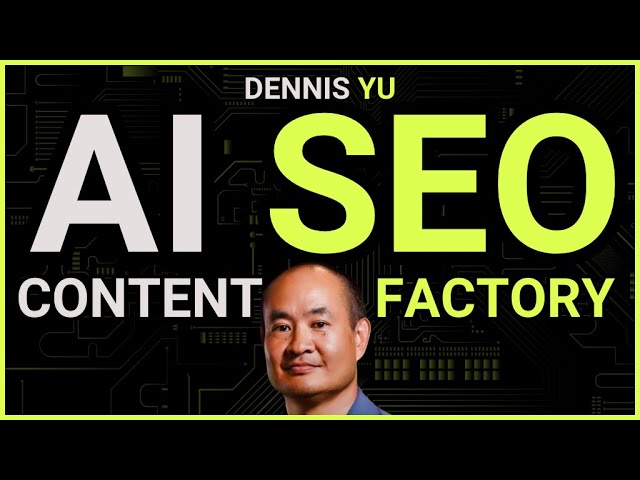
If AI can’t find verified proof that you exist, you’re invisible — no matter how much content you publish.
That’s what I told Darby Rollins when he invited me onto his Gen AI University Podcast to talk about what’s actually working with AI and SEO today. I’ve known Darby since we both spoke at the Ad World Conference in 2021. Since then, we’ve stayed connected, sharing wins, strategies, and client results. In this conversation, we broke down exactly how to build authority that both search engines and AI tools recognize.
The short version: entity SEO is the practice of making yourself a known, verified node in Google’s Knowledge Graph so that both traditional search and AI tools treat you as a credible source worth recommending. This article covers what that means, how it works, and what to do about it right now.
What Entity SEO Actually Means
Most people still treat ChatGPT and SEO as if they’re two separate things. That’s a mistake. AI tools pull from search engine signals. Google organizes content using structured data. Both rely on the Knowledge Graph — a web of people, companies, and content that tells machines who’s credible and who’s not.
Entity SEO is about making yourself a recognized node in that graph. It’s not about keywords or backlinks in isolation. It’s about connecting all your digital assets to your name so that Google and AI models can verify who you are, what you do, and why you’re worth recommending.
Your personal website, your podcast appearances, your social media, and any articles about you — they all need to tie back to one identity. If those sources are missing or scattered, you’re invisible to the machines making recommendations.
The SEO Tree: How Entities Connect
Dylan Haugen and I developed a framework we call the SEO Tree to explain how entity relationships work. Think of it this way: your personal entity is the trunk. Your company, your books, your podcast, your conference appearances — those are branches. Each individual piece of content, citation, or profile is a leaf.
A tree with a strong trunk but no branches doesn’t produce anything. A tree with lots of leaves but no trunk can’t stand up. The system only works when every level connects to the others.
In practice, this means your Wikidata entry (trunk) should link to your company pages, your book listings, and your professional profiles (branches). Each of those should link back to you and to each other. Your individual articles, podcast appearances, and social posts (leaves) should reference the branches they belong to. The result is a connected web of entity data that Google can traverse to build confidence in who you are. We documented how this works with a real client in our Grokipedia SEO Tree case study for David Meerman Scott.
Why Inputs Matter More Than Tools
People are obsessed with the latest AI tools — Jasper, Claude, ChatGPT. That’s like obsessing over which frying pan Gordon Ramsay uses. If you want to rank in AI or search, focus on your ingredients. That means real videos of your team doing the work, screenshots of dashboards and results, candid moments with clients or partners, and short clips from speaking gigs.
Take Anthony Hilb, who owns a lawn care company in Bloomington, Indiana. He doesn’t have fancy equipment or a marketing team. He records short clips of his crew mowing lawns, trimming trees, and chatting with customers. That real-world content tells AI tools: this person knows lawn care in Indiana. Anthony’s company now ranks number one in both Google and ChatGPT for his area. His story is one of the knowledge panel examples we’ve documented alongside cases like Parisa Rose, Brady Sticker, and Darby Rollins.
Same with Roger Wakefield, a plumber who creates YouTube videos showing what actually happens under the sink, or Jeremy, a remodeler in Phoenix who documents his projects step by step. These people rank in both search and AI because they’re feeding the machine what it’s hungry for: proof.
How AI Tools Decide Who to Recommend
AI tools don’t know the truth. They work on patterns. If enough trusted sources confirm your credibility, AI accepts it.
If five podcasts call you a Facebook ads expert, ChatGPT will too. If ten websites refer to your event as the largest in your field, Claude will repeat it. If you claim you were in Forbes but never link to the article, the machine ignores you.
This is exactly what happened with DigiMarCon. Because so many articles and pages reference DigiMarCon as a major digital marketing conference and link back to it, AI tools treat that as fact. The confidence score in Google’s Knowledge Graph works on the same principle — it measures how many authoritative, independent sources corroborate the same facts about you.
Stop assuming AI tools will “figure it out.” They won’t. Clear citations matter. Consistent identity matters. Structured data matters.
Claim Your Identity: Darby Rollins as an Example
During our conversation, we pulled up Darby Rollins’ Google Knowledge Panel. It existed, but he hadn’t claimed it — despite having published books, hosted podcasts, and interviewed experts. That’s like having a driver’s license you’ve never activated.
The claiming process involves uploading your government-issued ID to Google, linking your social profiles and websites, adding structured data (schema) to your site, and backing it up with citations from podcasts, events, books, and press. If your website says you were featured in Forbes, make sure it links to the actual article. Don’t just say it — show it.
UPDATE: Darby Rollins has now claimed his Knowledge Panel. If you need to do the same, our step-by-step claiming guide walks through the entire process with screenshots.
Build Authority With the Content You Already Have
Most people already have enough content — they just haven’t connected it in one place. Start with your website. Does your About page include links to podcasts you’ve been on? Your book on Amazon? Screenshots from events or client wins?
Consider Richard Canfield, who helps people create wealth through the Infinite Banking Concept. His personal website homepage includes all podcasts he’s been on, links to his books, and speaking appearances. This proves to search engines and AI that he is what he says he is.
Then check your social profiles. Are they connected to your site? Are your bios consistent? Have you claimed your profiles on LinkedIn, Instagram, YouTube, and Apple Podcasts? Use tools like Google Search to pull up all third-party sources that mention you. Your job is to link it all together into a coherent SEO tree, the same way we do for clients through our Knowledge Panel process at High Rise Influence.
The Content Factory: A System for Entity Building
If you’re putting in effort already, what you need is a repeatable system. That’s where the Content Factory comes in — our four-step process for turning real work into entity-building content:
Produce: Record real work — Zoom calls, customer wins, podcast clips. Process: Use tools like Descript and ChatGPT to turn raw footage into articles, social posts, and structured content. Post: Share it on your site and across social platforms with consistent naming and identity. Promote: Boost top content with dollar-a-day ads or organic engagement.
Think of the Content Factory like a kitchen. Better tools (faster blenders, sharper knives) help you scale, but they don’t replace the quality of your raw ingredients — real stories, real footage, real people. That’s what makes the final result valuable to both humans and machines.
Five Steps to Start Building Entity Authority Today
Here’s what to do right now:
1. Google your name. See if a Knowledge Panel exists. Check your confidence score with our free tool.
2. If a panel exists, claim it. If not, start building the entity foundation to trigger one.
3. Connect every digital property to your name. Standardize your bio, photo, and title across all platforms. Add schema markup with sameAs links.
4. Publish real proof. Short videos, photos, interviews, blog posts — anything that documents your work authentically.
5. Build your SEO tree. Link your main entity outward to your companies, books, and projects. Link each of those back. Create a connected web of entity data, not isolated pages.
Entity SEO isn’t a separate discipline from regular SEO. It’s what SEO has become. If you want both Google and AI to trust you, stop optimizing for keywords in isolation and start building a verified, connected identity that machines can verify across multiple independent sources.
As Darby Rollins put it in our conversation: more isn’t always better. Sometimes less, more intentional, higher quality content is the better path. He’s right. Now it’s your turn to take action.
This article connects to BlitzMetrics processes including SEO audit, Digital Plumbing, one-minute video, Content Factory, Knowledge Panel, entity linking, SEO Tree. Each of these concepts has a definitive article that explains the full framework.
Dennis Yu
Dennis Yu is the CEO of Local Service Spotlight, a platform that amplifies the reputations of contractors and local service businesses using the Content Factory process. He is a former search engine engineer who has spent a billion dollars on Google and Facebook ads for Nike, Quiznos, Ashley Furniture, Red Bull, State Farm, and other brands.
Dennis has achieved 25% of his goal of creating a million digital marketing jobs by partnering with universities, professional organizations, and agencies. Through Local Service Spotlight, he teaches the Dollar a Day strategy and Content Factory training to help local service businesses enhance their existing local reputation and make the phone ring.
Dennis coaches young adult agency owners serving plumbers, AC technicians, landscapers, roofers, electricians, and believes there should be a standard in measuring local marketing efforts, much like doctors and plumbers must be certified.