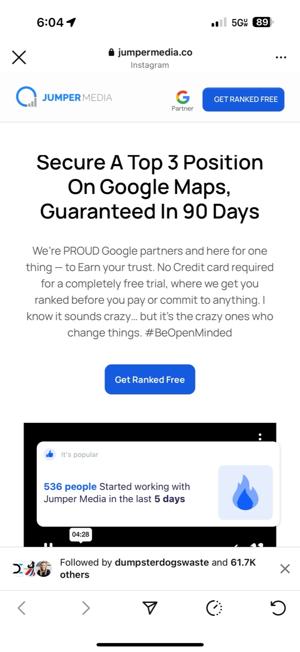
Every few months, a shiny new SEO promise makes the rounds: “Guaranteed top 3 rankings on Google Maps in 90 days.” No credit card required. No website access needed. Free trial. Sounds almost magical, right?
One recent example comes from Jumper Media, which boldly advertises:
“Secure a Top 3 Position On Google Maps, Guaranteed in 90 Days.”
At first glance, this is seductive. Who wouldn’t want fast, risk‑free rankings? But if you’ve been in the SEO or local marketing game long enough, you know the truth: if it sounds too good to be true, it usually is
This article isn’t about attacking one company. Instead, it’s about helping business owners understand why these guarantees raise red flags, what’s really going on behind the scenes, and what you should watch for before handing over your trust.
The Pitch: Big Promises, Little Transparency
Jumper Media markets itself as a Google Partner (true, but that status only applies to running Google Ads, not SEO). They promise rankings within days, claiming over 500 businesses signed up in a week. They emphasize that they don’t need access to your Google Business Profile or even your website.
To the untrained eye, that might sound reassuring: no risk, no commitment. But here’s the reality: if they don’t need access to your profile, they aren’t doing the real work of local SEO. So what are they doing instead?
The Likely Tricks Behind the Curtain
Without inside access, only a few levers can move your Google Maps rankings quickly. These are the usual suspects:
Click and engagement manipulation (“GPS drives”)
This is the big one. Companies hire real people or use networks of phones, proxies and bots to simulate local user behavior:
Clicking “Directions” on your listing.
Tapping to call your business.
Visiting your website via Google Maps.
/ interprets this as people loving your business and rewards you with higher rankings. Short term, it works. But long term? It’s risky. Google’s algorithms continuously update, and listings with suspicious engagement patterns can drop like a rock.
Review or citation blasts
Another common tactic: mass-creating reviews, business citations or third-party mentions. This creates the illusion of authority and activity, but if it’s not real, it’s fragile. Google has been cracking down hard on fake reviews, even suing companies that sell them.
Cherry‑picking easy wins
During the “free trial,” agencies often only onboard businesses that are already close to ranking. If you’re sitting at #5 in a low‑competition area, a nudge in clicks might get you into the top three. Then they can claim success — even though the real test is moving competitive listings in tough markets.
Why This Is Risky for You
Google’s guidelines are clear: manipulative tactics like fake reviews, traffic manipulation and misrepresentation violate the rules. The risks include:
Sudden ranking drops when the manipulation stops.
Suspension of your Google Business Profile.
Long‑term damage to your online trust if fake reviews get exposed.
Even if these methods “work” today, they’re not sustainable. It’s like renting a sugar rush — you’ll crash the second you stop paying.
What Reviews Say About Jumper Media
To be fair, Jumper Media isn’t a fly‑by‑night operation. They have positive reviews on platforms like Trustpilot, where many happy customers say they saw ranking improvements. But there are also complaints on the BBB; unresolved issues and billing frustrations give them a C rating. This kind of split reputation usually means the service does something but not consistently, and not without drawbacks. Treat glowing testimonials as marketing, not proof.
The “Free Trial” Catch
The free trial sounds like a no‑brainer. But here’s what to expect:
Qualification filters — not every business qualifies. They’ll choose ones that are easy to win with.
Upsell dependency — because the manipulated signals fade, you’ll need to keep paying to “maintain” rankings.
Data gaps — they might not show you what’s actually happening (like where clicks or reviews are coming from).
In short: the trial is bait, the subscription is the hook.
How to Protect Yourself
Before you sign on, here are questions to ask any SEO company making bold claims:
Show me the exact steps you’ll take. Transparency is non‑negotiable. If they dodge specifics, that’s a red flag.
Do these tactics comply with Google’s guidelines? Get the answer in writing. If they can’t guarantee compliance, you’re the one at risk.
Can I speak to recent clients in my industry and city? Testimonials on a website are easy to fake. Real conversations are not.
What happens if rankings drop? Who owns the responsibility if their methods backfire?
What’s your cancellation and refund policy? If they’re confident, they’ll let you walk away without hassle.
How to Test Safely
If you’re curious but cautious, you can test their claims on a low‑risk listing — a satellite office or a brand‑new profile, not your main location. Track your analytics and look for red flags:
Traffic spikes from strange locations.
Sudden waves of reviews.
Engagement patterns that don’t match your real customers.
This way, you can evaluate whether it’s smoke and mirrors without risking your main business.
Verdict
Does it work? Yes, in some cases, especially short‑term or in low‑competition markets.
Is it safe and sustainable? No. Anything that manipulates signals instead of building real authority is fragile and risky.
What’s smarter long‑term? Invest in real local SEO: optimizing your profile, gathering authentic reviews, building local content and earning true authority.
5‑Minute Checklist for Spotting SEO Scams
🚩 Too good to be true promises (“Guaranteed #1 in days”)
🚩 No access needed (means they’re likely faking signals)
🚩 Free trials with hidden catches (bait for ongoing fees)
🚩 Vague or secret methods (“proprietary process,” but won’t explain)
This article connects to BlitzMetrics processes including SEO audit, Digital Plumbing, Thank You Machine, SEO Tree. Each of these concepts has a definitive article that explains the full framework.
Dennis Yu
Dennis Yu is the CEO of Local Service Spotlight, a platform that amplifies the reputations of contractors and local service businesses using the Content Factory process. He is a former search engine engineer who has spent a billion dollars on Google and Facebook ads for Nike, Quiznos, Ashley Furniture, Red Bull, State Farm, and other brands.
Dennis has achieved 25% of his goal of creating a million digital marketing jobs by partnering with universities, professional organizations, and agencies. Through Local Service Spotlight, he teaches the Dollar a Day strategy and Content Factory training to help local service businesses enhance their existing local reputation and make the phone ring.
Dennis coaches young adult agency owners serving plumbers, AC technicians, landscapers, roofers, electricians, and believes there should be a standard in measuring local marketing efforts, much like doctors and plumbers must be certified.