
 by
by
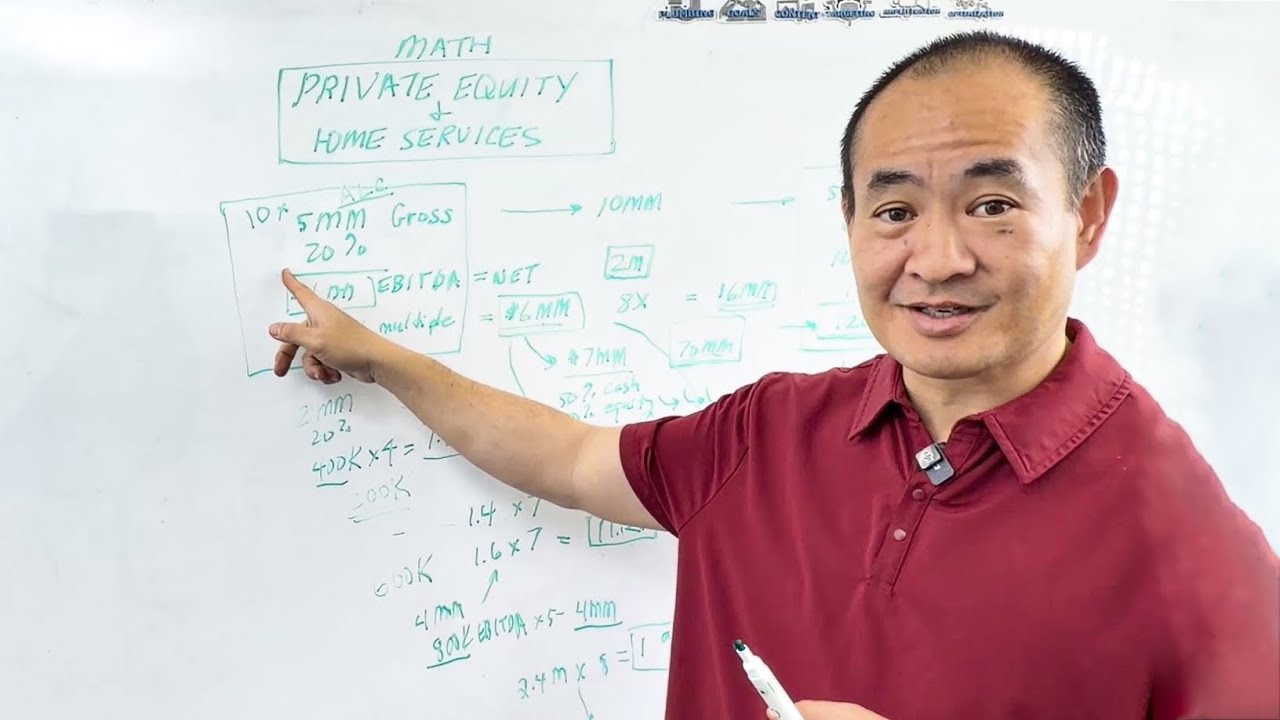
Episode 23 of The Marketing Mechanic — how to sell home service business to private equity, with the exact math.
A $5 million HVAC company can sell for $6 million. That same company, with two strategic moves, can sell for $19 million. Most home service owners running perfectly good businesses have no idea they’re sitting that close to an eight-figure exit—or what’s standing between them and it.
I open this episode with three real examples from people I’ve worked with: Elmer Zubiate, who grew his HVAC business to $50 million and sold at a 12x multiple; Jeff, who sold at 10x and now advises other operators heading toward private equity; and Anthony, who runs a $5 million lawn care business at a 20% margin and is already executing PE-style moves. These aren’t outliers. They followed a math-driven formula that any home service owner can understand—and apply.
This article breaks down that formula, step by step.
What EBITDA Actually Means for Home Service Owners
Start with a simple example. A home service business doing $5 million in gross revenue at a 20% margin generates $1 million in EBITDA—earnings before interest, taxes, depreciation, and amortization. For an owner without debt, that number is essentially net profit.
At $1 million EBITDA, a business in the $1–3 million earnings range typically commands a 6x multiple. That puts the valuation at $6 million.
Now double the gross revenue to $10 million at the same margin. EBITDA becomes $2 million. But here’s where the math shifts in the owner’s favor: the multiple doesn’t stay at 6x. It moves up to 8x, because larger, more stable businesses are worth proportionally more to buyers. At 2 × 8, that company is now worth $16 million.
That jump—from $6 million to $16 million—happened without changing how the business operates. It happened because earnings grew, and the multiple grew with them. The same principle applies whether you run HVAC, roofing, landscaping, or plumbing—as this real HVAC growth case shows.
How Roll-Ups Work and Why Buyers Pay a Premium for Scale
Private equity firms use a strategy called a roll-up: acquire multiple companies in the same vertical—HVAC, roofing, landscaping, plumbing—and hold them under one entity. The math behind why this works is surprisingly simple.
Take 10 companies, each doing $5 million gross at a 20% margin. That’s $10 million in combined EBITDA. A single company at $1 million EBITDA gets a 6x multiple. Ten companies with $10 million in combined EBITDA might command a 12x multiple—not because anything changed operationally, but because scale and size reduce risk in the eyes of buyers.
10 companies × $1M EBITDA = $10M combined EBITDA at a 12x multiple = $120 million valuation.
The PE firm might pay 7x per acquisition—say $7 million per company, or $70 million total—and immediately hold a portfolio worth $120 million. That $50 million difference is created through the deal itself, not through operational improvement. Lance Bachmann does this in roofing. Tommy Mello does it in garage doors. This is Warren Buffett’s core acquisition strategy: buy earnings, increase scale, capture multiple expansion. It’s also the same principle behind the Marketing Mechanic framework—build systems that compound value over time.
The Acquisition Math in Practice: Anthony’s Example
Here’s how the math works in practice. Anthony’s lawn care business ($5M gross, $1M EBITDA) acquires a competitor doing $2 million gross at a 20% margin. That smaller company has $400K EBITDA and, at its scale, commands roughly a 4x multiple—a $1.6 million valuation.
After the acquisition:
- Combined EBITDA: $1M + $400K = $1.4 million
- Multiple expands to approximately 7x
- New valuation: ~$9.8 million (call it $10M)
- Value created through this single deal: +$4 million—before any operational improvements
Now add efficiency gains: shared call center, shared marketing, combined equipment financing, better ad performance. I estimate a realistic $200K additional EBITDA from those gains, pushing the company to $1.6M EBITDA × 7x = approximately $11.2 million.
From $6 million to $11.2 million through one acquisition and modest operational improvement.
The Stepwise Approach: From $6 Million to Nearly $20 Million
The process compounds. Once the combined business is worth $11.2 million, it can acquire another company at 40% of its size—this time a $4 million gross business running at 20%, with $800K EBITDA valued at roughly 5x ($4 million purchase price).
After that second acquisition:
- Combined EBITDA: $1.6M + $800K = $2.4 million
- Multiple expands to 8x
- New valuation: $19.2 million
That’s a move from a $6 million company to one worth $19.2 million through two strategic acquisitions—without raising outside capital, and without transforming the underlying operations.
I point people toward Tom Shipley’s Dealcon conference as the place where home service operators learn the mechanics of M&A, due diligence, deal structure, and legal frameworks. I also reference Roland Frasier’s work on seller-financed acquisitions—where the purchase price comes out of the acquired company’s own earnings over time, requiring no upfront cash.
Four Ways to Grow Your Valuation—You Don’t Have to Sell to PE
Here’s my framework for how home service owners can grow their equity value before they sell home service business assets or the entire company:
- Expand to more service areas — more geographic coverage directly increases top-line revenue and EBITDA
- Add ancillary services — a landscaping crew that notices hail-damaged roofs can refer that lead to a sister roofing company; a pool service route can surface garage door, lawn, or pest control needs
- Acquire other companies — buy businesses that are 20–40% of your size using seller financing; the acquisition itself creates value through multiple expansion
- Cut unnecessary expenses — Dennis gives a specific example: eliminating $30,000 per month in wasted PPC spend. That’s $360,000 in annual savings. At a 6x multiple, it adds $2.16 million in company value. If the company is larger and commands an 8x or 12x multiple, the impact is proportionally greater.
Many smaller home service operators run lifestyle businesses: company cars, family members on payroll, personal expenses routed through the business. These reduce EBITDA on paper. When preparing for a sale or acquisition, trimming unnecessary expenses flows directly to the bottom line—and gets multiplied.
Marketing Infrastructure Is an EBITDA Driver
When you decide to sell home service business to a PE firm or strategic buyer, marketing infrastructure becomes a key part of the valuation. In my experience, most home service businesses—even technically excellent ones—have weak marketing. Richard McClure, an HVAC technician who understands systems at the level of an electrician and plumber combined, charges fair prices and does quality work but isn’t growing his business because the marketing infrastructure isn’t there.
Reputation, Google Maps visibility, real reviews, and consistent inbound demand aren’t just nice-to-haves. They’re the drivers of the EBITDA number that gets multiplied at exit. A business that dominates its local map pack commands a premium at sale—because the buyer sees a machine, not a person.
Where Are You in Your Journey to Sell Home Service Business?
Here’s the question I always ask home service owners: what stage are you at, and what’s your next move?
- One truck at $1 million gross? Focus on getting to $2–3 million EBITDA to unlock better multiples
- In the $2–20 million range? Consider whether organic location expansion, acquisition, or PE preparation is the right path
- Ready to sell home service business assets or the whole company? Get the books clean now—not after you’ve already found a buyer
- Never considered acquiring? It may be faster than organic growth—and seller financing means you may not need the cash upfront
Cody Jones, a funeral home owner I’ve been advising, sold his business the same way. Owners age out. Children don’t want to take over. The business either gets sold properly or gets shut down—85% of the time, it just shuts down. Preparation is what separates those outcomes.
If you’re a home service business owner looking to improve your Google Maps visibility—which directly supports the inbound demand that drives EBITDA—Local Service Spotlight’s Maps Visibility System starts with a free audit of your Google Business Profile and service area pages.
Want to see how the full Content Factory and Marketing Mechanic framework applies to your business? That’s where I connect the dots between your Google presence, your content, and your equity value—all working together.
About The Marketing Mechanic: This is a whiteboard video series where I explain marketing concepts, frameworks, and strategies based on real experience — drawing from real names, real stories, and real data from people I have worked with. These are not live screen-sharing demonstrations. For live working sessions where we build and optimize together on screen, join our AI Builder Program coaching calls every Thursday at 2 PM Pacific through Local Service Spotlight. New whiteboard episodes drop every Thursday morning on my YouTube channel.
This article connects to BlitzMetrics processes including SEO audit, Digital Plumbing, one-minute video, Content Factory, entity linking, SEO Tree. Each of these concepts has a definitive article that explains the full framework.
Originally published .
Dennis Yu
Dennis Yu is the CEO of Local Service Spotlight, a platform that amplifies the reputations of contractors and local service businesses using the Content Factory process. He is a former search engine engineer who has spent a billion dollars on Google and Facebook ads for Nike, Quiznos, Ashley Furniture, Red Bull, State Farm, and other brands.
Dennis has achieved 25% of his goal of creating a million digital marketing jobs by partnering with universities, professional organizations, and agencies. Through Local Service Spotlight, he teaches the Dollar a Day strategy and Content Factory training to help local service businesses enhance their existing local reputation and make the phone ring.
Dennis coaches young adult agency owners serving plumbers, AC technicians, landscapers, roofers, electricians, and believes there should be a standard in measuring local marketing efforts, much like doctors and plumbers must be certified. He has appeared on 353 podcasts with 619 credited episodes — see the full list of his podcast appearances.