
 by
by
Most young adults building a personal brand make the same mistake. They hire a photographer, put on a blazer, stand against a clean background, and smile at the camera. Then they wonder why nobody takes them seriously.
Here’s the problem: a solo headshot tells the viewer nothing about whether you matter. It’s just you. And in a world where anyone can generate a polished headshot in thirty seconds with an AI tool, “I have a professional headshot” isn’t a signal — it’s table stakes.
Authority is borrowed, not declared
Walk into any business conference and watch what the recognized operators do when they meet someone new. They don’t lead with a resume. They drop a name. “I was just with Brad at Capital City Roofing last week.” “Dan Antonelli was on my podcast a couple weeks ago.” “I’m in the AI Builder Program.”
That’s not name-dropping for vanity. That’s credibility transfer. In under three seconds, they’ve communicated: people you already trust, trust me.
Your profile photos should do the exact same thing.
The Facebook cover test
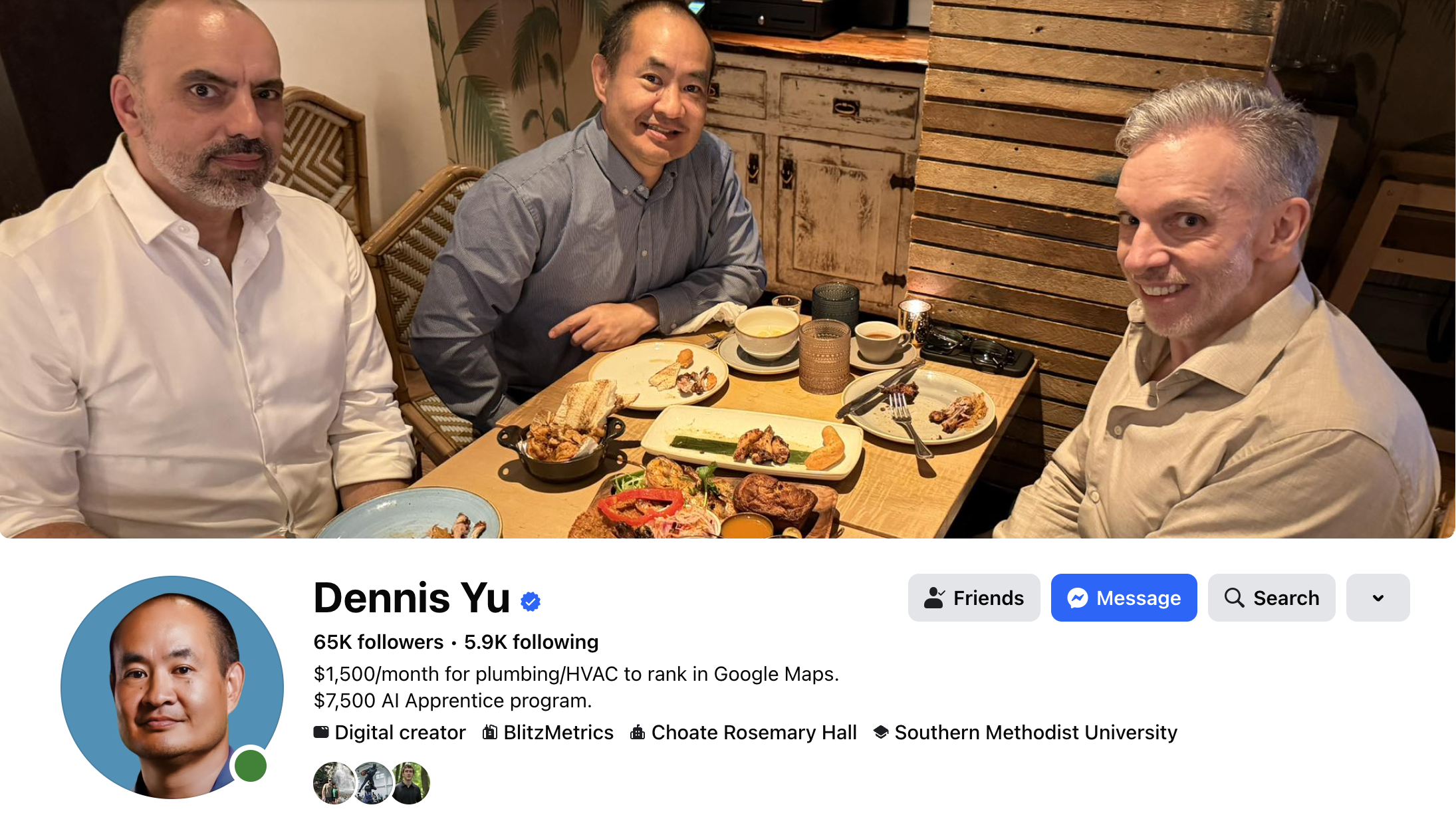
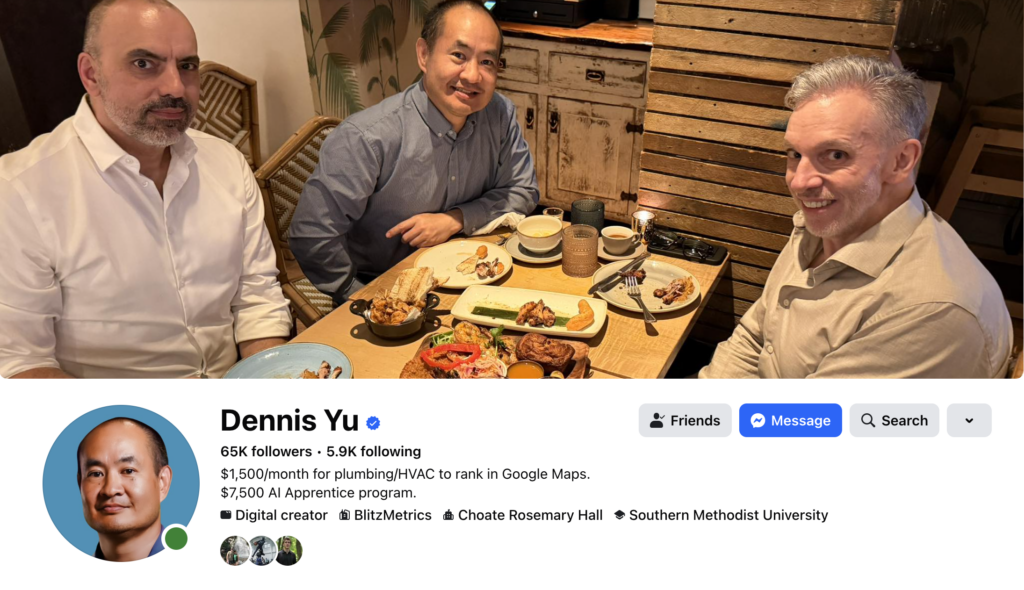
Pull up the Facebook profile of anyone you consider a real authority in their industry. Gary Vaynerchuk. Alex Hormozi. Or take a look at my own profile below. You will not find a single solo headshot as the cover photo.
You’ll find me with clients and partners. You’ll find Gary on stage in front of 5,000 people. You’ll find Alex with his team. Every one of those images is silently doing the work of a testimonial, a case study, and a credibility stamp — all at once, all before the viewer has read a single word.
Now look at the Facebook cover of someone trying to break in. Blank. Generic sunset. A solo photo. Sometimes a logo of a company nobody’s heard of. The difference is not subtle.
Why the solo photo actively hurts you
It’s not that a solo headshot is neutral. It’s that it’s negative signal. When somebody googles you and finds nothing but solo content — solo podcast clips, solo headshots, solo selfie posts — their brain fills in the gap with the most plausible conclusion: this person operates alone because nobody else has chosen to be in the frame with them.
That’s not what’s actually true for most people. Most people have relationships they could be showcasing. They just aren’t capturing them, or they aren’t posting them.
The playbook
Here is what I tell the young operators I mentor to do instead, starting today.
Every time you’re in a room with someone recognized in your space, take a photo with them. Not a selfie from your phone held at arm’s length — a real photo, taken by someone else, with both of you in frame, looking like you belong there. If you’re at a conference, ask the person next to you to take it. They will always say yes.
When you go on someone’s podcast, ask for a photo at the end. Most hosts will happily do this. That single image is worth more than the entire podcast clip in terms of brand signal, because it proves the relationship existed.
When you visit a client in person, document it. Flying out to sit with a roofing operator in Atlanta? Take photos inside the office, on the floor, in the meeting room. Those photos do something a Zoom screenshot never can: they prove you show up.
Rotate your cover photo every 30 days. Whatever your most recent high-signal moment is, put it on top. Don’t let your Facebook cover be a two-year-old solo shot of you on a ski trip. The cover photo is the single highest-impression image you own. Treat it that way.
Your profile photo can stay a professional headshot — but it should be the only solo image anywhere in your presence. Everything else is you in relationship.
The AI headshot trap
A quick note on AI-generated headshots. Tools that generate professional-looking headshots from a selfie are everywhere now, and they’re tempting because they’re cheap and fast. The problem is the same as with any solo headshot — except now the image is synthetic, and viewers can increasingly tell. “Polished solo photo that looks vaguely off” is a worse signal than “imperfect phone photo of you with a real person.”
The bottom line
Stop investing in better solo headshots. Start investing in better rooms. Every event you attend, every client you visit, every podcast you record in person is an opportunity to walk away with an image that does five years of trust-building in one frame.
The people you stand next to are the fastest, cheapest, most durable brand asset you will ever own. Capture them.
Originally published .
Dennis Yu
Dennis Yu is the CEO of Local Service Spotlight, a platform that amplifies the reputations of contractors and local service businesses using the Content Factory process. He is a former search engine engineer who has spent a billion dollars on Google and Facebook ads for Nike, Quiznos, Ashley Furniture, Red Bull, State Farm, and other brands.
Dennis has achieved 25% of his goal of creating a million digital marketing jobs by partnering with universities, professional organizations, and agencies. Through Local Service Spotlight, he teaches the Dollar a Day strategy and Content Factory training to help local service businesses enhance their existing local reputation and make the phone ring.
Dennis coaches young adult agency owners serving plumbers, AC technicians, landscapers, roofers, electricians, and believes there should be a standard in measuring local marketing efforts, much like doctors and plumbers must be certified. He has appeared on 353 podcasts with 619 credited episodes — see the full list of his podcast appearances.