
 by
by
When you buy a one-time credit pack for a software tool, the receipt is supposed to be the record of what you paid for. This is the account of a $99 Content AI credit pack bought through Rank Math, a receipt that listed no expiration date, and a month-long support exchange that ended with the credits voided over a validity term that we say never appeared at the point of sale.
What follows is the full timeline, documented with the actual support emails from both sides. Personal contact details such as the mailing address are redacted.
What was purchased
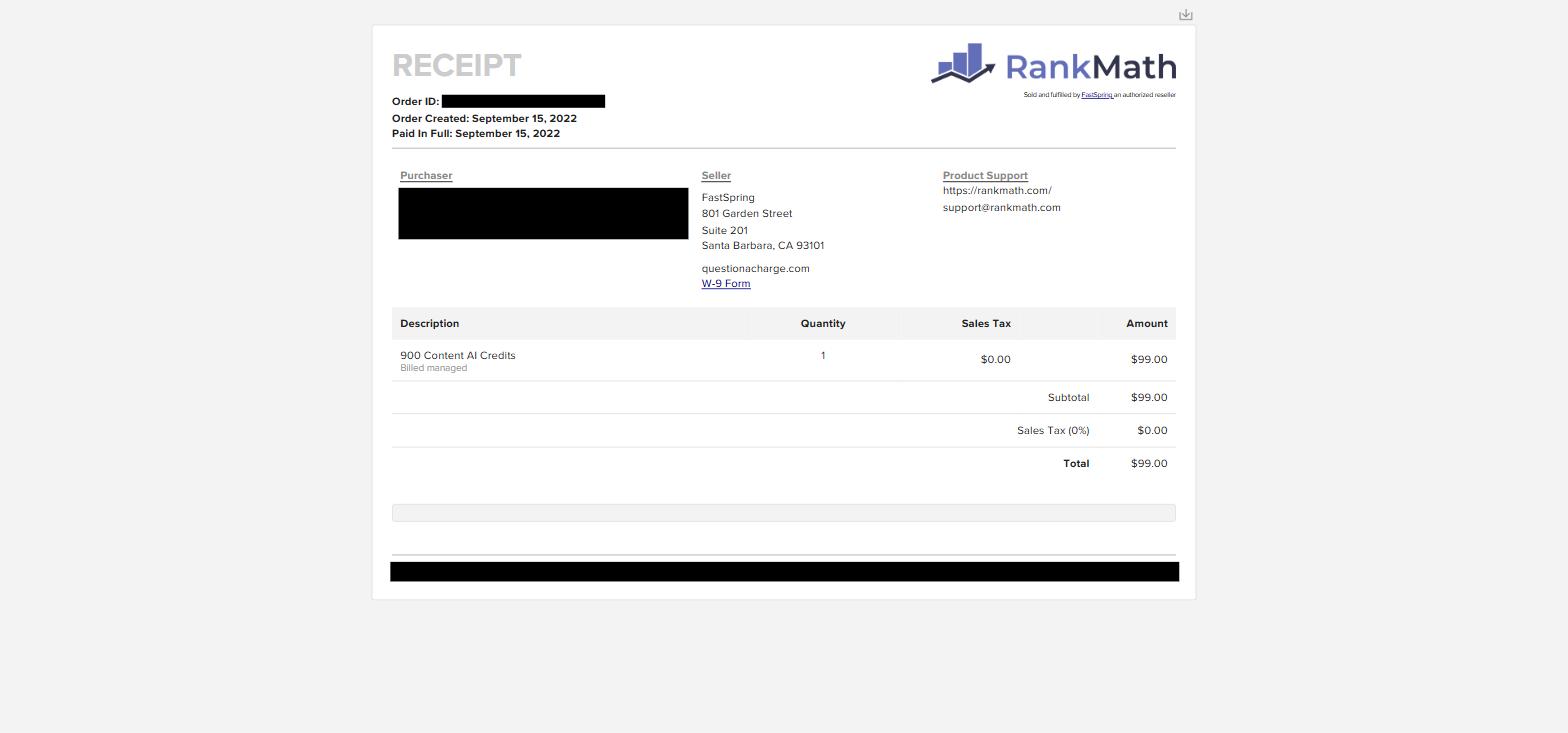
The purchase was a pack of 900 Content AI Credits, bought in September 2022 as a one-time payment of $99 through FastSpring, Rank Math’s authorized reseller. The account has been an Agency subscriber since 2021, and this credit pack was a separate one-time add-on, not part of the recurring plan.
The receipt lists the product description, the quantity, the sales tax, and the total. That is all it lists. There is no expiration date, no validity window, and no subscription end date recorded anywhere we received it.
What happened to the credits
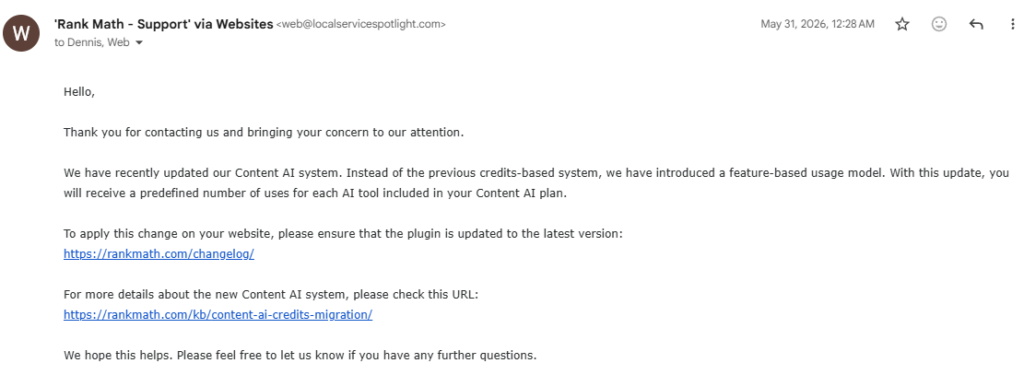
In early 2026, Rank Math moved Content AI from a credit-based system to a usage-based model. After that migration, the account showed the Content AI balance as empty. The credits from the original pack were gone, and no notice was sent to us before they disappeared.
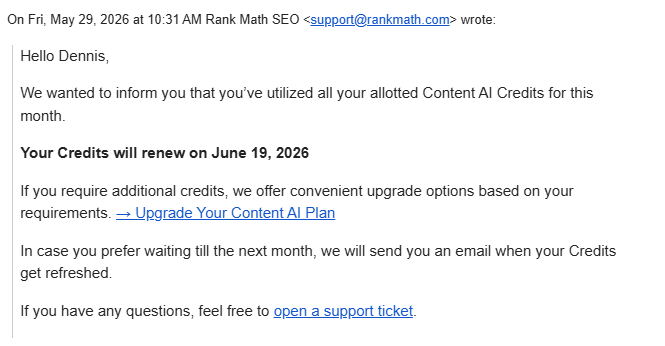
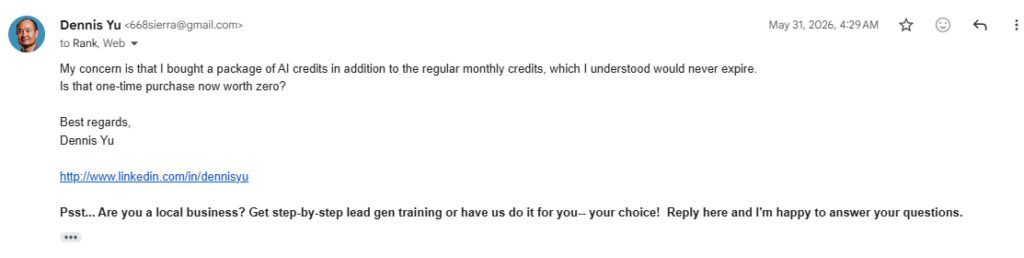
We opened a support ticket asking a simple question: what happened to the credits that were paid for, and could they be restored or refunded.

The first denial (June 23)
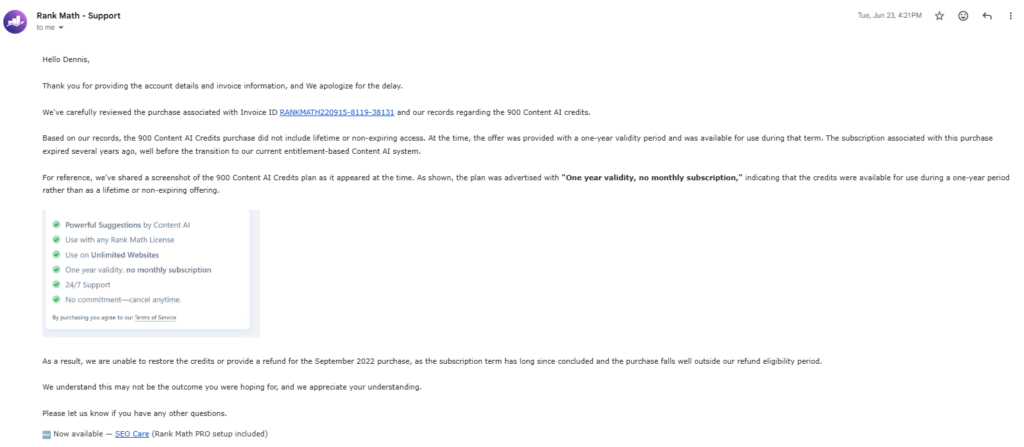
After we supplied the account details and invoice, Rank Math gave its first answer on June 23, 2026. Support stated the 900 credits were never sold as a lifetime or non-expiring product, that the offer carried a one-year validity, and that the plan page at the time read “One year validity, no monthly subscription.” On that basis, support declined to restore the credits or issue a refund.

The documentation request (June 24)
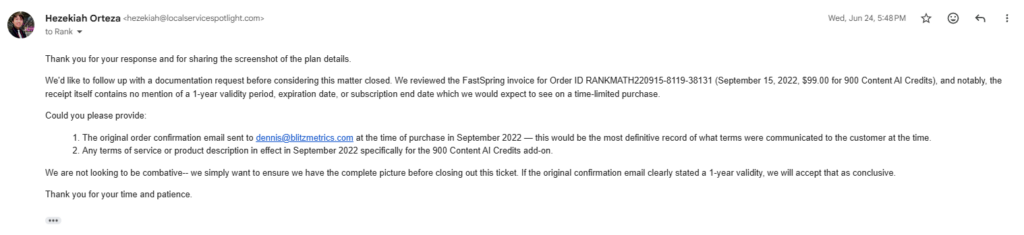
The next day, we replied with a specific, good-faith request. The FastSpring receipt showed no validity period or end date, so we asked Rank Math for the one document that would settle it: the original 2022 order confirmation email, plus any product terms in effect for that add-on at the time of sale.
We stated plainly that if the original confirmation email clearly showed a one-year validity, that would be accepted as conclusive.
The detailed denial (June 28)
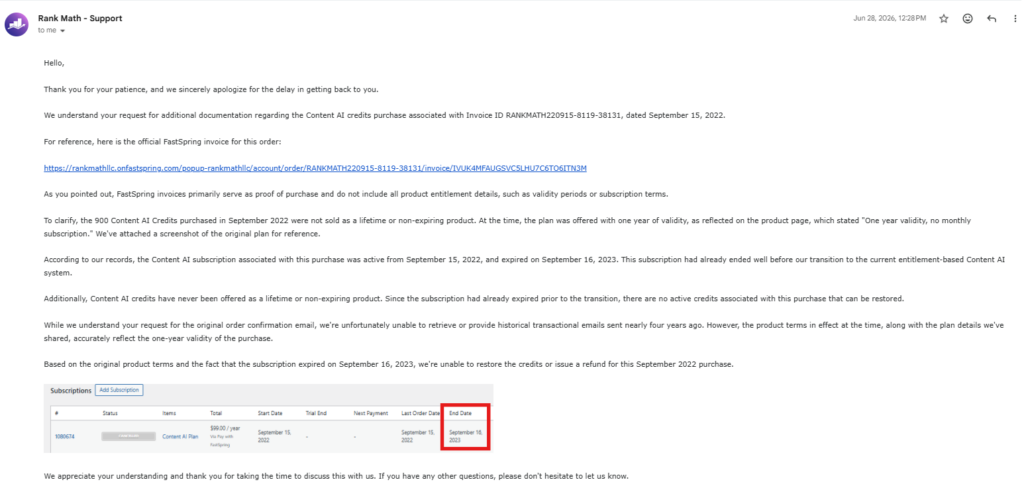
On June 28, Rank Math answered in more detail. Support repeated the one-year validity position and stated that, according to its records, the subscription tied to this purchase was active from September 15, 2022 and expired on September 16, 2023, well before the migration to the new system.
Support also acknowledged it could not retrieve or provide the original 2022 order confirmation email, citing the age of the transaction. So the one record the buyer asked for, the record that would prove the term was disclosed at purchase, was confirmed to be unavailable.
The escalation and final answer (July 11)
We asked for the matter to be raised to a senior billing reviewer, pointing out that the invoice carried no expiration and that support had already conceded it could not produce the original confirmation email. Rank Math escalated the request internally.
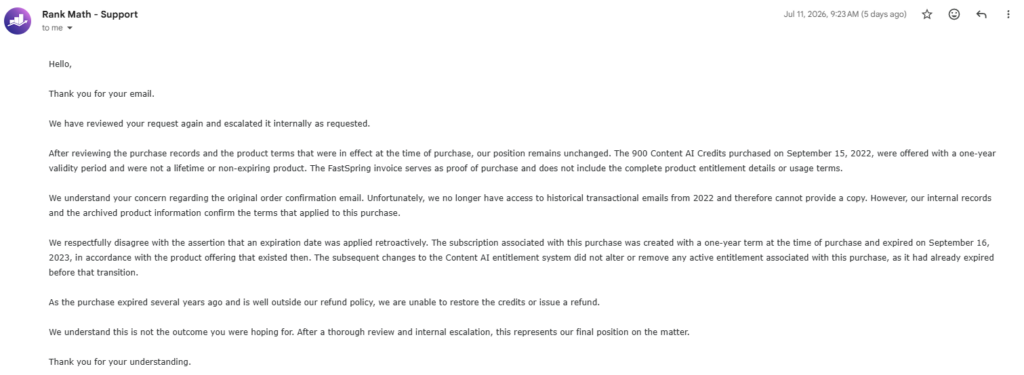
On July 11, the answer came back unchanged. Support said its position remained the same, disagreed that any expiration had been applied retroactively, and stated this was its final decision. The credits would not be restored and no refund would be issued.

The core of the dispute
The disagreement comes down to one gap. The receipt shows no term. We asked for the original order confirmation email that would prove a one-year term was communicated at the time of purchase, and support said it could not retrieve emails from that far back.
So the only written record we hold shows no expiration, and the seller cannot produce a written record from the time of sale that shows one. Rank Math points to its internal records and archived plan information as proof the term existed. In our view, applying an expiration this way and then voiding a paid product based on it is not a fair way to treat a customer, and it raises consumer protection questions worth flagging for other buyers.
What buyers should take from this
If you buy a credit pack or any one-time digital product, save more than the receipt. Save the plan page as it looked when you bought it, save the order confirmation email, and screenshot any terms that describe how long the product lasts. If the seller changes its system later, those saved records are the only thing that protects what you paid for.
We use and recommend this SEO software across client sites and rely on its Pro tools inside WordPress every day. This write-up is not about the plugin’s quality. It is about how a paid product was handled when its terms were in question.
Have you had a digital purchase voided by a term that was not on your receipt? We would like to hear how you handled it.
Originally published .
Dennis Yu
Dennis Yu is the CEO of Local Service Spotlight, a platform that amplifies the reputations of contractors and local service businesses using the Content Factory process. He is a former search engine engineer who has spent a billion dollars on Google and Facebook ads for Nike, Quiznos, Ashley Furniture, Red Bull, State Farm, and other brands.
Dennis has achieved 25% of his goal of creating a million digital marketing jobs by partnering with universities, professional organizations, and agencies. Through Local Service Spotlight, he teaches the Dollar a Day strategy and Content Factory training to help local service businesses enhance their existing local reputation and make the phone ring.
Dennis coaches young adult agency owners serving plumbers, AC technicians, landscapers, roofers, electricians, and believes there should be a standard in measuring local marketing efforts, much like doctors and plumbers must be certified. He has appeared on 353 podcasts with 619 credited episodes — see the full list of his podcast appearances.