
 by
by
I recently asked a team member a simple question after they submitted two invoices covering two separate billing periods in one go: why is sending two invoices at once not advisable?
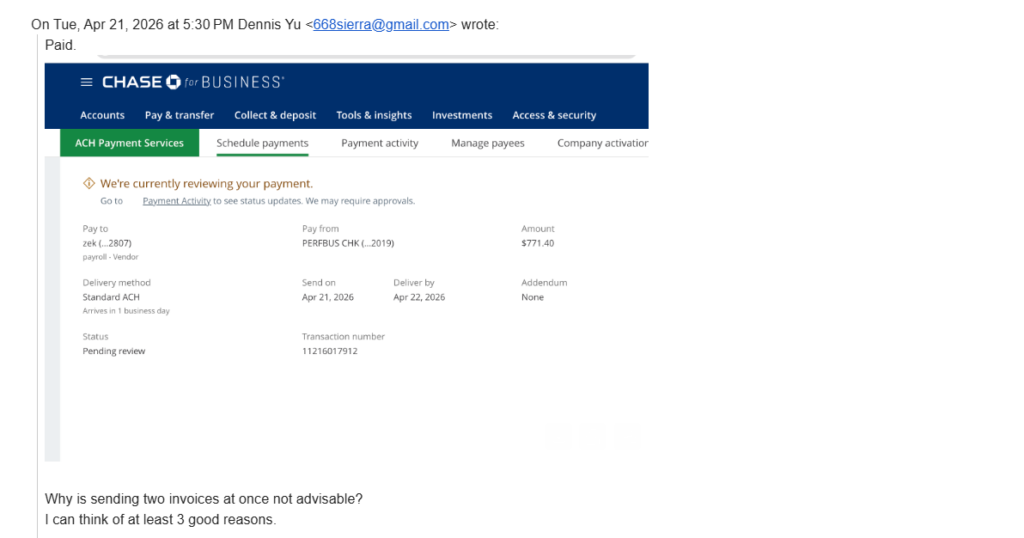
They gave me two reasons. They missed the most important one.

Here are all three.
It doubles the cash flow burden on your client
Clients budget around predictable billing cycles. When you stack two periods into one request, you are forcing them to cover twice the cost in a single payment window, a hit they did not plan for. That creates friction, delays, and sometimes outright resentment, even if the work was good. Your client’s cash flow is not your variable to mess with.
It makes tracking and reconciliation a headache
Accounting is not just about paying people. It is about matching every payment to a period, a project, and a record. When two invoices arrive bundled together, it blurs the books. Your client’s accounting team now has to do extra work to untangle what you should have kept clean. That extra work has a cost, and it comes out of the goodwill you have built.
It signals that you cannot manage your own workflow
This is the one most people miss.

Late or bundled invoicing is not just an administrative slip. It tells your client that you are not organized enough to track your own deliverables and deadlines. If you cannot manage the simple, repeatable task of submitting one invoice per period on time, it raises a legitimate question: what else are you not managing well? Trust erodes in small moments like this, not just big ones.
One invoice. One period. On time. It is not complicated. It is just discipline. And discipline is what separates team members who get referred from those who get replaced.
Originally published .
Dennis Yu
Dennis Yu is the CEO of Local Service Spotlight, a platform that amplifies the reputations of contractors and local service businesses using the Content Factory process. He is a former search engine engineer who has spent a billion dollars on Google and Facebook ads for Nike, Quiznos, Ashley Furniture, Red Bull, State Farm, and other brands.
Dennis has achieved 25% of his goal of creating a million digital marketing jobs by partnering with universities, professional organizations, and agencies. Through Local Service Spotlight, he teaches the Dollar a Day strategy and Content Factory training to help local service businesses enhance their existing local reputation and make the phone ring.
Dennis coaches young adult agency owners serving plumbers, AC technicians, landscapers, roofers, electricians, and believes there should be a standard in measuring local marketing efforts, much like doctors and plumbers must be certified. He has appeared on 353 podcasts with 619 credited episodes — see the full list of his podcast appearances.