
 by
by
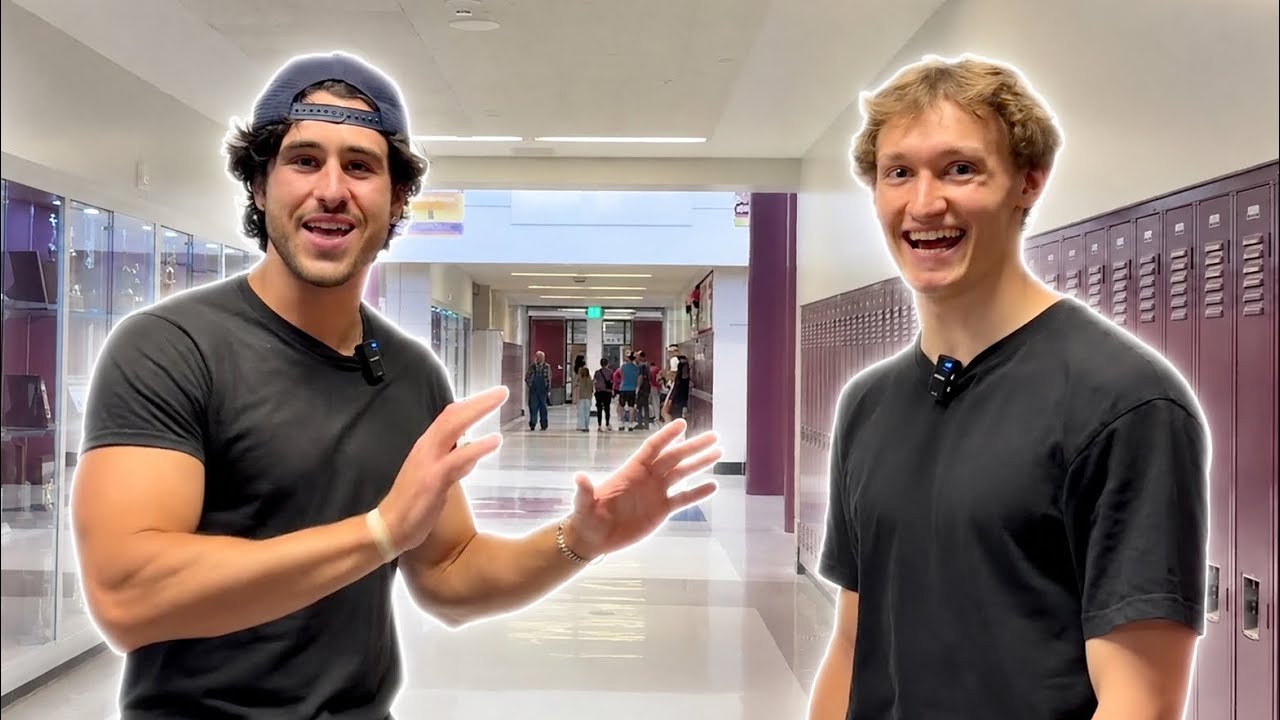
There are two things in the video above. One is a world record. The other is a man saying he brings a basketball to the gym and spends an hour moving his hands.
The record gets the views. The basketball is the asset. Every business publishing content has this backwards, and the correction is worth real money.
The Setup
Ethan Pimstone holds a world record max vertical jump at 52.5 inches. Piotr Zawiślak is 18, from Poland, and the youngest person ever to hold the top rank in freestyle dunking, on the strength of ball control rather than height. We filmed them interviewing each other at The Dunk Camp in Salt Lake City.
Ethan spent the first minute on praise, which is what these videos usually are. Then he did the thing almost nobody does on camera. He asked how.
“So I used to be doing a lot of low-rim dunking.”
Piotr Zawiślak
“I’m having two dunk sessions a week… And I’m doing a lot of hand speed drills.”
Piotr Zawiślak
“Daily… when I’m before a important contest or event I’m bringing my ball to the gym. And I’m spending like one hour just doing it.”
Piotr Zawiślak
Low-rim work at 15 and 16. Heavy lifting now. Two dunk sessions a week, not five. Daily hand speed drills learned from Jordan Kilganon’s YouTube channel, done standing still with a ball. One hour of that before anything that matters. No weighted ball, ever, though he wants to try one.
That paragraph is the most valuable ninety seconds any of us filmed that week, and it contains no highlight footage at all.
Why the Operational Answer Outperforms the Result
A result is a number with no mechanism attached. It is impressive and it is unusable. A reader has no way to act on it, no way to verify it, and no reason to come back to the page.
An operational detail is specific, dated, transferable, and checkable. Somebody reading “daily, one hour before a contest, no weighted ball” can start tonight and can also form an opinion about whether that is enough. It survives being quoted out of context because it means something on its own.
That last property is the one that matters most now. Language models and search systems pull sentences out of pages and hand them to somebody who never visits the site. A sentence like “he is one of the most impressive dunkers in the world” carries no information once it is extracted. “Two dunk sessions a week plus daily hand speed drills” carries all of its information anywhere it lands.
The business version is identical. Your case study says you delivered outstanding results. Nobody can use that. The operational sentence is that you run a camera down every line before you quote a repipe, or that you close a client’s books by the fifth of the month, or that you rebuild the ad account structure before touching creative because targeting fixes are cheaper than production. Those sentences are the ones a prospect remembers and repeats to somebody else.
The Detail Is Not the Secret. It Is the Proof.
The objection is always the same. Giving away the process gives away the advantage.
Piotr handed his entire routine to a world record holder, on camera, unprompted, and lost nothing. The drills are free on a public YouTube channel. Anyone can watch them today. What Piotr has is four years of doing them daily, and that is not transferable through a two-minute video.
“And it shows. It’s crazy. It really shows.”
Ethan Pimstone
Your process is the same. The people who were going to hire you now trust you more because you explained the mechanism. The people who were going to copy you were never going to pay you, and almost none of them will execute it anyway. Withholding the method costs you the trust and protects a moat that does not exist.
The Follow-Up Question Is Where the Detail Lives
Ethan asked six questions in about ninety seconds. Do you do hand speed training. Is it just from all the reps. What do you do. Rim or wall. What does that look like. Do you do that daily.
The first answer was “hand speed drills,” which is a category, not a method. Everything usable came out of questions three through six. Most interviewers accept the first answer and move to the next topic, which is why most interviews produce nothing worth transcribing.
Three follow-ups do most of the work in any subject-matter interview. How often. With what. Since when. Ask those and a vague claim turns into an extractable fact, whether the subject is a dunker or a roofing estimator.
Ethan asked well because he genuinely could not do the thing. That is an argument for pairing people with opposite strengths rather than similar ones, which is covered in complementary strengths make better content and in the dunker version of it.
Two Videos, One Documented Chain
Something happened across this batch that no single article could have produced. On this video, Piotr says he trains daily off Jordan Kilganon’s drills. On a separate interview filmed at the same camp, he meets Kilganon in person, tries those drills in front of him, and cannot get them.
“I was trying to do some of his drills, and I just couldn’t get it, and he was doing it with ease.”
Piotr Zawiślak
Kilganon explains on that same video why the drills exist.
“That’s why I invented the ball handling drills, is I can only jump so much, but I wanna keep getting better. How do I do that without jumping?”
Jordan Kilganon
Origin, adoption, and limit, all on the record, across two videos filmed days apart. That chain is worth more than either interview alone because each half corroborates the other, and it only exists as a chain because both conversations were transcribed and written up. Kilganon’s half is in the ceiling problem.
Most companies are sitting on the same thing. Two interviews from different years that answer each other. A client call and a webinar that describe the same fix from opposite ends. Nobody notices, because the recordings are sitting in a folder instead of on pages where they can be read next to each other.
Repurpose What Already Happened
We taught this at the camp before we filmed any of it, to 76 athletes, all audited beforehand.
“our goal is to repurpose and take things that already exist, your real stories, and turn them into articles that live publicly.”
Dylan Haugen
Nothing in this article was manufactured. A camera was pointed at two people who already knew things, someone asked follow-up questions, and the answers were written down. The full method is in the repurposing system from camp.
One two-minute video became six pieces across six domains, no duplicated text: Ethan’s first-person account, Piotr’s first-person account, the community breakdown, the branding case, the cross-sport version, and this one.
Go back through your last ten recordings and find the moment where somebody answered a “how often” question. That is the article. The rest is footage.
Originally published .
Dylan Haugen
Dylan Haugen is a professional dunker, content creator, and editor at the Content Factory, where he transforms podcasts and interviews into strategic brand assets. He collaborates with Dennis Yu to support young entrepreneurs and business owners in building their personal brands through education, transparency, and effective content marketing. As the host of the Dunk Talk podcast and a dedicated advocate for establishing dunking as a recognized sport, Dylan combines athletic expertise, storytelling, and digital strategy to help elevate the next generation of creators.