

Everyone’s asking the same question: is AI going to take my job? But that’s the wrong question. If you’re a marketer or working in digital marketing, the real question is: what are the things that remain valuable as AI gets progressively smarter?
In this week’s Marketing Mechanic, I’m going to give you a clear roadmap to survive the next three years so you’re not caught off guard by the changes happening right now
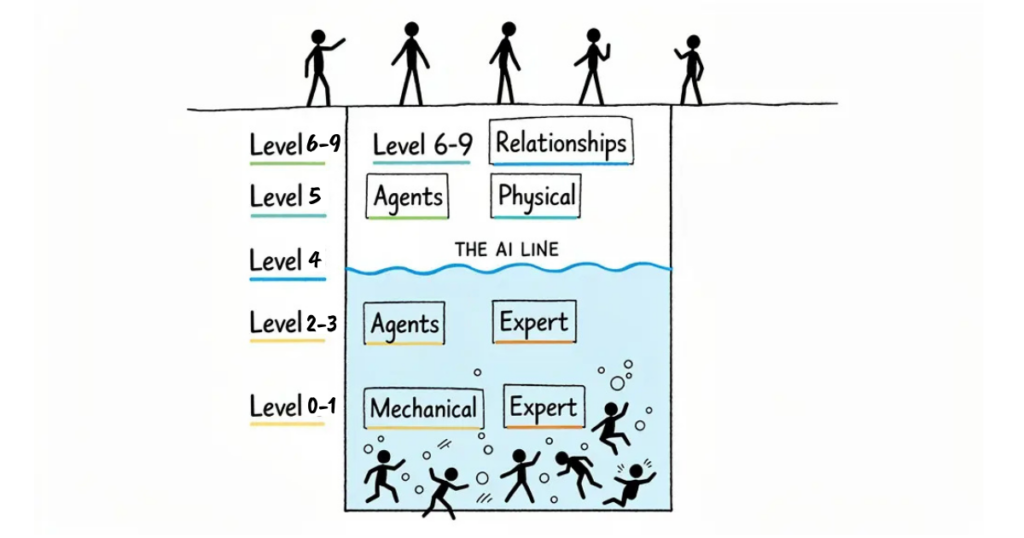
The water is rising
Think of it like an aquarium where the water level is rising. A few years ago when ChatGPT first came out, the water level was low. It could handle simple stuff: photo recognition, sorting, categorization, basic copywriting. The people doing that kind of work, virtual assistants handling very simple mechanical tasks, were barely keeping their heads above water.
I look at tools we used to use, like Yoast, All in One SEO, or Link Whisper. Those tools did great mechanical things. Link Whisper, for example, would look across all the content on a site with a thousand blog posts and figure out internal linking opportunities based on keywords, tags, and categories.
That’s mechanical VA-level work. Someone you’d hire on Fiverr. Data entry. Very simple. Today, an AI agent can do better internal link building for free — because it actually understands your business context, not just keywords.
Level one: Mechanical work
As the water level starts to rise, you hit what I call Level One mechanical work. This is rules-driven work: the majority of things you’d do inside Google Ads, Local Service Ads, or even WordPress content editing.
These VAs would do things that maybe weren’t worth automating. You’d pay them $3 to $4 an hour, which was the whole idea when we’d been in the Philippines and Pakistan, meeting with leaders of those countries on how to build these programs.

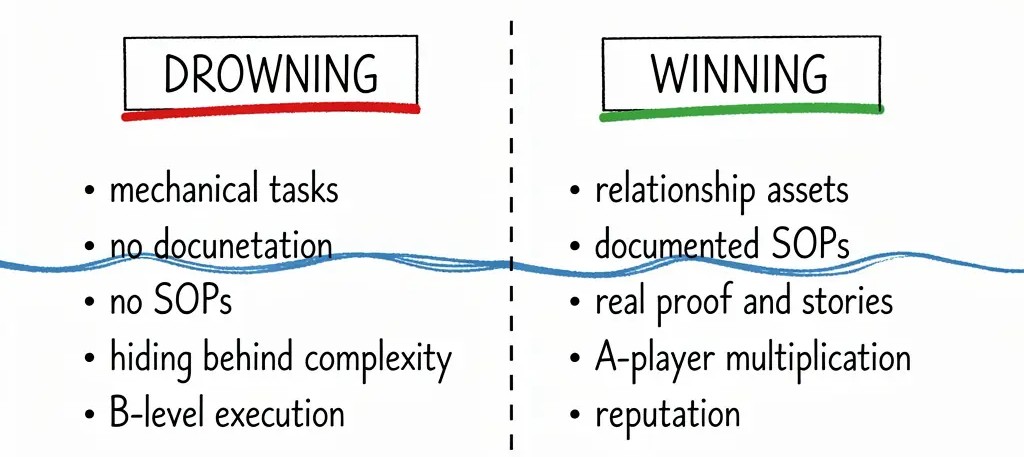
But as the water level gets higher, these people are drowning. I remember in our sock factory, Brennan was paying about $1.80 an hour. We had 300 VAs from the Philippines resizing photos and putting them on custom socks. Now software does that. There’s no more $3 to $5 an hour VAs.
Level two: Expert work
We have a nine-level system based on real skills and real tasks that correspond to what we’ve actually been paying people over the last 20-plus years. This isn’t a theoretical framework. This is real work being replaced by AI.
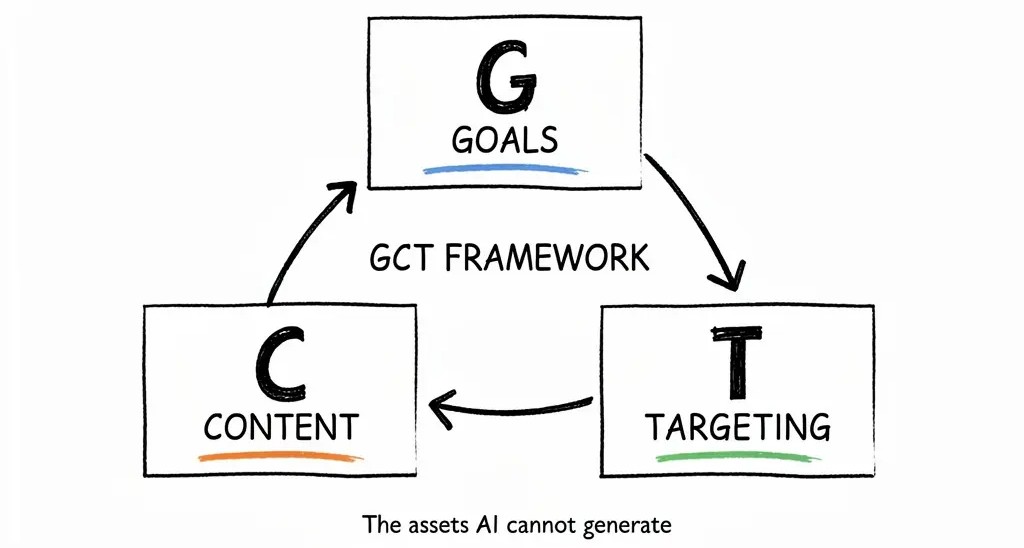
So what makes expert work? It’s things that have multiple steps chained together. It requires reasoning and interpretation. It requires reference back to context, not just mechanically executing a task. It requires understanding a client’s goals, content, and targeting.
Take ad optimization. Why can’t that be done mechanically? Because you could just bid up and down based on CTR, cost per acquisition, and lifetime value to maximize profit. But there’s the context of the creative, seasonality, what competitors are doing, changes in sales performance, and how well you close.
There’s what’s going on in the broader market, PE firms coming in and jacking up prices. Context is more important than mechanical execution, and this is where different agents get chained together into SOPs.
The agent era
This is where people are really starting to freak out. Agentic AI. Everything you’ve seen about agents, even Google finally, reluctantly released their agents after sitting on them for years.
What is an agent doing? The same thing an expert would do, except now it has not only the context feeding in but also the access: access to answer the phone, spend money on the credit card, and do things you and I would do through a laptop.
This is where most agencies are getting exposed. The offshore ones charging $8 an hour to answer phones are already drowning. If you look at American agencies, people like Joshua Crouch and Lane Houk are good at selling, but the actual delivery is mechanical. It’s mechanical plus a layer of account management, and that’s just lipstick on top of hiding the fact that the work isn’t there.
AI can now audit the work. You can’t hide anymore. If you’re a digital marketing agency and you don’t like me because I turned the light on in the room, don’t blame me. Don’t blame the light. Blame the fact that the results aren’t there. Don’t get mad at the scale.
Relationship assets: What AI can’t replace
So what’s above the water? What can’t the agent do?
Relationship assets.
I just had Erik Huberman, who runs the world’s largest and fastest-growing digital agency, on. He did $700 million last year and bought 23 agencies. Meanwhile, so many people doing marketing, legal work, accounting, and tax work through a laptop are drowning.

You’re not going to beat AI at chess. You’re not going to beat AI at optimizing for SEO, which is really just a set of mechanical items that can be made complex. When there’s a set of rules, like how Google works, how Facebook or TikTok Ads or LinkedIn Lead Gen operate, the frameworks are set. There’s only a certain way you can maneuver.
So what’s the advantage? The true proof and the assets from relationships. This is what I call GCT: specific Goals, Content, and Targeting. Stories and relationships that are made visible.
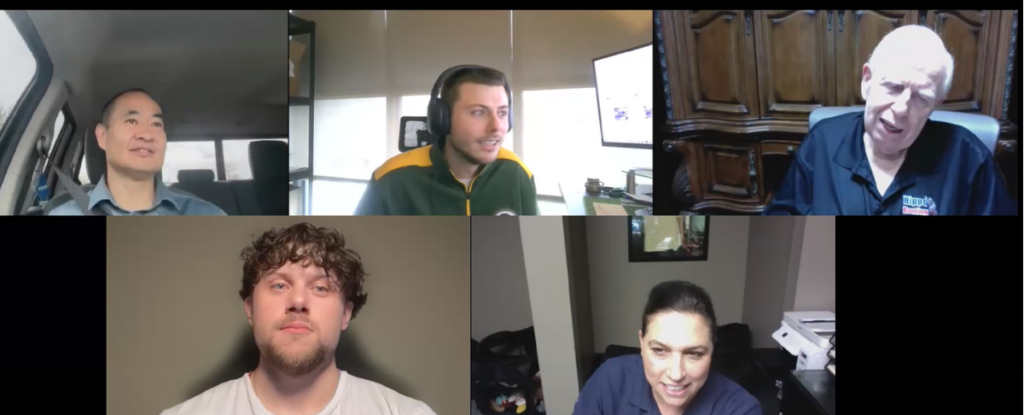
We met with Hippo Roofing today. They have 600-plus reviews and have done 10,000 jobs. They rank in Google Maps, but their website only ranks on 22 keywords because they haven’t used digital as a reflecting mirror of their real assets.
When you have real assets and use AI agents to repurpose them across LinkedIn, Facebook, YouTube, Google My Business, and all these other channels, you build out your entity strength. You become part of the knowledge graph that Google uses, and you get referenced when ChatGPT makes recommendations.
Who’s winning and who’s losing
Here’s the weird dichotomy. Erik Huberman’s agency is growing faster than ever. He’s hiring people. He’s doing the exact opposite of agencies that can’t find clients because their clients are saying, “I fired my agency and had my son use ChatGPT.”
And honestly? That’s actually better than what most agencies were doing. When we audit their accounts, we find they haven’t made changes in three months.
Erik is able to grow because he has so much reputation and strength on the strategy side. He buys struggling agencies and pulls them up by centralizing power in software, operations, website building, and ads.
I think of AI as just a reputation multiplier. That’s really what it is. It’s not a technical thing. I look at friends of mine like Tom Shipley, who runs Deal Con. Arguably he’s not an AI guy, but he’s done so much in M&A because as digital businesses struggle, there are opportunities to buy them out. In just the last two months, the number of agencies reaching out to me saying they want to exit has been staggering.

The one-year prediction
Here’s the main point: I don’t think most digital marketers will be able to operate as they are in a year from now.
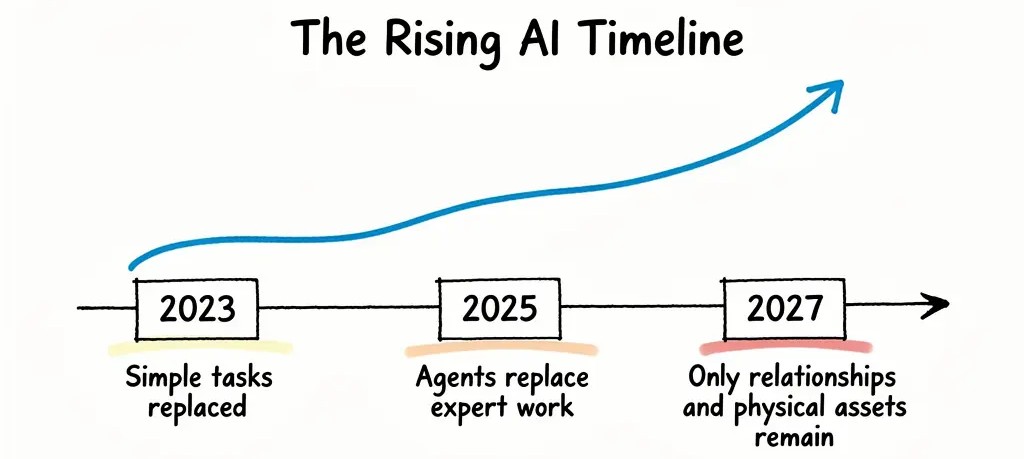
Elon Musk said white-collar jobs will be mostly done within a year. White-collar jobs will be eliminated before blue-collar jobs. Facebook, Google, and others are laying off a third of their workforce.
It’s not a binary yes-or-no of keeping your job. It’s to what degree your job is gradually being absorbed by agents that keep getting better.
Physical assets are the new moat
This is why Lance Bachman, who ran One SEO (the world’s largest SEO company), sold it and started buying roofing companies. Level five is physical. Jensen Wang says there’s a boom in the trades because it’s going to be a while before a robot is running a snake in a 1970s ranch house.
If physical becomes more important as digital work gets commodified, how do you move from relationship assets into physical assets? You do real-world things. Meet people in person for podcasts. Meet them for meals. Take what’s in your phone, your Google Photos and Apple Photos, and feed those assets to your agents. The agents will magnify the power of those assets.
Multiply your best people
We announced that all of our people, regardless of country, are now at $22 an hour minimum. Everything below that can be done by agents. I predict by summer 2027, we should be able to pay $50 an hour or more because everything underneath that line doesn’t need a human.
The agent works for tokens. It’s faster, cheaper, and better. So we’re accelerating this. Our A-players who do great work, people like Daniel Goodrich, Dan Leibrandt, Marko S. Sipilä, and George Paladichuk, these are the ones you want to replicate into agents.


Why wouldn’t I want 10 more media buyers like Marko? Or 10 more people who can build AI call centers like George?

But if I’m multiplying the best people by 10 and building clone agents, what does that mean for B-level copywriters, B-level marketers, B-level anything in white-collar laptop work? You only need a few people who are really good.
My friend Peter Ele Haggy was the engineer at Yahoo who wrote the code for type-ahead search results. One guy. Our other Peter at Google created Gmail. One guy. A billion people use Gmail. There’s so much power in that leverage. That’s why superstars in Silicon Valley are being offered hundred-million-dollar paychecks, not just because of this AI bubble. These people are worth more because agents are able to multiply their impact.
Open-source your knowledge
We’ve published all our SOPs and agent frameworks to blitzmetrics.com for anyone to access. We initially kept them as custom GPTs, but I realized we only had about a year and a half before this all becomes commoditized anyway.
The way we work now: we speak directions to our agents in natural language, reference specific SOPs, and the agents execute. One of our clients, Ethan Van De Hey, who runs a double-digit million roofing company in Wisconsin, told his agent to run ad campaigns according to our Dollar-a-Day strategy. The agent did it. Not because it was role-playing, but because it followed published SOPs.
The agents research, execute, QA their own work, and document everything. Other agents come in and audit. We use Claude for execution and ChatGPT for auditing because it’s better at catching mistakes. As Sam Altman would say… well, Sam Altman, don’t sue me. But the point is you have checks and balances, like the legislative, judicial, and executive branches.
Build your ark
When I look ahead to Level Six, fully autonomous AI, I know that even if I try to play keep-away with our SOPs, what matters are the assets and relationships.
I flew to Atlanta to hang out with Brad Strawbridge. I spent time with a quiet billionaire three days ago. We are all building our arks. You should build yours with people who have reputation, authority, and real business assets.

This is why companies are rolling up. Ten HVAC companies under one umbrella. Ten digital agencies under Erik Huberman. Cody Jones doing roll-ups in funeral homes. Jeff Hughes in family law offices. Not because of strength in numbers, but because there’s more reputation to multiply across these companies.

What does this mean for you?
Think about this rising AI line. Where are you operating? Maybe parts of your operations have no documentation and you’re drowning. Maybe your marketing has no accountability, no SOPs, no measurement.
A lot of agencies are coming to us saying, “Can you just implement your SEO and ads?” They’re good at client relationships but need help with execution. We’re happy to share because when you give knowledge, you don’t lose it. It becomes a standard, and that standard becomes worth even more.
So instead of chasing the latest AI update and getting distracted by the noise, ask yourself: what are you going to do to get above the rising AI line?
Dennis Yu
Dennis Yu is the CEO of Local Service Spotlight, a platform that amplifies the reputations of contractors and local service businesses using the Content Factory process. He is a former search engine engineer who has spent a billion dollars on Google and Facebook ads for Nike, Quiznos, Ashley Furniture, Red Bull, State Farm, and other brands.
Dennis has achieved 25% of his goal of creating a million digital marketing jobs by partnering with universities, professional organizations, and agencies. Through Local Service Spotlight, he teaches the Dollar a Day strategy and Content Factory training to help local service businesses enhance their existing local reputation and make the phone ring.
Dennis coaches young adult agency owners serving plumbers, AC technicians, landscapers, roofers, electricians, and believes there should be a standard in measuring local marketing efforts, much like doctors and plumbers must be certified.