
 by
by
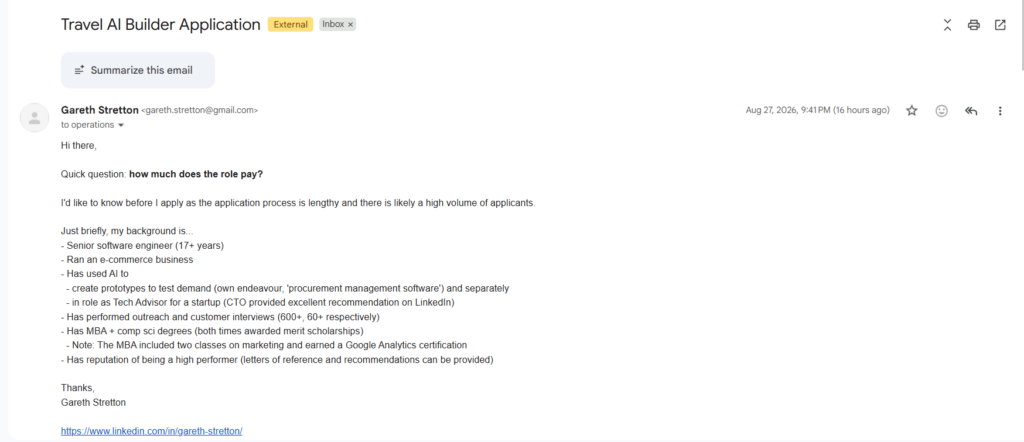
Someone emailed me this week about an open role. Seventeen years in software, an MBA, ran his own business, hundreds of customer interviews. Strong background.
His first message asked how much it pays.
I told him it wasn’t a fit and not to bother applying.

He was surprised, and I don’t blame him. So here’s an honest answer to a question a lot of people are searching for: should you ask about salary before you apply, and what does the employer read into it when you do?
The short answer
Yes, ask. But almost never as your opening line.
The question isn’t the problem. Where you put it is.
What your first email actually communicates
Every hiring manager is reading your first message for signal, whether they admit it or not. There’s very little to go on, so the little there is carries weight.
When somebody’s opening contact is about compensation, before they’ve asked anything about the work, the clients, or the problem we’re solving, that tells me what they’re solving for. I’ve been wrong about that maybe twice in twenty years.
Plenty of excellent people solve for the number. They should go work somewhere that posts one, and plenty of companies do. Better we both find that out in one email than after four rounds of interviews.
Why some employers won’t post a range
A lot of candidates assume no posted number means the employer is hiding something. Sometimes that’s true. Often it isn’t.
Here’s my reason. We pay for performance, and the salary sits underneath that as a floor. Everybody submits a weekly report: metrics, analysis, what they’re doing next, and the receipt showing what actually changed. Pay follows that record.
So nobody gets capped by whatever figure we guessed at during hiring. Somebody who levels up in three weeks gets paid like it in three weeks. Post one number and you’ve anchored everybody to the guess.
Imagine if the score of a game were based on how many points each player thought he should score. The referee tallies up everyone’s wishful points and declares a winner. That’s how pay works at most companies. It rewards whoever argues hardest, and those are almost never the people delivering most.

Here’s what people miss about performance pay. It protects the quiet ones. When you measure output, the person who’d normally get talked over in the meeting gets promoted for the work they’re actually doing.
Why a strong resume doesn’t override this
The guy who emailed me had a genuinely good background. That’s my point. If the resume were the test, he’d have sailed through.
Credentials tell you how long somebody worked. They don’t tell you how they think. Years measure duration. Degrees measure completion. Neither one predicts whether somebody owns the outcome when the plan falls apart on a Tuesday, communicates before there’s a problem instead of after, and finishes what they started.
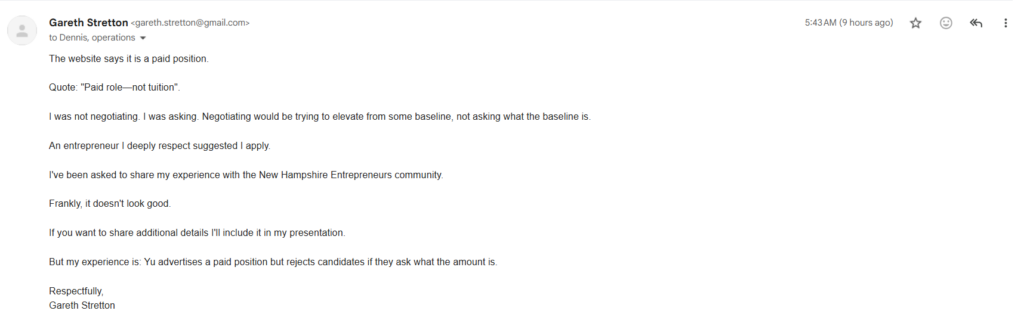
None of that shows up on paper. All of it shows up in how somebody opens a conversation.
So when should you ask?
Ask after you’ve shown interest in the work. That’s it. That’s the whole rule.
A message that opens with a specific observation about what the company does, a real question about the role, and then asks about compensation range reads completely differently from one that leads with the number. Same question, same information requested, opposite signal.
If you’re worried about wasting your time on a long application, say that. “I’d like to make sure we’re in the same range before I put a few hours into this” is a reasonable sentence. What separates it from what I received is that it comes attached to evidence you actually want the job.

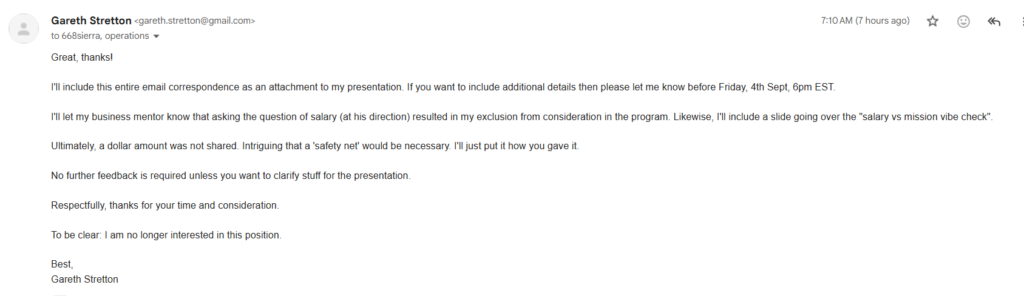
And if an employer treats a well-placed salary question as offensive, you’ve learned something useful about them for free.
What we ask for instead
Our application is a one-minute video. No resume, no cover letter, no week of interviews.
The best predictor I’ve found is whether somebody will make a one-minute video about anything at all. How they played golf yesterday. Something they thought about after a podcast. One minute leaves no excuses, so what it really measures is whether you’ll do it.
It has nothing to do with vanity or building an audience. It shows me whether you can explain a thought clearly and direct work like a manager. These days the people you’re directing are AI agents. We talk to Claude and ChatGPT in English, the same way we’d brief a colleague. If you can’t say what you want out loud, the tools won’t save you.
We landed on this after letting in people who looked motivated and weren’t.
I took a $114,000 pay cut
I started at American Airlines making $18.50 an hour. Eighty-hour weeks, so really about $9 an hour. Goldman Sachs would have paid me $150,000 before bonus.
I turned it down for what my mentor could teach me. Money wasn’t my main consideration, though I had bills and could have argued my worth.

I don’t expect anybody to repeat that. But it’s why I hire for roles where the opportunity is the point and the pay follows the work.
Originally published .
Dennis Yu
Dennis Yu is the CEO of Local Service Spotlight, a platform that amplifies the reputations of contractors and local service businesses using the Content Factory process. He is a former search engine engineer who has spent a billion dollars on Google and Facebook ads for Nike, Quiznos, Ashley Furniture, Red Bull, State Farm, and other brands.
Dennis has achieved 25% of his goal of creating a million digital marketing jobs by partnering with universities, professional organizations, and agencies. Through Local Service Spotlight, he teaches the Dollar a Day strategy and Content Factory training to help local service businesses enhance their existing local reputation and make the phone ring.
Dennis coaches young adult agency owners serving plumbers, AC technicians, landscapers, roofers, electricians, and believes there should be a standard in measuring local marketing efforts, much like doctors and plumbers must be certified. He has appeared on 353 podcasts with 619 credited episodes — see the full list of his podcast appearances.