
 by
by
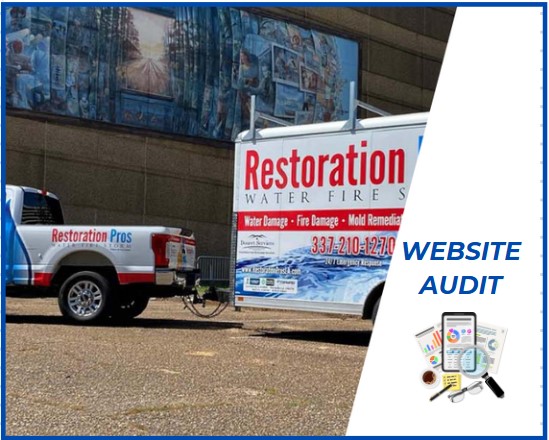
This page is a worked example (a leaf). The canonical for how we audit is How we audit. The seven-component exam and the full published list: SEO Audits by Dennis Yu.
Chuck Doucet owns Restoration Pros, a water, fire, and mold restoration company in Lafayette, Louisiana with 20 years behind it. Calls and traffic have slipped, and this Restoration Pros SEO audit found why: a 2.2-out-of-100 link authority, only 91 keywords ranked, and a 10-page site doing none of the heavy lifting. Here is the gap and the fix order.
2.2/100
link authority — built mostly on low-value paid directories
91
keywords ranked — far below the thousands a 20-year firm should hold
10
pages on the whole site — the homepage alone carries ~40 keywords
At first glance Restoration Pros looks solid: a professional layout and videos that show real expertise in restoration and mold remediation. This Restoration Pros SEO audit pulled the public signals apart to find why a 20-year reputation is not translating into found-on-Google service calls.
Read The Ranking And Link Metrics
The site ranks for only 91 keywords, far below the several thousand a firm this established should hold. It does rank for the high-volume, low-difficulty term “water damage restoration pros,” which is a strong starting point, but it sits at position 10 for an easy local term like “water and fire restoration company New Iberia Louisiana” and position 9 for “water mitigation Lafayette.”
Link authority is the root cause at 2.2 out of 100, dragged down by low-value paid directories. Without real links the site will not rank for the terms that matter, like “water remediation” or “fire damage restoration,” no matter how good the service pages read.
| Signal | What the audit found | What it means |
|---|---|---|
| Link authority | 2.2 / 100, paid directories | Money terms will not rank |
| Keywords ranked | 91, far below target | Thin organic reach |
| Site pages | 10 total; homepage holds ~40 keywords | One page does the work |
| Blog author | No author profile | Reads as AI, no EEAT |
RUN THIS YOURSELF
In Ahrefs, check the link authority score, then open the referring domains and see what they are. A 2.2-out-of-100 score sourced from paid directories means no real authority is flowing in — that is why easy local terms still sit on page one bottom. Showing an owner where their links actually come from is how a young agency owner reframes “we did SEO” into a real plan.
See Why The Homepage Carries Everything
In Lafayette the company does appear in the local pack, which helps discoverability, and most traffic still flows through the Google Business Profile rather than the website. Rankings have nudged up — from position 8 to 5 on some terms — but the site itself is doing little.
With only 10 pages, the homepage does the heavy lifting and holds about 40 keywords, while the location and service pages underperform and pull almost no traffic. People recognize the 20-year brand, but they are not finding it through the service keywords that bring emergency calls.
Prove Real Experience For EEAT
The content does not yet demonstrate Experience, Expertise, Authority, and Trust. The blog has no author profile, which makes it read as AI-generated, and the water damage page carries keywords but no backlinks or trust signals, so it offers little SEO value.
The fix is proof of real-world work: technician activity, before-and-after jobs, and community involvement. There is no need for a new website — just authentic, non-stock photos and one-minute story videos that show genuine expertise in water damage, mold removal, and fire restoration. This is the MAA framework — measure the gap, analyze the cause, then act.
RUN THIS YOURSELF
Open the client’s blog and look for an author profile and byline. When there is none, the content reads as AI to Google and earns no EEAT credit — a real author with a bio and job photos is a same-week fix. Pointing an owner at their own author-less blog is how a young agency owner makes the EEAT gap concrete.
Build Local Pages And Community Content
Build out location and service pages that show real results in Lafayette, New Iberia, and Youngsville, and tag photos with the actual suburb so local relevance climbs. The device does not matter; capturing authentic moments does, and technicians can drop photos into a shared Google workspace to keep content flowing.
Add the community signal the strategy is missing: branded shirts at local cook-offs and fundraisers, a founder story, technician growth, and answers to the People Also Ask questions real users type, like “what does it cost?” and “can they come right away?” Plan on 6 to 10 weeks to build this out. The same diagnostic runs on any local business — see it end to end in the Quick Audit process.
THE DELIVERABLE
Turn A 20-Year Reputation Into Calls
We will pull your links, rankings, and local presence apart the same way — and tell you what to fix first to bring the emergency calls back.
Get Your Own Quick Audit →Power Hour with Dennis →Originally published .
Dennis Yu
Dennis Yu is the CEO of Local Service Spotlight, a platform that amplifies the reputations of contractors and local service businesses using the Content Factory process. He is a former search engine engineer who has spent a billion dollars on Google and Facebook ads for Nike, Quiznos, Ashley Furniture, Red Bull, State Farm, and other brands.
Dennis has achieved 25% of his goal of creating a million digital marketing jobs by partnering with universities, professional organizations, and agencies. Through Local Service Spotlight, he teaches the Dollar a Day strategy and Content Factory training to help local service businesses enhance their existing local reputation and make the phone ring.
Dennis coaches young adult agency owners serving plumbers, AC technicians, landscapers, roofers, electricians, and believes there should be a standard in measuring local marketing efforts, much like doctors and plumbers must be certified. He has appeared on 353 podcasts with 619 credited episodes — see the full list of his podcast appearances.