
 by
by

It's my birthday, October 6, and I want a clear plan for what comes next. I put my vision, the proof behind my work and my next steps into a PDF I can sit down and read. Here are real parts of that plan, plus the files to build your own with Claude, ChatGPT or the AI you already use.
An actual excerpt from page 7 of my working PDF, The Second Curve, version 9, September 28, 2026. These are teaching appearances you can check, not logos added to a sales deck.
Start your plan · Read the starter PDF · Download the editable kit
I like books. I like being able to sit down, read something in detail and see how the pieces fit together. That's why I wanted this as a PDF. A long trail of chat messages is hard to read that way.
But I also wanted to act on it. My plan needed to help an agent understand what matters to me, what evidence we have, what we're working toward and what to do next.
The PDF gives me the whole picture. The editable files let us keep working.
What is a Second Wave plan?
It's a plan for your next chapter, built from what you've already done.
It combines your second brain, your vision, your authority and your next actions. The question I want it to answer is simple: Given who I am, what I've earned and what I want, what should I do next?
My working PDF is titled The Second Curve. It credits Charles Handy's book about the Second Curve, published in 2015. The chart below reminds me to begin the next phase while I still have the resources to build it.
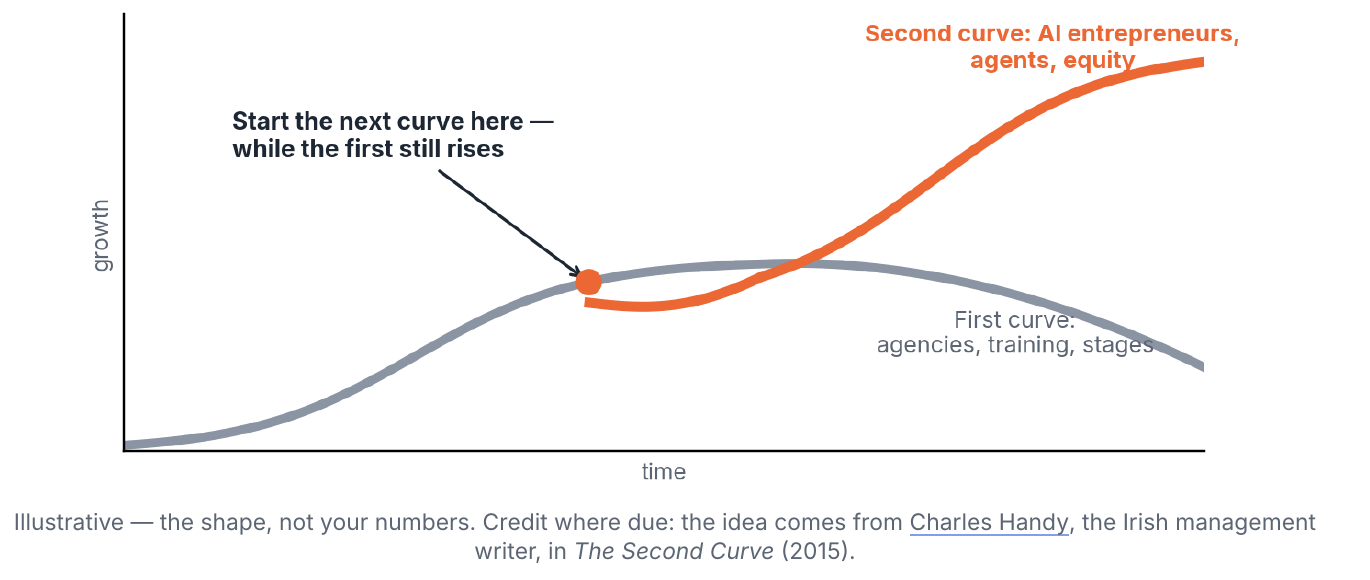
Excerpt from page 9 of my PDF. This is an illustration of the idea, not a revenue chart or a forecast.
Your next chapter might be a business, a book, a different role or a way to spend more time with your family. You decide what it is. The agent helps you examine the evidence and work through the steps.
How do you choose a vision that fits you?
Start with the week you want to live. Who are you helping? What work do you enjoy? What do you want to keep doing, and what do you want to stop?
My PDF uses this four-circle diagram to consider what I love, what I'm good at, what people need and what they will pay for. It's a useful worksheet for finding the overlap.
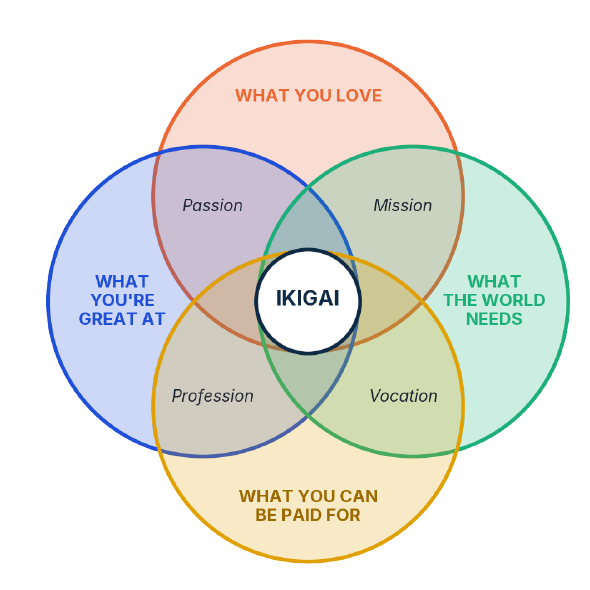
The diagram from page 4 of my PDF. Use it to ask better questions; it won't choose your life for you.
For me, systems and teaching fit together. I teach young men to put AI agents to work for the contractors who keep America running. That's also how I describe my work on my personal site.
When I consider a new project, I can ask whether it helps that mission. I can also ask whether it leaves room for reading, friends and the life I want to have.
Write a one-page vision with five things: whom you serve, what you want to be known for, what you want to build, what a good week looks like and what you will stop doing. Then ask the AI to find conflicts. A plan that requires every evening you meant to protect needs another look.
What does this look like in my actual plan?
Page 29 has a happiness formula that makes my priorities pretty clear:
Faith + family + teach the few + adventure + play − chasing − babysitting.

Original excerpt from page 29 of The Second Curve, v9. This is my formula. Yours may look different.
That last part matters. If my plan fills the week with chasing people and repeating basic instructions, it has failed one of my own tests. The AI needs to know what I want more of and what I want less of.
The same page gets specific about reading:
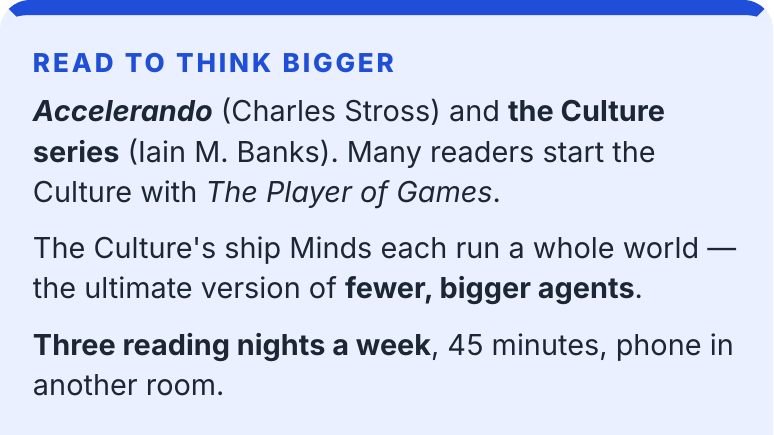
Selected original text from the “Read to Think Bigger” card, page 29.
The target is three reading nights a week, 45 minutes, phone in another room. That's something I can put on a calendar and check. “Read more” would leave too much room for interpretation.
It also includes a proposed Friday check-in:

Original “Friday Joy Score” card, page 29. It proposes a 3 p.m. Friday question: “This week, 1 to 10?”
The idea is to look back after 12 weeks and see which weeks made me happy and what was in them. It's a question about whether the plan is producing a life I enjoy while I build.
Page 33 turns that into a scorecard. These two rows sit alongside the work measures:

Original page 33 rows. The columns are metric, September planning baseline and December 31 target. Trampoline hoops was “not tracked,” with a target of three sessions a week in Vegas. The joy score was to start October 2 and trend upward. These are entries in the original plan, not a claim that the targets have been met.
You don't have to borrow my hobbies or beliefs. Borrow the structure: name the life you want, set a specific target and decide how you'll tell whether the week supported it.
How do you map the authority you already have?
Give the agent evidence it can inspect.
The authority inventory at the top of this article includes my Tom Ferry teaching appearance and my Social Media Examiner interview. Each has a source page that identifies me and the subject we covered.
Those records help support my experience teaching digital marketing. They don't prove I'm the right person for every topic I might want to pursue next. That's the useful part of the exercise: seeing where my evidence fits my vision and where I still need to do the work.
Here's how I can turn those two real entries into an authority map:
| Record from my PDF | Source you can inspect | What it supports |
|---|---|---|
| Tom Ferry teaching appearance | Original episode page | Experience teaching digital marketing to a real estate audience |
| Social Media Examiner interview | Original interview | Experience explaining Facebook marketing in a third-party publication |
The next question is how that experience helps me serve the audience in my vision. I still need evidence for the particular problem I'm promising to solve.
You can start with a customer result, a license, a talk, a useful article, a project you completed or a person you've actually worked with. Put each in a table like this:
| What you want to establish | Evidence to collect | What it helps you do |
|---|---|---|
| You can solve a particular problem | A documented result, with permission to share it | Support a relevant offer |
| You can teach the subject | A recording, lesson or published explanation | Create a useful guide or workshop |
| Others recognize your work | A third-party interview, review or citation | Support a public introduction |
| You have a relevant relationship | A shared project or documented interaction | Identify a reasonable next conversation |
A photo together establishes that you were together. A shared project establishes more. Keep the description as precise as the evidence.
Ask the agent to record the source, date, what it supports and how it relates to your goal. When the source is missing, leave a gap. You'll learn more from an honest gap than from a flattering paragraph.
What belongs in your second brain?
Start with a small set of files you can understand and keep current:
- Vision: what you're trying to accomplish and why.
- Evidence: claims, source links, dates and any limits.
- Plan: your priorities and what success would look like.
- Action ledger: the next action, owner, due date and result.
- Session state: decisions made, work completed, open questions and where to resume.
Keep one current editable plan and dated PDF snapshots. That makes it easier to change AI tools without rebuilding your history. I explain the reasoning in why I keep portable files.
Use your own documents and records you have permission to use. Keep passwords out of the plan. If you're sharing a project with a team, make a separate version containing only what that team needs. Our shared-memory setup guide explains that structure in more detail.
How do you turn the vision into a 90-day plan?
Choose up to three priorities. For each one, name the result, your starting point, an owner and the next action.
Here's how I can work from the actual reading and joy entries in my document:
| Actual entry in my plan | Next action I can take | Evidence to record |
|---|---|---|
| Three reading nights weekly, 45 minutes, phone elsewhere | Choose the three nights and protect those blocks | Which sessions actually happened |
| A Friday joy score from 1 to 10 | Put the question in the weekly review | The dated score and a sentence about why |
Those next actions are my translation of the source entries into a working ledger. The screenshots above show what the original plan says. Neither a calendar block nor a written target proves I did the work.
For your business priorities, use the same approach: a starting point, a measurable result, an owner, a next action and proof. Choose the few that matter for the next 90 days.
Every action should connect back to the vision. If the agent proposes a podcast, ask who it serves and which gap it closes. If it proposes a new tool, ask what work the tool will help finish.
I also want an owner and a clear way to check the result. A draft, a sent message and a verified outcome are different stages. Your ledger should make those stages visible.
Can a PDF become a place to take action?
Yes, if you design it that way.
Ask for a readable plan with links to the evidence and the working files. Put the next action at the end of each major section. Give the PDF a date and version so you know which snapshot you're reading.
Then return changes to the editable plan and action ledger. An agent can use an uploaded PDF as context, but it still needs the current decisions and work records. The PDF itself doesn't send messages, update your calendar or connect accounts.
The starter PDF below puts these real excerpts and personal targets in one sitting's worth of reading, alongside worksheets and the setup steps. It gives you a starting point for your own plan.
How do you start in Claude, ChatGPT or another AI?
Download the Second Wave starter kit and unzip it. Open START-HERE.md. You can also read the PDF guide first.

Scan to open these setup steps on your phone. Already here? Use the download link above.
Pick the AI you already use:
| Your tool | What to do |
|---|---|
| Open ChatGPT | Create a project called “My Second Wave.” Add your documents to Sources and paste AGENT-CONFIGURATION.md into the project instructions. Follow the official ChatGPT project guide. |
| Open Claude | Create “My Second Wave.” Add your documents to project knowledge, then paste the configuration into “Set project instructions.” Follow the official Claude project guide. |
| Another assistant | Upload or paste the configuration and workbook into a chat. Ask it which files it can read. Save the updated files after each session so you can return to the work. |
Start with your bio or business page, a few examples of your work and rough notes about what you want next. You can begin in an ordinary chat if you don't want to set up a project yet.
Copy this first prompt:
Help me build my Second Wave plan using the attached configuration
and workbook. Tell me which files you can actually read.

Help me clarify my vision, map my authority with sources, identify
the gaps and choose up to three priorities for the next 90 days.

Keep facts, my decisions, proposals and unknowns separate.
Don't invent results, relationships or credentials.

Create an editable plan and action ledger. Where file creation is
available, also make a readable PDF I can review in one sitting.
Otherwise give me a print-ready version I can save as a PDF.

Begin with a short evidence summary and at most three useful questions.
The kit contains a starter agent configuration written for this exercise, a workbook, evidence and action ledgers, a session handoff, and DENNIS-EXAMPLES.md with these sourced examples. Keep my examples as reference material and build your plan from your own goals. The ZIP is a set of editable files you use in your own workspace. You still choose the tool and add your information.
What should you tell the agent?
Tell it how to work, as well as what to work on.
I want it to ask useful questions in small batches, cite material claims, challenge a weak connection between evidence and a goal, and leave an updated record when the session ends.
The starter configuration begins with research, planning and drafts. You can later authorize specific actions and connect the tools needed for them. A configuration file can't grant access to your email or override your app's permissions.
If you use Claude Code, see its CLAUDE.md context guide. For Codex, see the AGENTS.md configuration guide. In the web apps, use the project instruction field described above.
When you want reusable methods beyond this starter, our current skill installation guide and public skill library explain the available paths. Add a skill when you have a job for it to do.
How do you know the setup works?
Ask the assistant to name the files it read, state one goal you actually supplied, cite one piece of evidence and identify a next action tied to that goal. Open the source yourself. Correct anything it misunderstood before giving it a bigger job.
Then use a weekly review: What changed? What finished? What did we learn? What needs a decision? What are the next three actions?
Include a question about the life you wanted. Did the week leave room for it? My plan includes a joy score. Yours might track family dinners, time outdoors or evenings spent reading.
You can add a recurring review once the manual review is useful. Check that your platform saved the task, can reach the right sources and produces a useful first run. A request in a chat is only a request until the schedule is actually created.
Can your team help me implement this?
Yes. We offer a $7,500 white-glove implementation service through Local Service Spotlight. Our team helps you implement this, and I'm involved too.
If you'd like help, ask us about Second Wave implementation. Tell us what you're trying to build, what you've already done and where you feel stuck. We'll discuss the fit and scope with you.
You can also use the free kit and start on your own. Open the workbook, add three pieces of evidence and tell the agent what you want your next chapter to look like. That's enough to begin.
Setup instructions checked October 6, 2026. PDF excerpts are from the September 28 working file; its original page footers retain September 27. The starter kit is an adaptation for readers.
Originally published .
Dennis Yu
Dennis Yu is the CEO of Local Service Spotlight, a platform that amplifies the reputations of contractors and local service businesses using the Content Factory process. He is a former search engine engineer who has spent a billion dollars on Google and Facebook ads for Nike, Quiznos, Ashley Furniture, Red Bull, State Farm, and other brands.
Dennis has achieved 25% of his goal of creating a million digital marketing jobs by partnering with universities, professional organizations, and agencies. Through Local Service Spotlight, he teaches the Dollar a Day strategy and Content Factory training to help local service businesses enhance their existing local reputation and make the phone ring.
Dennis coaches young adult agency owners serving plumbers, AC technicians, landscapers, roofers, electricians, and believes there should be a standard in measuring local marketing efforts, much like doctors and plumbers must be certified. He has appeared on 353 podcasts with 619 credited episodes — see the full list of his podcast appearances.