
 by /
by /
How do you do SEO at scale using AI for an agency? It’s easy to do it for one client. But when you have thirty or forty clients, a lot of people, and a lot of tools, it becomes complicated, especially when you’re bringing in AI to do the work, maintain quality, and report results back to clients.
I’m Dennis Yu, and in Episode 37 of The Marketing Mechanic, I’m going to show you the exact framework I’ve used personally and with agencies to make this work.
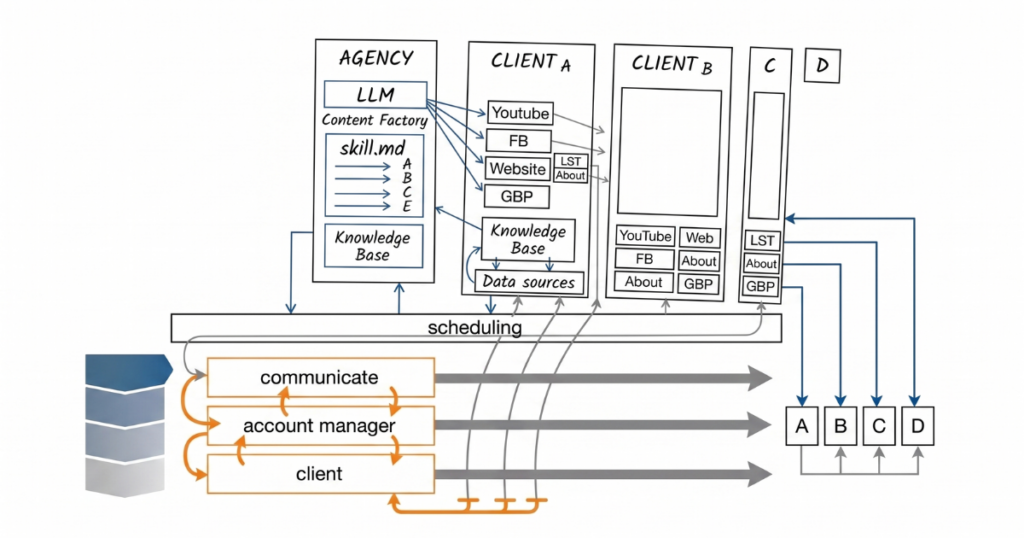
Stop obsessing over the tool
The first thing people get wrong is obsessing about which tool to use, whether it’s Grok, Opus, Gemini, or whatever the latest model is. That matters very little compared to the actual way things are done.
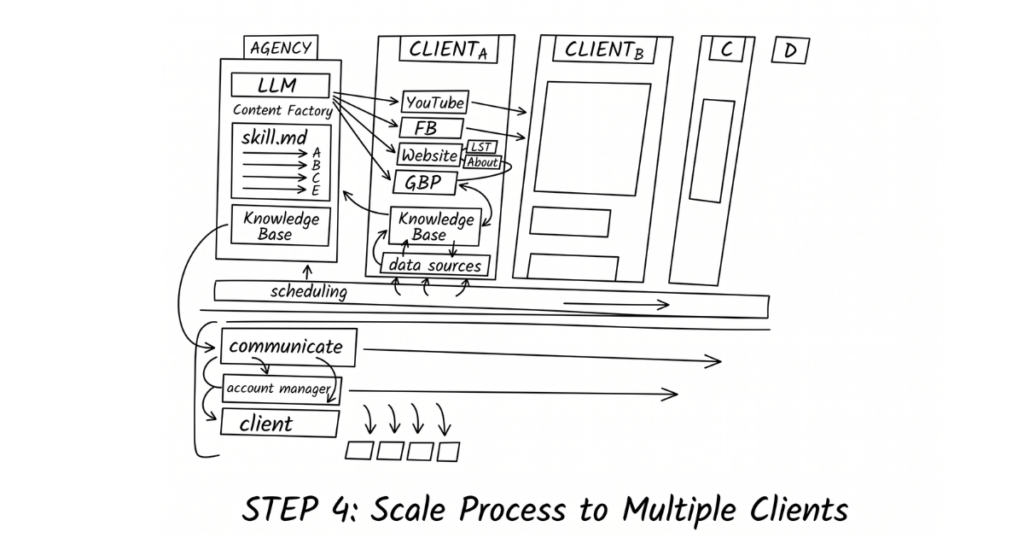
How things are done lives in what I call Skill MD files. These are structured instructions for specific tasks like keyword research, blog posts, video repurposing, or updating a Google Business Profile. Each task has its own skill file.
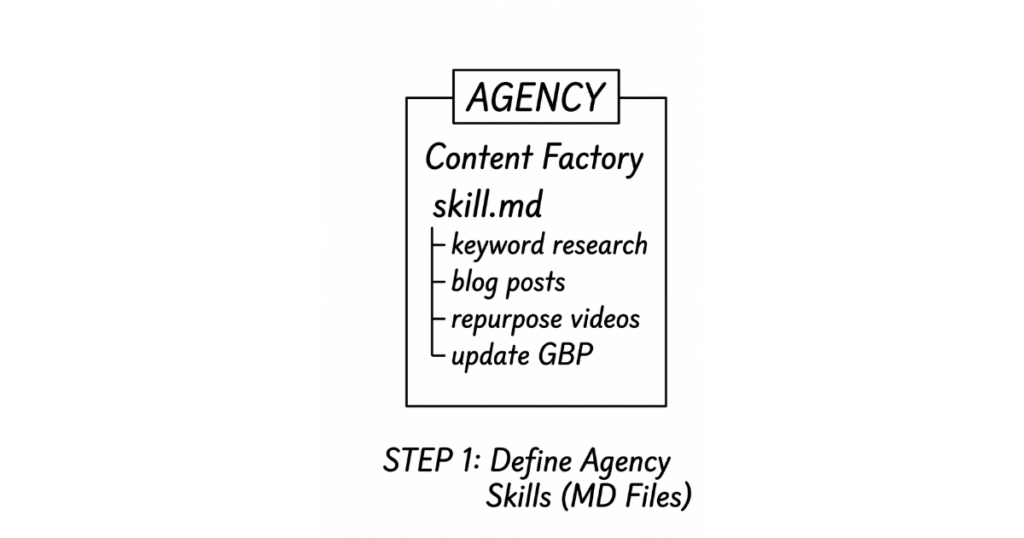
Why impersonating experts hurts you
A lot of people go straight to ChatGPT and say something like, “You’re Rand Fishkin, and you’re good at SEO. Go apply SEO to this website.” That used to work a few years ago for conversational purposes, but it actually hurts you when you want AI to do real work.
When you tell an AI to impersonate someone, you’re filling up the context window with information that doesn’t help it accomplish the task. It’ll basically give you a convincing conversation, but it won’t get the work done. That’s the difference between conversational AI and agentic AI.
You need skill files instead.
The framework: skills, knowledge base, and LLM
Here’s how the system works. You have three layers:
Your LLM of choice sits on top. Below that are your skill files. And below the skills is your knowledge base, which some people call a Content Library. It could live in Obsidian, Google Docs, spreadsheets, whatever works for you. The point is it contains all the real information about your agency and your clients.
For your agency, the knowledge base should reflect who you are. What’s your reputation? What results can you prove? What’s your niche? Who is your ideal client? If you’re not clear on this, you’ll struggle to serve your clients well, and AI won’t fix that.
We have an agency called Roofing Launch that exclusively serves roofing companies. That clarity makes everything easier.

Building client knowledge bases
For each client, you build a separate knowledge base. Let’s say you have a roofer in Denver who does mostly residential roof replacement due to hail damage. You’d pull information from their Google Business Profile, Yelp reviews, website, service areas, relationships with other contractors, and any management systems like ServiceTitan, HubSpot, or GoHighLevel.
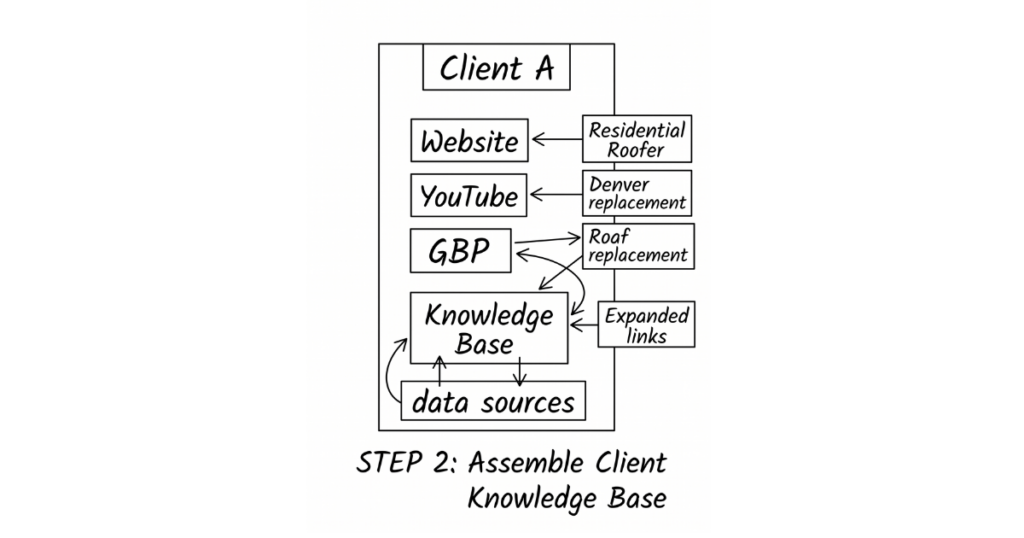
All of this feeds into the client’s knowledge base. When your skill files run against a complete knowledge base, the AI agents can do real, quality work.
The mistake most agencies make
What a lot of agencies do is point the LLM straight at each channel, saying “go fix the website” or “go work on location pages” or “go post on Facebook.” They skip the skill files and the knowledge base entirely.
There are plenty of tools that will automatically cross-post or run ads, but without the underlying structure of skills and knowledge, the output is generic and ineffective.
The scheduling layer
Once you have your skills and knowledge bases set up, you add a scheduling layer. I recommend weekly cadence for local service businesses. Every week, the system kicks off and looks for new content opportunities.
Maybe your client was on a podcast, or they’re celebrating an employee’s ten-year anniversary, or a technician posted a roof inspection video on Instagram. All of this new information flows into the knowledge base, triggers the relevant skills, and produces content that can update the website schema, create blog posts, build internal links to location service pages, and more.
This same structure replicates across every client. If your agency serves roofing companies, the process is almost identical for each client with just slight differences in location, service mix, and specifics.
Why niching down matters
If you’re an agency with a restaurant, a roofer, a nonprofit, and an e-commerce client, this system becomes much harder. Each industry has different data sources, different modules, and different optimization patterns.
But if you stick to one vertical, there are fewer data sources to integrate, your reputation builds faster, and your skill files get trained on what actually works for that industry. You know the cost per lead. You know what converts. The AI gets better because your data gets better.
The communication layer
Getting the work done is only part of it. You also have to communicate with your clients. This sounds obvious, but you’d be surprised how many agencies fail here.
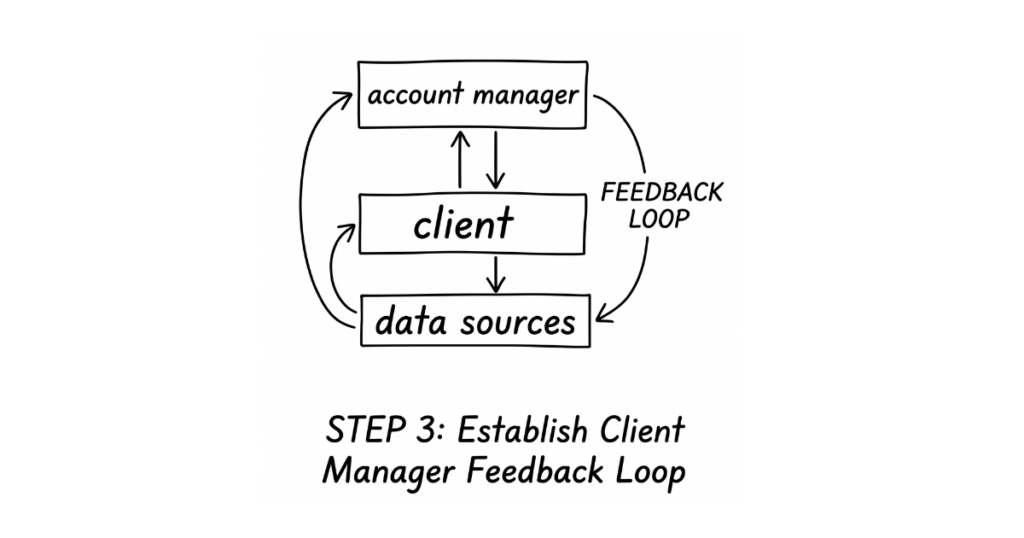
When work is completed, that has to result in communication, whether it’s an email, a text, an update in Basecamp, Monday, ClickUp, or whatever project management system you use. For larger agencies with a hundred plus clients, an account manager can send personalized updates. The AI can do the analysis and draft the message, and the account manager sends it.
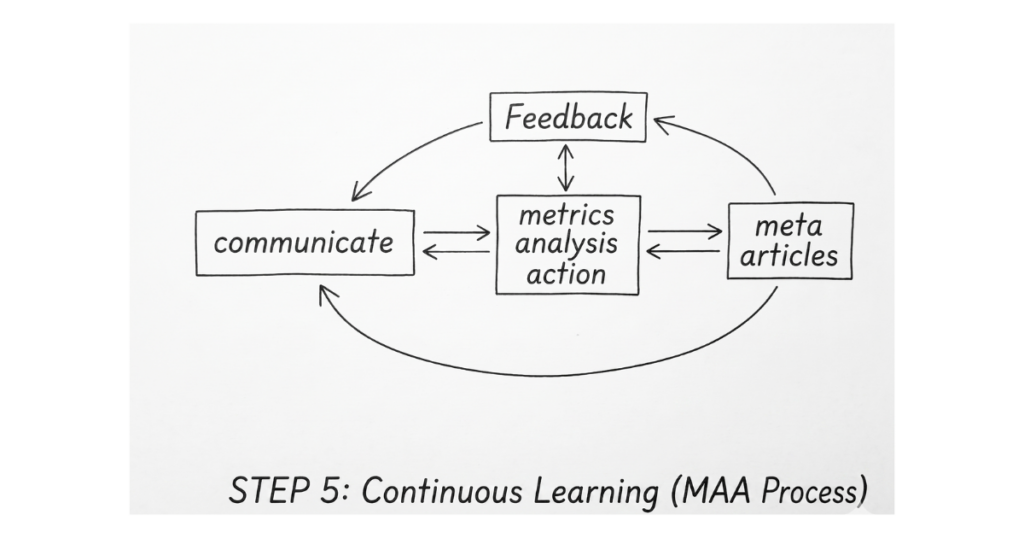
This communication creates a feedback loop. When you tell clients what you’re doing, they tell you what’s changing on their end. Maybe they expanded their hours, rebranded their trucks, or changed their pricing. All of that feeds back into the knowledge base and keeps everything current.
If you don’t communicate, clients forget about you and eventually think you’re just collecting money every month. Send them a Christmas card. Send them socks with their face on them. Show them you care and that results are growing.
The continuous learning loop
As this work gets done, the AI agents document what they’re doing and write meta articles back into your agency’s knowledge base. Over time, these become definitive articles showing how you do things in your vertical. That updates your skill files, which makes your agents better, which produces better results.
This is how you build a moat. As the AI models improve, your system improves with them. You’re not afraid of the next big model release because your skill files and knowledge base are your real advantage. The LLM is just the engine in the car. You still need the transmission, the wheels, and everything else.
You probably already have most of this
A lot of agencies get to three or four million dollars with only a few of these components in place, which surprises me because there’s usually a churn issue or a growth ceiling tied to the owner being the bottleneck.
If you’ve been doing this work yourself before AI, you probably already have most of these pieces. You just need to systematize them so AI agents can do the work. That means writing skill files, organizing knowledge bases, setting up communication workflows, handling escalations, and tracking results in a closed feedback loop.
We call this MAA: metrics, analysis, action. You continue to improve, learn, and experiment. Clients appreciate the track record, and if team members leave, new people can come in and see exactly how everything works.
What to do next
Think about where you are in this process. If you’ve implemented some AI but it’s not yet doing the actual tasks, or if you’re thinking about bringing work in-house because you’re not happy with other agencies, I encourage you to follow this framework.
If you have any questions, drop a comment or reach out to me at dennis@blitzmetrics.com. I’m a real human, not an AI, and I’ll reply.
I’m Dennis Yu, your marketing mechanic. See you in the next episode.
Dennis Yu
Dennis Yu is the CEO of Local Service Spotlight, a platform that amplifies the reputations of contractors and local service businesses using the Content Factory process. He is a former search engine engineer who has spent a billion dollars on Google and Facebook ads for Nike, Quiznos, Ashley Furniture, Red Bull, State Farm, and other brands.
Dennis has achieved 25% of his goal of creating a million digital marketing jobs by partnering with universities, professional organizations, and agencies. Through Local Service Spotlight, he teaches the Dollar a Day strategy and Content Factory training to help local service businesses enhance their existing local reputation and make the phone ring.
Dennis coaches young adult agency owners serving plumbers, AC technicians, landscapers, roofers, electricians, and believes there should be a standard in measuring local marketing efforts, much like doctors and plumbers must be certified. He has appeared on 353 podcasts with 619 credited episodes — see the full list of his podcast appearances.