
 by
by
This page is a worked example (a leaf). The canonical for how we audit is How we audit.
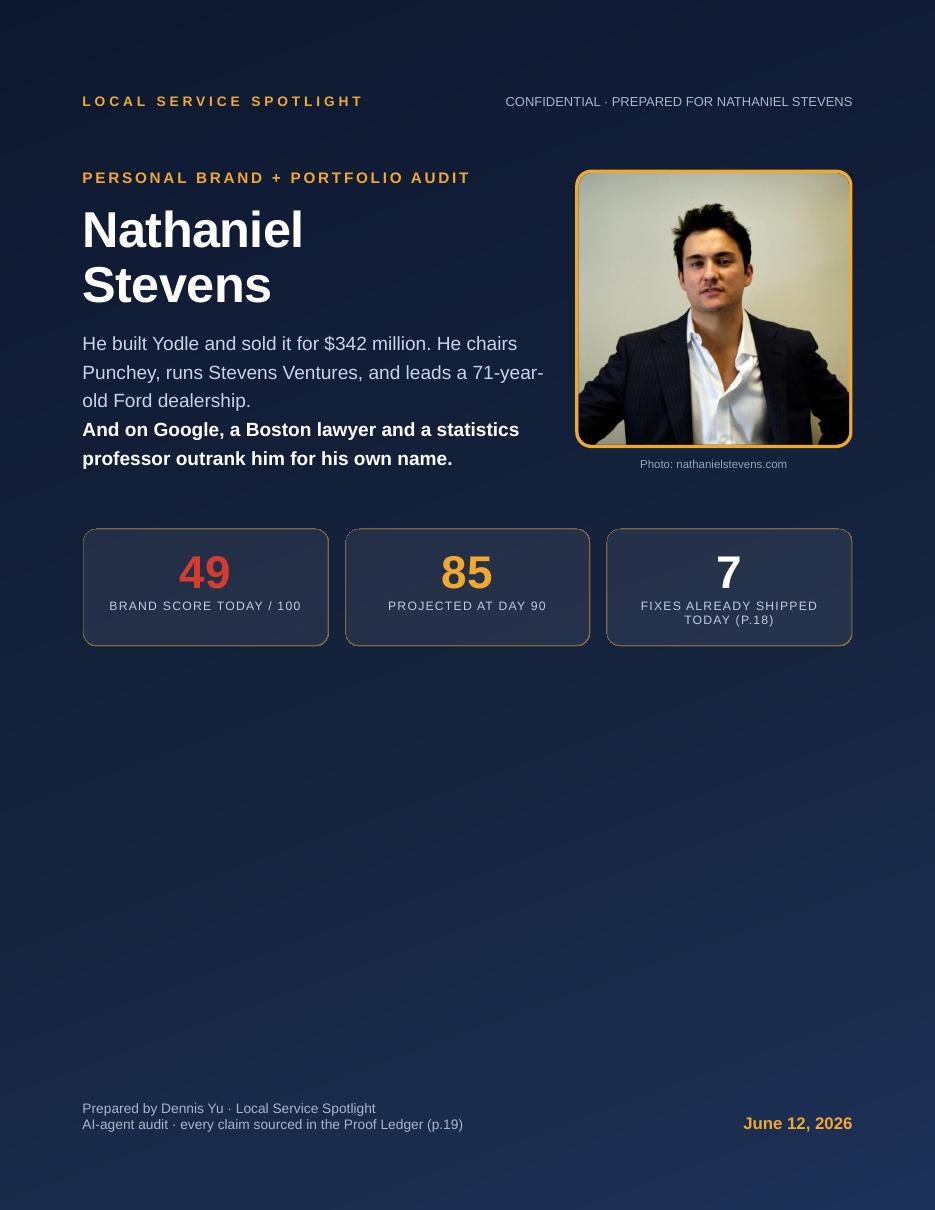
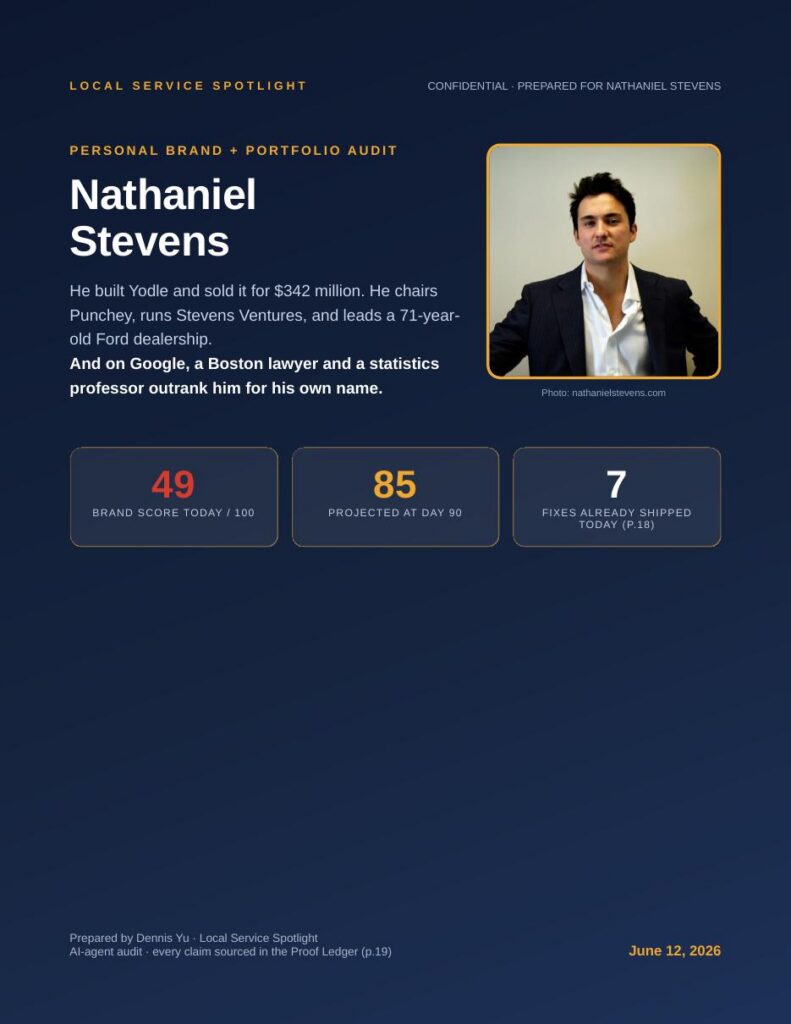
Nathaniel Stevens founded Yodle with a $30,000 loan and sold it to Web.com for $342 million. He chairs Punchey, runs Stevens Ventures, and leads the Ford dealership his family has owned since 1955. Yet when we started, the #1 Google result for his name was a Boston environmental lawyer, his Wikipedia article had been deleted, and the video on his own About page had quietly ceased to exist. This is the full playbook we ran to fix it — written so any operator (or agent) can run the same process for anyone in the same situation.
4
work cycles, each compounding on the last
5,000+
words of sourced founder content added
19
schema FAQ answers separating him from 6 namesakes
When to run this playbook — recognize the pattern
This is a specific archetype, and it is more common than you would think: a person with overwhelming real-world credentials and a weak, fragmented, or eroding digital identity. You are looking at this situation when you see most of these signs:
- They do not rank #1 for their own name — namesakes (a lawyer, a professor, an actor) outrank them, sometimes from far weaker domains.
- Assets are disappearing: a deleted Wikipedia article, a deleted YouTube channel, dead embeds, social links pointing to 404s.
- Google holds duplicate, untyped entities for them and their companies (no Knowledge Panel).
- Their entity home is thin — a few pages, no schema, no real content depth, dated design.
- They own search demand they rank nowhere on — e.g., the name of a company they founded that still gets thousands of searches a month.
- Their backlink profile is thin or polluted with spam.
If that is your subject, the rest of this document is the exact sequence to fix it.
The framework
Every personal-brand build runs on the same four-stage BlitzMetrics model. Each stage is a precondition for the next:
| Stage | What it means |
|---|---|
| 1. Entity Home | One canonical site you control that states, in machine-readable form, who the person is and everything they own. This becomes their replacement Wikipedia. |
| 2. Knowledge Panel | Corpus consistency until Google types the entity and merges the duplicate fragments. Earned, not filed — you create the conditions. |
| 3. Content Factory | A steady cadence of sourced content on the person’s own land, targeting the demand they already have authority for. |
| 4. Dollar-a-Day | Amplify the proof to lookalike audiences at $1/day per asset, compounding through retargeting. |
Phase 0 — Diagnose before you touch anything
You cannot fix what you have not measured. Pull the current reality with these tools — each maps to a specific question:
| Question | How to answer it |
|---|---|
| Who ranks for their name? | Ahrefs SERP overview + a manual incognito search. Identify every namesake on page one. |
| How fragmented is their entity? | Google Trends entity autocomplete returns Knowledge-Graph IDs (KGMIDs) with no API key — count the duplicates for the person and each company. |
| What demand do they own but miss? | Ahrefs keyword volumes for the companies/products they founded. The founder can always out-rank aggregators on intent — once a page exists. |
| What broke or vanished? | Crawl their site for embeds and social links; verify each. (The dead About video here was found by querying YouTube’s oEmbed endpoint, which returned 404 for both the video and its entire channel.) |
| Is the link profile clean? | Ahrefs referring domains, sorted by DR. Spam-seller storefronts at the top = a disavow job. |
| What facts can you actually prove? | Primary sources only — SEC filings for exits, press archives, the company’s own pages. Build a proof ledger as you go. |
For Nathaniel this produced the scorecard: 49/100 — ranks #3 for his own name (behind a DR-14 lawyer and a statistics professor), 9 duplicate KGMIDs, a deleted Wikipedia article and YouTube channel, a spam-polluted link profile, and 1,207 monthly searches for “yodle” that his site captured none of.
Phase 1 — Stop the bleeding (Cycle 1)
- Fix the vanishing assets first. Replace dead embeds with live, verified ones (we confirmed the replacement video via oEmbed before publishing), and repoint every dead social link sitewide. A site sending crawlers to 404s is actively shrinking the entity.
- Wire the identity graph. Add
PersonJSON-LD to the home and About pages with the full discriminating attributes — legal name, birth date and place,alumniOf,award,jobTitle,worksFor,knowsAbout, and a completesameAsarray (every real profile + every company). These attributes are what let Google tell your person apart from the namesakes. - Rebuild the entity home to a credible standard. Hero with the one-line story, a stat band of the hard numbers, a press strip, per-company sections, and clear calls to action. It must look like it belongs to the person it describes.
- Document everything in a sourced audit. Every claim tied to a primary source, with the 90-day plan. This is the artifact that aligns the client and proves the work.
Phase 2 — Consolidate the entity (Cycle 2)
- Own the demand you already have authority for. The single highest-leverage page was the founder’s first-person history of the company he sold — the live Yodle inside-story page — built to capture the 1,207/mo “yodle” searches no aggregator can outrank him on. Then deepen every company page — Punchey, Stevens Ventures, and Stevens Auto Group — from a stub into a real, sourced account (3× the depth: leadership, portfolio with outcomes, the thesis).
- Disambiguate explicitly. Add a “Which [Name]?” FAQ block to the homepage — in both visible copy and
FAQPageschema — that states plainly the person is not the lawyer, the professor, or the actor. You are handing Google the discriminators it needs to collapse the duplicate fragments. - Anchor to entities Google already trusts. Add
Organization(andAutoDealer, etc.) schema to each company page, naming the person as founder/role and pointing at the company’s existing healthy Knowledge-Graph node. “Founder of [a typed, 15-year-old entity]” is the strongest hook to pull a person out of topic purgatory. - Run the content factory + internal mesh. Publish first-person essays targeting the other owned keywords — “Why I Came Back to Run Stevens Ford” and “The Operating Layer of Local Business” — and wire reciprocal internal links: entity home ⇄ company pages ⇄ press ⇄ articles.
- Tune on-page SEO everywhere. Keyword-mapped titles, meta descriptions, and Open Graph tags on every page and post.
Phase 3 — Refine until it is right (Cycle 3)
Run this as a QA loop — render every page, inspect, fix what is weaker than it should be, re-check, repeat:
- Authorship and E-E-A-T. Make sure every article is attributed to the person, not a generic “admin” account — in the visible byline and the Article schema’s
authorentity. Author identity is a real ranking and trust signal. - Real share images on every URL. No page should fall back to a generic default Open Graph image. Set an appropriate, distinct featured image per page and post so every share looks intentional.
- Curate the visual assets. Audit the photo gallery and remove anything off-brand (here: a beach shot and a nightclub photo on a nine-figure founder’s site). The brand is only as serious as its weakest visible asset.
- Polish the metadata. Trim over-long titles, fix miscategorized posts, confirm canonical tags and the sitemap.
- Surface the best work from the top page. Add a “Latest Writing” section to the homepage linking the flagship articles, so the highest-authority page passes equity to the pieces that need to rank.
The discipline that makes it safe: verify before you vouch. Every claim traces to a primary source — Ahrefs for the SERP and link data, YouTube oEmbed for the dead-channel forensics, SEC 8-K filings for the $342.4M and $210M exits. And whatever you cannot verify, you refuse to assert: here, there is no film-production entity under his name (the IMDb and talent-agency “Nathaniel Stevens” listings are different people), so the “media” story is told only through Stevens Ventures’ documented technology-and-media mandate. Wrong-entity merges are expensive to unwind; clean entities are built on facts, not flattery.
Phase 4 — Off-property & measure
Two kinds of work live outside the entity home and need the owner’s access:
- Reclaim owned authority links: the person’s other properties (company sites, fund site, bios) should each link the entity home — these are free, high-authority editorial links you already control.
- Clean the link profile: file a spam disavow in Search Console, submit a fresh sitemap.
Then measure on a loop: name-SERP composition, KGMID count (target: many → one), ranking keywords, legitimate referring domains, Knowledge-Panel trigger, and AI-search citations (“who is [name]” in ChatGPT/Perplexity).
What it produced for Nathaniel
| Dimension | Before | After 4 cycles |
|---|---|---|
| Flagship “Yodle” page | did not exist / ~399 words | ~1,200-word founder history |
| Structured data | none | Person, Organization ×3, AutoDealer, FAQPage ×5 (19 answers) |
| Namesake disambiguation | none | homepage “Which Nathaniel Stevens?” block |
| Authorship & share images | “admin” byline, generic OG image | correct author entity, distinct image per URL |
| Homepage content surfacing | company links only | + a “Latest Writing” section linking the flagship essays |
| Brand score | 49 / 100 | 85 projected at day 90 |
And the engine keeps running. In June 2026 we captured a two-hour in-person founder interview — stories and entity-defining facts on camera — now in production as a wave of videos and on-site articles, each to be published with VideoObject schema and wired into the same entity mesh. A Knowledge Panel is a compounding outcome, not a one-time fix; every consistent surface makes the next one land harder.
Proof ledger
$342.4M Yodle exit & $210M Opcity exit — SEC 8-K filings. Bio facts — deleted-Wikipedia mirror cross-checked against press. DR, keywords, SERP, referring domains — Ahrefs API. Nine duplicate KGMIDs — Google Trends entity autocomplete. Dead About video & channel — YouTube oEmbed 404s, verified three times. Punchey leadership & David Olk board seat — punchey.com and the PR Newswire release. Every number in the audit maps to one of these.
The Deliverables
The full 21-page audit documents the forensics, the nine duplicate entities, the spam-link autopsy, and the 90-day plan. See the rebuilt entity home for the playbook in production.
Audit #11 in the Local Service Spotlight series, now in its fourth build cycle — following Nathaniel’s profile feature and this week’s audits of Chuck Thokey, George Leith, Jim Klauck, Marko Sipila, and Tom Shipley. Same method every time: diagnose with primary sources, build the entity home, consolidate, refine, measure — then come back and make it better.
Local Service Spotlight · Free Quick Audit
Want this kind of analysis for your business? Get your free audit.
In about 5 minutes you’ll get a real diagnosis of where you stand in Google and AI search — plus a prioritized action plan tied to revenue, not vanity metrics. Prescription before diagnosis is malpractice, so we start with your data. Then you decide: implement it yourself (even with your own AI agents), or have our trained AI Builders do it for you.
Get my free audit →
Originally published .
Dennis Yu
Dennis Yu is the CEO of Local Service Spotlight, a platform that amplifies the reputations of contractors and local service businesses using the Content Factory process. He is a former search engine engineer who has spent a billion dollars on Google and Facebook ads for Nike, Quiznos, Ashley Furniture, Red Bull, State Farm, and other brands.
Dennis has achieved 25% of his goal of creating a million digital marketing jobs by partnering with universities, professional organizations, and agencies. Through Local Service Spotlight, he teaches the Dollar a Day strategy and Content Factory training to help local service businesses enhance their existing local reputation and make the phone ring.
Dennis coaches young adult agency owners serving plumbers, AC technicians, landscapers, roofers, electricians, and believes there should be a standard in measuring local marketing efforts, much like doctors and plumbers must be certified. He has appeared on 353 podcasts with 619 credited episodes — see the full list of his podcast appearances.