
 by
by
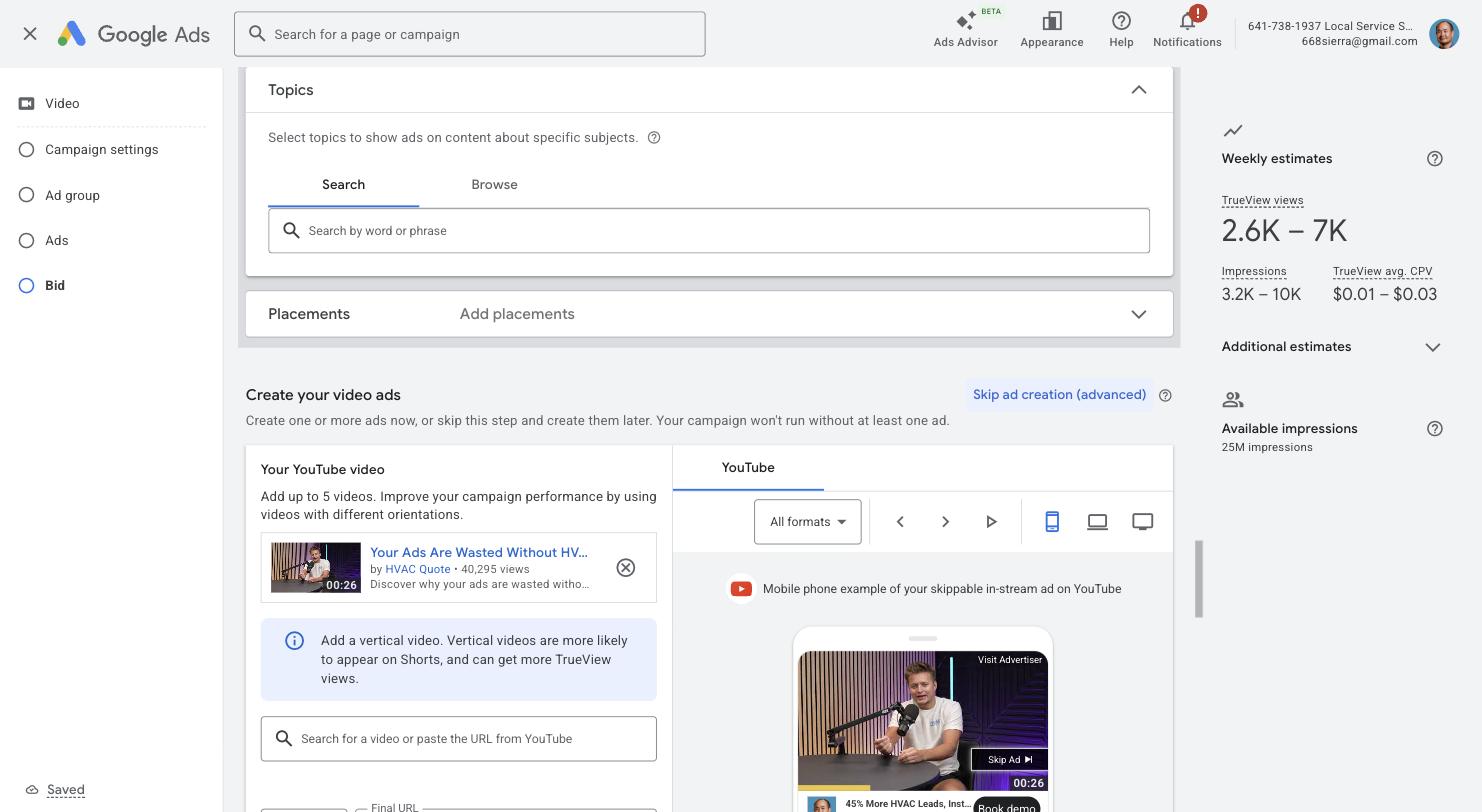
I’ve been running YouTube Boost promotions on the HVAC Quote channel for months. I’d spent $1,000–$2,000 over the last year, one-click boosting videos whenever Studio suggested it, and getting plenty of views at a good cost. Then I had to admit something uncomfortable: I had no idea whether any of those views were actual HVAC business owners or just homeowners watching furnace repair content. Boost doesn’t let you target by job title, industry, or buying intent. You pick a video, a country, and a budget — that’s it.
That’s fine for brand awareness. It’s a disaster for B2B SaaS. HVAC Quote — the tool Marko Sipila built to help HVAC contractors show instant quotes on their websites — has a very specific buyer: the owner of an HVAC contracting company. There are roughly 100,000 of them in the United States. There are also roughly 130 million US households with an HVAC system. If I’m targeting “HVAC” broadly, 99% of the audience is the wrong side of the marketplace.
So we rebuilt everything inside Google Ads, where we actually have micro-targeting levers. Here’s exactly what we did, why we did it, and how we got the inventory pool from 3.3 billion weekly impressions down to 25 million — a 132x reduction that tells us we’re finally hitting contractors instead of consumers.
The Problem: Broad Targeting Kills B2B SaaS
The math is brutal. HVAC Quote’s CAC is around $2,000. Cost of acquisition before the sales rep takes over is roughly $700. We were willing to spend $6/day on this campaign to prove the targeting works before scaling to $100/day. At $6/day that’s $180/month, which means the targeting has to be tight enough that nearly every view is a potential buyer.
When we first built the campaign, Google estimated 3.3 billion weekly impressions in the inventory pool. That’s not a campaign — that’s a billboard in Times Square. Any B2B marketer who sees a 10-figure impression estimate should stop and rebuild. You want your forecast to be uncomfortably small. If the pool is the size of a country, you’re targeting a country.
Step 1: Audit What Was Already Working on Boost
Before spending another dollar we pulled all nine historical Boost promotions from the HVAC Quote channel and calculated CPV and view-through rate for each. One video was the clear winner: Your Ads Are Wasted Without HVAC Quote Tool — 27 seconds, $0.0087 CPV, 43.8% VTR. That’s the creative we ported into Google Ads, because it had already proven it holds attention on cold YouTube traffic.
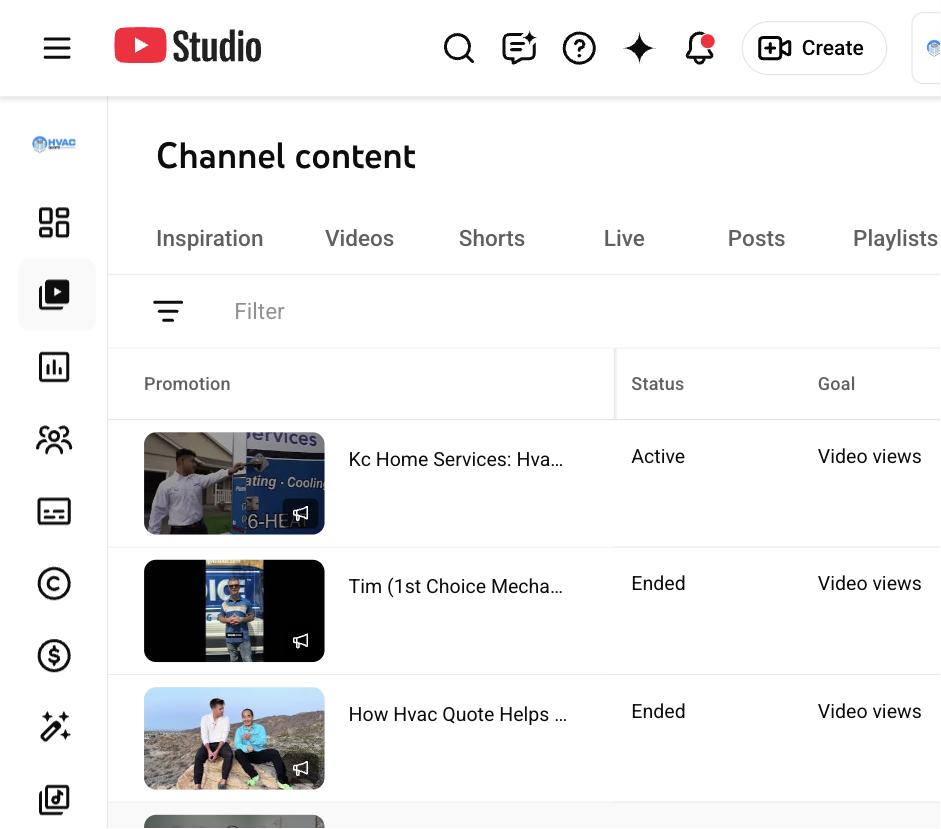
Reusing a proven Boost video for a Google Ads cold campaign is a trick Marko and I have been refining for months. He ran a parallel experiment turning conference footage into Boost creative — that’s how HVAC Quote went from zero to 300 customers.
Step 2: Build a Custom Segment Around Real Contractor Behavior
This is the single most important move in the whole campaign. Instead of using a pre-built “in-market” audience (which is almost always consumer-leaning), we built a custom intent segment called “HVAC Supply House Buyers + Brand Intent” using two signals that only real HVAC contractors produce.
Keywords only contractors search
- hvac price book
- hvac flat rate software
- servicetitan alternative
- hvac dispatch software
- comfort advisor training
- hvac business coaching
- hvac lead generation
- service mvp joe crisara
- nexstar network
A homeowner never searches any of those. Only an owner or GM does.
URLs only contractors visit
- supplyhouse.com, ferguson.com, johnstonesupply.com
- carrierenterprise.com, lennoxpros.com, baker-dist.com, munchsupply.com
- goodmanmfg.com, daikincomfort.com
- servicetitan.com, housecallpro.com
- acca.org, ahrexpo.com, servicemvp.com
Supply houses don’t sell to consumers — you need a contractor license to open a wholesale account. Trade associations like ACCA and AHR Expo are industry-only. ServiceTitan and Housecall Pro are SaaS tools only contractors use. Google combines those keyword + URL signals to find people whose behavior matches the profile. That’s the filter.
Step 3: Layer Demographic Reality on Top
HVAC contracting ownership in the US is overwhelmingly male, 35–64, above median household income. We set:
- Gender: Male only (unchecked Female and Unknown)
- Age: 35–64 (unchecked Unknown)
- Household income: Top 10–30% (unchecked Unknown)
Unchecking “Unknown” is the non-obvious move. Google defaults to including Unknown demos, which is a massive leaky bucket of VPN users, bots, and low-signal profiles. For a $6/day B2B campaign you want high-signal humans only.
Step 4: Force AND Logic With Content Keywords
Here’s the trick most YouTube advertisers miss. Audience + demographics in Google Ads defaults to OR logic — the system shows your ad to anyone in the audience or matching the demos. To force AND logic (audience AND topical context), you add content keywords that constrain where the ad is allowed to run.
We added 25 content keywords covering the HVAC business software universe: hvac business, hvac marketing, hvac sales, hvac technician, hvac contractor, grow hvac business, hvac lead generation, hvac software, hvac pricing, hvac replacement, hvac install, hvac service call, comfort advisor, servicetitan, housecall pro, joe crisara, nexstar, hvac company owner, hvac dispatch, hvac flat rate, hvac estimate, hvac quote, home services business, plumbing hvac business, hvac business growth.
Now the ad only runs when: (audience = custom HVAC supply segment) AND (video context = HVAC business/software topic) AND (demo = male, 35–64, top 30% HHI). Three filters stacked.
Step 5: Remove the Leaky Buckets
- Deleted the “General Contracting & Remodeling Services” in-market segment — full of homeowners planning renovations.
- Unchecked GDN video partners — off-YouTube placements are lower quality for B2B.
- Turned off audience expansion — Google’s “optimized targeting” helpfully loosens your filters without asking.
- Unchecked Shorts placement — Shorts audiences skew young and consumer.
This is the same discipline we wrote about for roofing B2B: Google’s default audiences are built for consumer scale, not B2B precision. You have to strip them out one by one.
Step 6: Lock the Creative and the Bid
- Video: Your Ads Are Wasted Without HVAC Quote Tool (proven $0.0087 CPV / 43.8% VTR)
- Formats: Skippable in-stream + In-feed discovery
- Headline: “45% More HVAC Leads, Instantly”
- Long headline: “Turn HVAC Website Visitors Into Booked Jobs With Instant Online Quotes”
- Description: “Show upfront pricing on your site. Used by 100+ HVAC companies. Book a free demo.”
- CTA: Book demo
- Business name: HVAC Quote
- Final URL: go.hvacquote.ai
- Bid: Target CPV $0.03 (roughly 3x the Boost winner — expected, because micro-targeted inventory is scarcer)
- Budget: $6/day, Standard delivery
- Geo: United States only, English
Step 7: Verify the Inventory Pool Actually Shrank
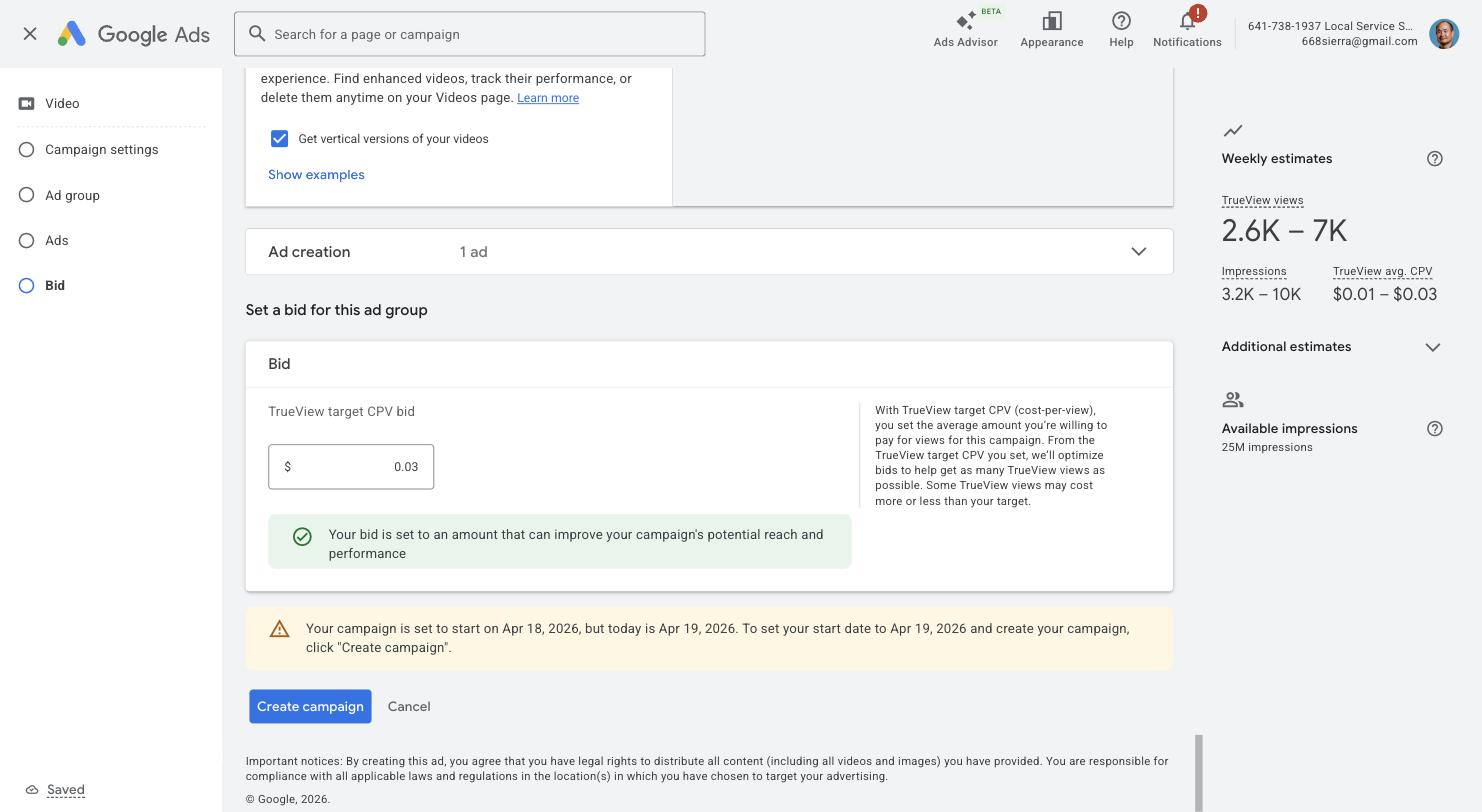
After all of the above, the forecast dropped from 3.3B to 25M weekly impressions and 2.6K–7K weekly views. That’s a 132x reduction. 25M is still a healthy pool — plenty of room to spend $6/day — but it’s bounded by real B2B signals rather than “anyone watching anything HVAC-ish.” If the pool had still been in the billions, we would have kept tightening.
Step 8: Fix the Conversion Plumbing
None of this matters if we can’t measure who books a demo. We audited go.hvacquote.ai and found the Google Ads tag firing but no conversion event on demo bookings, and no GA4 at all. We drafted an email to George Paladichuk — Marko’s developer — with a four-step ask: create the conversion action in Google Ads, install the event snippet on the booking confirmation page, install GA4, and ping back so we can flip the campaign from Target CPV to Max Conversions once there’s conversion data flowing.
George is the right person for this because he runs NaiL AI and knows exactly how to wire pixels cleanly on a production site.
Step 9: Keep Boost for Mid-Funnel Retargeting
Going forward, Boost isn’t our top-of-funnel tool anymore — it can’t micro-target. Instead, Boost becomes a mid-funnel amplifier: we boost videos that earned high retention among viewers the Google Ads cold campaign already qualified. Targeting happens upstream; Boost just increases frequency to warm prospects. This is the exact pattern Marko has been running as a Dollar-a-Day YouTube engine, just now layered on top of a proper B2B cold audience.
Why This Matters for Every B2B SaaS Advertiser
The reason B2B SaaS campaigns fail usually isn’t bad creative, bad landing pages, or even bad bids. It’s broad audiences. The moment you accept a multi-billion-impression inventory pool, 95%+ of your spend hits the wrong person. For HVAC Quote the wrong person is a homeowner; the right person is a contractor who buys from Ferguson, belongs to ACCA, and has researched ServiceTitan.
We built the campaign around those specific behaviors, forced AND logic with content keywords, stripped the leaky buckets, and watched the inventory pool collapse to a realistic B2B size. At $6/day we’re not trying to hit the 1,000-customer goal with this campaign alone — we’re proving the targeting converts. Once George wires up the conversion pixel and we see CPA data, we scale from $6 to $100/day with confidence that every incremental dollar is landing on an HVAC business owner, not a homeowner with a broken compressor.
This is the Dollar-a-Day strategy applied to B2B SaaS: start tiny, tune the targeting until the signal is clean, then scale only what’s proven.
Your Turn
If you’re running B2B ads and your Google forecast shows billions of weekly impressions, stop. Rebuild with a custom intent segment based on wholesale-buying behavior, trade-association browsing, and competitor-software research. Layer content keywords to force AND logic. Uncheck Unknown everywhere. Your pool should feel uncomfortably small. That’s the point.
Want help building a B2B campaign like this for your own software? Book a call with BlitzMetrics and we’ll walk through your current targeting, forecast, and conversion setup together.
Originally published .
Dennis Yu
Dennis Yu is the CEO of Local Service Spotlight, a platform that amplifies the reputations of contractors and local service businesses using the Content Factory process. He is a former search engine engineer who has spent a billion dollars on Google and Facebook ads for Nike, Quiznos, Ashley Furniture, Red Bull, State Farm, and other brands.
Dennis has achieved 25% of his goal of creating a million digital marketing jobs by partnering with universities, professional organizations, and agencies. Through Local Service Spotlight, he teaches the Dollar a Day strategy and Content Factory training to help local service businesses enhance their existing local reputation and make the phone ring.
Dennis coaches young adult agency owners serving plumbers, AC technicians, landscapers, roofers, electricians, and believes there should be a standard in measuring local marketing efforts, much like doctors and plumbers must be certified. He has appeared on 353 podcasts with 619 credited episodes — see the full list of his podcast appearances.