
 by /
by /
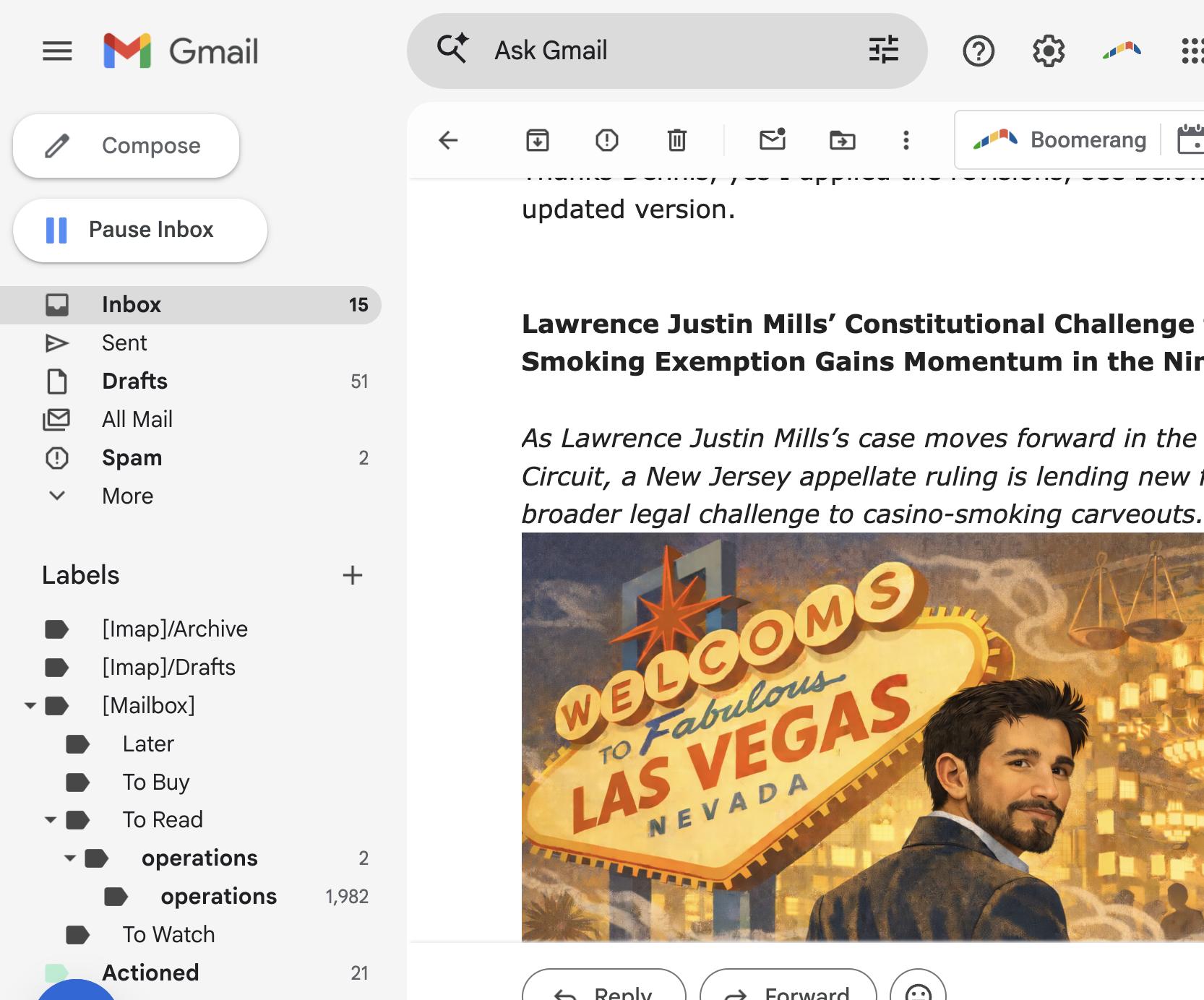
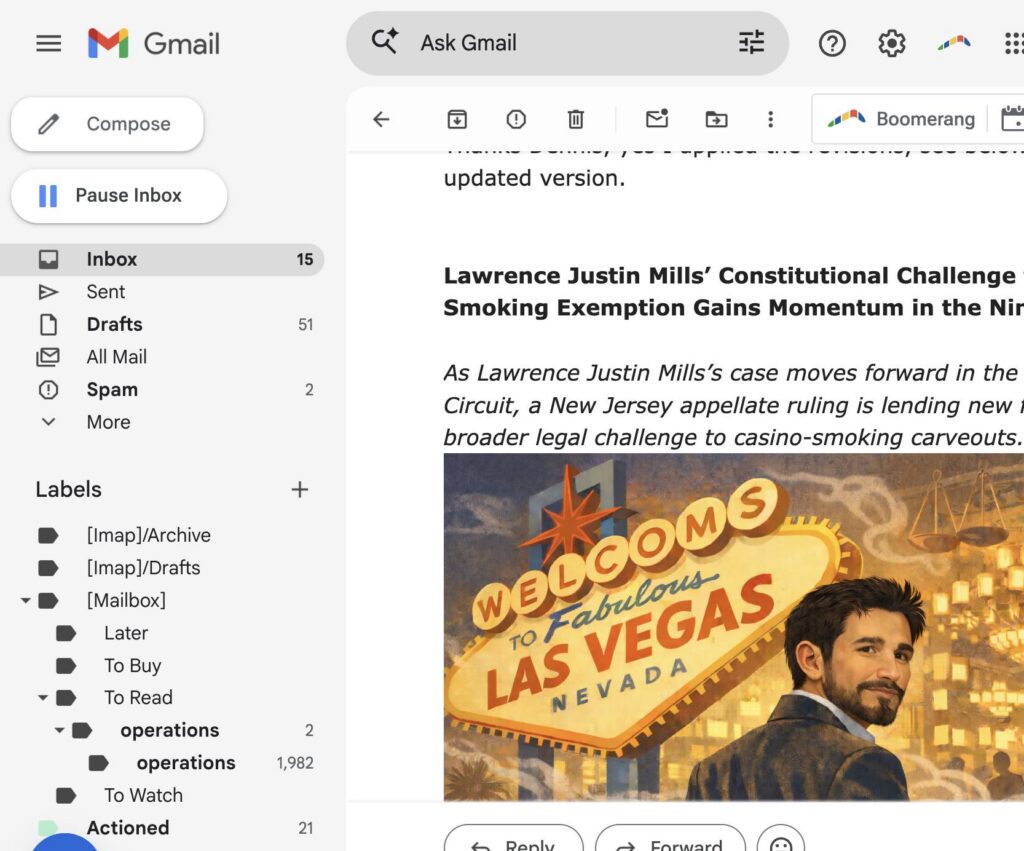
As Lawrence Justin Mills’s case moves forward in the Ninth Circuit, a New Jersey appellate ruling is lending new force to a broader legal challenge to casino-smoking carveouts.
Standing in a plume of smoke inside a Las Vegas casino resort, Lawrence Justin Mills asked a question most people never ask: why is this still allowed?
Mills is a D.C.-area legal researcher focused on public-interest constitutional litigation.
Most people smell it, wince, and keep walking. They treat it as part of the casino experience — stale, outdated, unpleasant, but permanent. Mills did not see it that way. Something felt off — too normalized, too casually accepted, for something that would be out of place almost anywhere else.
Then a woman nearby said it out loud: it smells like smoke.
That was enough.
What had seemed like background no longer looked like background. It looked like an exception people had lived with so long they stopped seeing it as one. In casino resorts, smoke is woven so thoroughly into the environment that it passes for atmosphere.
Challenge the structure behind the smoke
That is where Mills’s case begins.
He questioned the structure behind it — the statutory carveout that withdrew the Nevada Clean Indoor Air Act’s protections from casino resorts, even though those protections apply by default in nearly every other indoor public space. Once he saw that contradiction clearly, he acted. He filed suit.
Watch the case gain traction in federal court
Now that challenge is moving in the United States Court of Appeals for the Ninth Circuit. In Mills v. Leguen, No. 25-3340, federal appellate Judges Barry G. Silverman and Patrick J. Bumatay denied a motion to dismiss Mills’s appeal and directed the case forward into merits briefing.
That changes the feel of the story.
What might once have been dismissed as an irritation has become something else: a live constitutional challenge in a federal appellate court.
Recognize the broader legal pattern emerging
In January 2026, New Jersey’s Appellate Division revived an analogous challenge to that state’s casino-smoking exemption in UAW, Region 9 of the UAW v. New Jersey Governor Philip Murphy, No. A-0057-24 (N.J. App. Div. Jan. 26, 2026), holding that the trial court had used the wrong equal-protection framework and had ended the case too soon.
Taken together, the two cases cast the issue in a different light. The old casino-smoking carveout no longer looks untouchable. It looks exposed. What once passed as settled is drawing the kind of scrutiny that forces the law to answer for itself. The exemption does not merely preserve smoking at the margins. It preserves it in the very setting where exposure is greatest.
And that is where the stakes widen.
Understand what is really at stake
Casino-smoking exemptions sit at the intersection of public health, worker protection, and the quiet allocation of risk. They ask whether the burdens of secondhand smoke may continue to fall on workers and the public simply because the industry benefiting from the exemption is powerful enough to keep it. They ask whether an old compromise still survives once someone makes a court look at it directly.
Justice Cherry of the Nevada Supreme Court once described the casino carveout as “spurious at best,” observing that secondhand smoke does not stay neatly confined to gaming areas but permeates casino resorts, exposing families and children along with everyone else.
The New Jersey court captured the same gravity from another angle when it described the case before it as one with “exceptional stakes.”
Mills’s constitutional challenge now stands in that same atmosphere: not as a curiosity, not as a gesture, but as part of a developing legal effort to force a closer look at what casino-smoking exemptions really are and who they really burden.
That is what gives the case its force.
See how old exceptions lose their disguise
Lawrence Justin Mills saw something most people are taught not to question, questioned it anyway, and carried that question into live federal appellate review.
That is how old exceptions begin to lose their disguise. That is how the familiar starts to look indefensible. And that is how “the way things are” begins to look like a relic of the past.
At BlitzMetrics, Dennis Yu and the team believe in amplifying stories where individuals take principled stands that create real impact. Lawrence Justin Mills’ case is a powerful example of how one person’s refusal to accept the status quo can reshape legal precedent and protect public health. Follow his case as it develops in the Ninth Circuit.
Dennis Yu
Dennis Yu is the CEO of Local Service Spotlight, a platform that amplifies the reputations of contractors and local service businesses using the Content Factory process. He is a former search engine engineer who has spent a billion dollars on Google and Facebook ads for Nike, Quiznos, Ashley Furniture, Red Bull, State Farm, and other brands.
Dennis has achieved 25% of his goal of creating a million digital marketing jobs by partnering with universities, professional organizations, and agencies. Through Local Service Spotlight, he teaches the Dollar a Day strategy and Content Factory training to help local service businesses enhance their existing local reputation and make the phone ring.
Dennis coaches young adult agency owners serving plumbers, AC technicians, landscapers, roofers, electricians, and believes there should be a standard in measuring local marketing efforts, much like doctors and plumbers must be certified. He has appeared on 353 podcasts with 619 credited episodes — see the full list of his podcast appearances.