
 by
by
How two practitioners with different entry points to digital marketing arrived at the same conclusion about Knowledge Panels, entity recognition, and owning your narrative in search and AI.
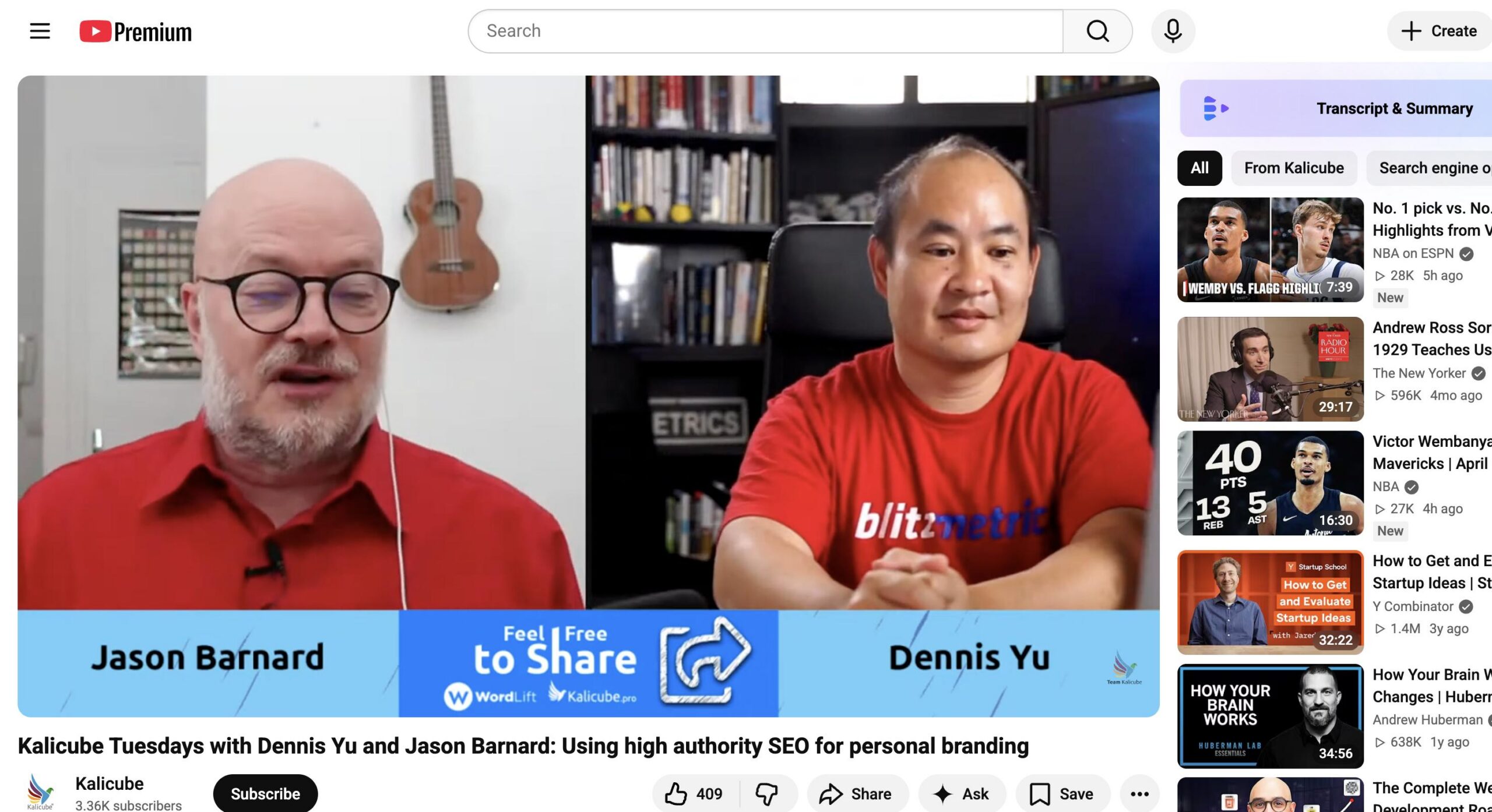
Dennis Yu — former Yahoo search engine engineer, BlitzMetrics CTO, and Facebook advertising pioneer — has appeared on Jason Barnard’s Kalicube Tuesdays podcast multiple times, endorsed Jason’s book on Knowledge Panels, and references Jason’s work regularly in client conversations and podcast interviews. Jason Barnard is the founder and CEO of Kalicube, the company behind the Kalicube Process — a three-phase methodology for managing how Google and AI platforms understand, represent, and recommend a brand. He is widely recognized as “The Brand SERP Guy,” and Google’s own Senior Search Analyst John Mueller has said he doesn’t know anyone externally with as much insight into Knowledge Panels. This article documents their relationship, what Dennis has learned from Jason’s approach, and where their methods converge.
How Dennis and Jason first connected
Dennis and Jason run in overlapping circles — conferences, podcasts, and the broader SEO and digital marketing community. Their first formal collaboration was on Kalicube Tuesdays, Jason’s weekly video series where he interviews experts in digital marketing, SEO, and brand management. That series now has over 400 episodes and has become a foundational resource for understanding how brands can optimize their presence across Google and AI platforms.
Dennis appeared as a guest to discuss personal branding strategies and how high-authority SEO intersects with social media engagement. The conversation covered rebuilding a brand’s presence in Google’s Knowledge Graph, using WordLift to push entities into the Knowledge Graph, how to bring personal branding and high-authority SEO together, and how Facebook ads drive search rankings without traditional SEO tactics.
In a follow-up episode, they dug deeper into how Facebook activity affects search engine results pages. That episode — “Facebook’s Hidden Impact on SERPs” — covered Dennis’s Brand SERP and Knowledge Panel, his Search Generative Experience result, the Dollar a Day engagement strategy, and how social shares create corroborative signals that Google picks up on.
In April 2025, Jason reached out to Dennis directly, noting that Dennis talks about Knowledge Panels frequently on podcasts and that Dennis’s own Knowledge Panel scores were among the best Kalicube had analyzed across their dataset. Jason sent Dennis an AI audit report generated by Kalicube’s proprietary system — the same tool backed by billions of data points that Kalicube uses with its premium consulting clients. Dennis responded by noting how refreshing it was that Jason — the founder and CEO — responded personally, calling it a reflection of his genuine care and expertise as a founder.
What makes Jason Barnard’s personal branding exceptional
Jason Barnard has built one of the most deliberately constructed personal brands in the digital marketing industry. His approach is worth studying because he practices exactly what he teaches, and the results are visible in Google and AI search results for anyone who checks.
His visual consistency is unmistakable. Jason wears a red shirt in virtually every public appearance — podcast interviews, conference keynotes, headshot photos, social media profiles. This is not an accidental style choice. It is deliberate visual entity signaling across every platform where his image appears. When Google, ChatGPT, or Perplexity encounters images of Jason Barnard, the red shirt creates an immediately identifiable visual pattern that reinforces entity recognition.
Jason Barnard’s personal brand site serves as the canonical hub for his entity. It is structured with clear entity information — his role as CEO and Founder of Kalicube, his career as a serial entrepreneur, award-winning innovator, keynote speaker, and bestselling author. The site includes testimonials from industry leaders, consistent messaging about his authority in Digital Brand Intelligence, and schema markup that connects every piece to the broader Knowledge Graph. This is the kind of personal brand site architecture that the BlitzMetrics team builds for clients as part of the process for triggering a Google Knowledge Panel.
Jason wrote the book — literally. His publication Your Instruction Manual for Google Knowledge Panels, released in April 2025, distills the Kalicube Process into a 17-point checklist for triggering, managing, and expanding a Knowledge Panel. Dennis endorsed the book, writing that Jason’s 17-point checklist is the simplest and most fun way to methodically get a Google Knowledge Panel and that Jason is the top practitioner he knows when it comes to Brand SERPs. Dennis added: “He’s also showing us how to keep up with AI + SEO changes — to use AI the right way in teaching Google who we are.”
Where Dennis and Jason’s approaches converge
Dennis and Jason entered digital marketing from completely different directions. Dennis spent years as a search engine engineer at Yahoo before becoming one of the world’s foremost Facebook advertising experts, training thousands of marketers, and working with brands from the NBA to Rosetta Stone. Jason built his authority through deep specialization in Brand SERPs and entity SEO, accumulating billions of data points through Kalicube’s proprietary technology.
Despite these different starting points, their conversations on Kalicube Tuesdays revealed they have arrived at remarkably similar conclusions about how digital visibility actually works.
During their conversation about Facebook’s impact on search results, Dennis explained how he ranked number two in Google for “Facebook advertising” — directly behind Facebook itself — without doing anything he would categorize as traditional SEO. He spoke on TV, shared his knowledge, wrote articles, and let the organic footprint build naturally. Jason’s analysis of Dennis’s Brand SERP and Knowledge Panel showed exactly why this worked: Dennis’s digital footprint was so consistent and corroborated across multiple platforms that Google confidently displayed his information even without a formal Knowledge Vault anchor.
This is the principle at the heart of both Jason’s Kalicube Process and BlitzMetrics’ approach to Digital Plumbing: consistency and corroboration across trusted sources build algorithmic confidence. Neither Dennis nor Jason invented this principle, but they arrived at it independently — Dennis through spending over a billion dollars on Facebook and Google ads for Nike, Quiznos, Ashley Furniture, Red Bull, and State Farm, and Jason through over a decade of entity SEO research and knowledge panel optimization.
How Jason’s framework deepened Dennis’s understanding of Knowledge Panels
Dennis has been transparent about where Jason’s expertise strengthened his own. During their podcast conversation, Dennis asked Jason for confirmation on specific technical questions — something Dennis rarely does in his own domain of Facebook advertising, where he is the one everyone else asks.
When discussing how Google treats social profiles versus business pages, Dennis turned to Jason for clarification, saying he believed Google treats them the same but wanted confirmation from someone who had studied it deeply. When the conversation shifted to Brand SERP click-through rates and whether organic CTR on branded terms exceeded 20 percent, Dennis sought Jason’s data-backed perspective rather than relying on his own assumptions.
Dennis told Jason directly that his consistency and niche expertise in Brand SERPs meant Dennis did not need to be told Jason was an authority — the body of work spoke for itself. In Dennis’s words, the credibility was so deeply established through years of consistent, niched-down content that no pitch was necessary. That is the difference between manufactured authority and earned authority, and it illustrates why the Content Factory process at BlitzMetrics emphasizes building real reputation signals over fabricating them.
Jason’s Kalicube Process — built around three phases of Understandability, Credibility, and Deliverability — gave Dennis a structured framework for concepts he had been practicing intuitively. Dennis’s Dollar a Day strategy of boosting high-engagement content creates exactly the kind of corroborative signals that Jason’s process requires in the Credibility phase. When a piece of content achieves 10 percent engagement and gets shared organically — Dennis’s research shows a share is worth 13 times a like because Facebook treats it as a new post — those signals ripple through search and AI systems as third-party validation.
What their email exchange reveals about complementary approaches
When Jason reached out in April 2025 with the Kalicube AI audit report, Dennis’s response laid out exactly how the two approaches work in tandem. Dennis explained that the BlitzMetrics angle on Knowledge Panels is as a stepping stone to helping local service business owners — plumbers, landscapers, dentists — collect stories that make them the local authority. Once the digital footprint is built through a personal brand site, a tuned-up business site, and content repurposed across social media, BlitzMetrics runs LSA and Dollar a Day campaigns that make the phone ring with measurable, incremental revenue tracked in the CRM.
Jason’s approach through Kalicube focuses on training Google and AI to accurately represent a brand. He describes AI platforms as an “untrained salesforce” — ChatGPT, Perplexity, Gemini, and Claude are already having conversations with your prospects 24 hours a day, but without proper training, they fumble the close when someone searches your name and recommend competitors when asked who is the best in your industry.
The difference between their approaches is emphasis, not philosophy. Dennis starts with revenue-driving campaigns and uses entity recognition as the foundation that makes those campaigns more effective. Jason starts with entity recognition and uses it to drive revenue by ensuring AI platforms recommend his clients. Both require the same underlying work: consistent messaging, verified profiles, third-party corroboration, and content that demonstrates real expertise to both humans and algorithms.
Specific elements of Jason’s methodology worth studying
Jason’s approach to Brand SERP optimization offers several tactical insights that complement BlitzMetrics’ existing processes for building Knowledge Panels and personal brands.
The Entity Home concept — designating one canonical website as the single source of truth about an entity — maps directly to what BlitzMetrics calls the personal brand site. Jason insists that every social profile, press mention, and third-party reference should point back to this canonical source. This creates a self-reinforcing loop where Google’s confidence in the entity grows with every new corroborating signal. Dennis teaches the same architecture to local service business owners through BlitzMetrics and Local Service Spotlight, where the personal brand site becomes the hub that all other digital properties link back to.
Jason’s three-phase structure of Understandability, Credibility, and Deliverability provides a sequencing framework. Many practitioners try to build credibility before establishing understandability — creating press coverage and podcast appearances before Google even recognizes the entity. Jason’s process insists on getting the plumbing right first: make sure Google understands who the entity is before trying to demonstrate why the entity matters. This sequencing aligns with the BlitzMetrics emphasis on Digital Plumbing as the prerequisite for everything else in the Content Factory.
The red shirt is not just a personal quirk — it is a masterclass in visual entity consistency. When building personal brands for local service business owners through the Content Factory, consistent visual presentation across all platforms creates the same kind of recognizable entity signal that Jason has perfected through years of deliberate practice. It teaches a lesson every entrepreneur can apply: pick a visual anchor and use it everywhere, because algorithms track visual patterns just as they track text patterns.
What this means for local service businesses
The collaboration between Dennis and Jason matters most for the entrepreneurs and local business owners that BlitzMetrics serves. Most plumbers, landscapers, and dentists will never hire a premium Brand SERP consultancy. But the principles Jason has systematized — entity consistency, third-party corroboration, a canonical personal brand site, schema markup that tells Google exactly who you are — are exactly what BlitzMetrics delivers through its scalable Content Factory process and Local Service Spotlight platform.
When Dennis tells a roofer in Phoenix that they need a Knowledge Panel, he is applying the same entity-first philosophy that Jason has spent over a decade refining. The delivery mechanism differs — Jason works with CEOs and high-net-worth individuals through bespoke consulting backed by billions of data points; Dennis works with local service businesses through systematized training and Dollar a Day campaigns — but the core engine is the same.
Both approaches prove the same thing: Google and AI do not care about your ad budget or your follower count. They care about whether they can confidently answer three questions about you. Who are you? Can we trust what we know about you? Should we recommend you to our users? Jason Barnard has built an entire company around answering those questions methodically, and his work has made every Knowledge Panel practitioner — including Dennis — sharper at the craft.
Connect with Jason Barnard and learn more
To learn more about Jason Barnard’s work, explore his company at Kalicube, read the Kalicube article documenting Dennis’s insights on Brand SERPs, or pick up his book on Amazon. Watch his Kalicube Tuesdays series for over 400 episodes of interviews with digital marketing experts. And if you want to see what a masterfully optimized Brand SERP looks like, just Google his name — the red shirt will be hard to miss.
To understand how BlitzMetrics applies these same entity-building principles for local service businesses, read the full guide on Knowledge Panels or learn how the Dollar a Day strategy turns social engagement into search visibility. For a deeper look at how Dennis and Jack Wendt discuss Knowledge Panels and agency scaling at DigiMarCon NYC, watch the conversation below.
Q&A
How did you and Jason Barnard first connect?
Jason and I run in the same circles — conferences, podcasts, and the broader SEO and digital marketing community. Our first formal collaboration was on his Kalicube Tuesdays podcast, where I came on to talk about personal branding, high-authority SEO, and how Facebook ads drive search rankings. We hit it off because we realized we’d been arriving at the same conclusions from completely different directions.
What did Jason teach you about Knowledge Panels that you didn’t already know?
Jason gave me a structured framework for concepts I’d been practicing intuitively. His three-phase approach — Understandability, Credibility, and Deliverability — showed me that sequencing matters. A lot of practitioners try to build credibility before Google even recognizes the entity. Jason insists on getting the plumbing right first, which aligns perfectly with how we think about Digital Plumbing at BlitzMetrics.
Why did you endorse Jason’s book on Knowledge Panels?
Because his 17-point checklist is the simplest and most fun way to methodically get a Google Knowledge Panel. Jason is the top practitioner I know when it comes to Brand SERPs, and he’s also showing us how to keep up with AI and SEO changes — how to use AI the right way in teaching Google who we are. That’s not something you can say about many people in this space.
How does your Dollar a Day strategy complement Jason’s Kalicube Process?
My Dollar a Day strategy boosts high-engagement content — posts that hit 10 percent engagement or higher. When that content gets shared organically, those signals ripple through search and AI systems as third-party validation. That’s exactly what Jason’s process requires in the Credibility phase. So my ad strategy feeds the corroborative signals his methodology depends on. They’re two sides of the same coin.
What does Jason’s work mean for the local service businesses you serve?
Most plumbers, landscapers, and dentists will never hire a premium Brand SERP consultancy. But the principles Jason has systematized — entity consistency, third-party corroboration, a canonical personal brand site, schema markup — are exactly what we deliver through our Content Factory process and Local Service Spotlight platform. When I tell a roofer in Phoenix that they need a Knowledge Panel, I’m applying the same entity-first philosophy Jason has spent over a decade refining.
What’s the biggest takeaway from your collaboration with Jason?
Google and AI don’t care about your ad budget or your follower count. They care about whether they can confidently answer three questions: Who are you? Can we trust what we know about you? Should we recommend you? Jason has built an entire company around answering those questions methodically, and his work has made every Knowledge Panel practitioner — including me — sharper at the craft.
Originally published .
Dennis Yu
Dennis Yu is the CEO of Local Service Spotlight, a platform that amplifies the reputations of contractors and local service businesses using the Content Factory process. He is a former search engine engineer who has spent a billion dollars on Google and Facebook ads for Nike, Quiznos, Ashley Furniture, Red Bull, State Farm, and other brands.
Dennis has achieved 25% of his goal of creating a million digital marketing jobs by partnering with universities, professional organizations, and agencies. Through Local Service Spotlight, he teaches the Dollar a Day strategy and Content Factory training to help local service businesses enhance their existing local reputation and make the phone ring.
Dennis coaches young adult agency owners serving plumbers, AC technicians, landscapers, roofers, electricians, and believes there should be a standard in measuring local marketing efforts, much like doctors and plumbers must be certified. He has appeared on 353 podcasts with 619 credited episodes — see the full list of his podcast appearances.