

We talk a lot about content repurposing at BlitzMetrics. But most people who say they repurpose content just copy-paste a transcript, slap a title on it, and call it a blog post. That is not repurposing — that is dumping. Real repurposing means taking one asset and transforming it into something new that serves a different purpose, reaches a different audience, and strengthens the overall content ecosystem on your site.
This case study walks through exactly how we did that for Ethan Van De Hey’s Encourage Mindset Podcast, turning 45 YouTube video episodes into a fully interlinked content hub with individual episode articles, thematic roundup posts, a tag-based taxonomy, and strategic internal linking — all using AI-assisted browser automation in a single working session.
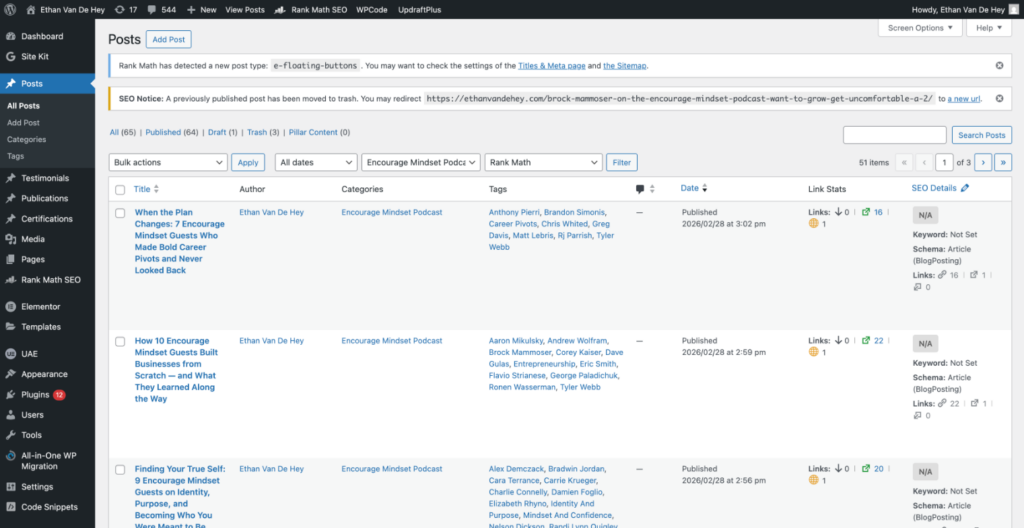
The whole process took roughly 600 tool steps across two conversation sessions (about 294 steps in the latest session alone). At roughly 50,000 to 80,000 tokens per step for a model like Claude Opus, that puts the total token usage in the neighborhood of 15 to 25 million tokens — which at current API pricing translates to somewhere between $50 and $150 in compute cost. For that investment, we built an entire content ecosystem that would have taken a human content strategist days or weeks to produce. The screenshots throughout this article are real — captured during the actual working session as the AI navigated between YouTube, WordPress, and the REST API.
The Starting Point: 45 YouTube Episodes, Zero Content Strategy
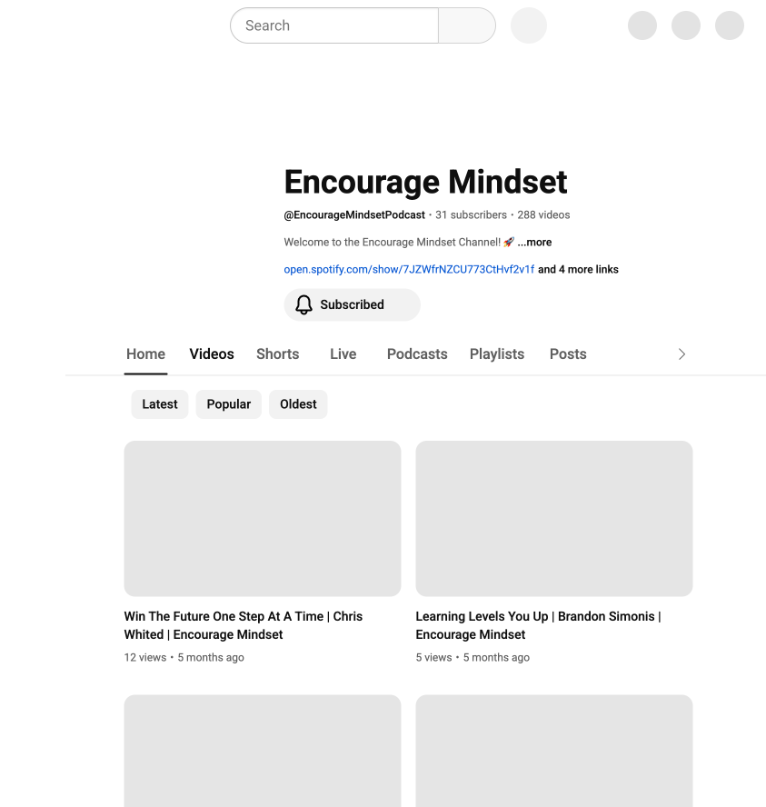
Ethan’s Encourage Mindset Podcast had 45 full-length episodes on YouTube, featuring guests across topics like entrepreneurship, leadership, mindset, career pivots, and personal identity. The YouTube channel had the content. The personal brand website at ethanvandehey.com had about 42 articles already written for earlier episodes. But there was no linking between them, no tag structure, no roundup content, and no way for Google to understand how all of these conversations fit together.
The site had content. It did not have a content ecosystem.
Step 1: Audit What Already Exists
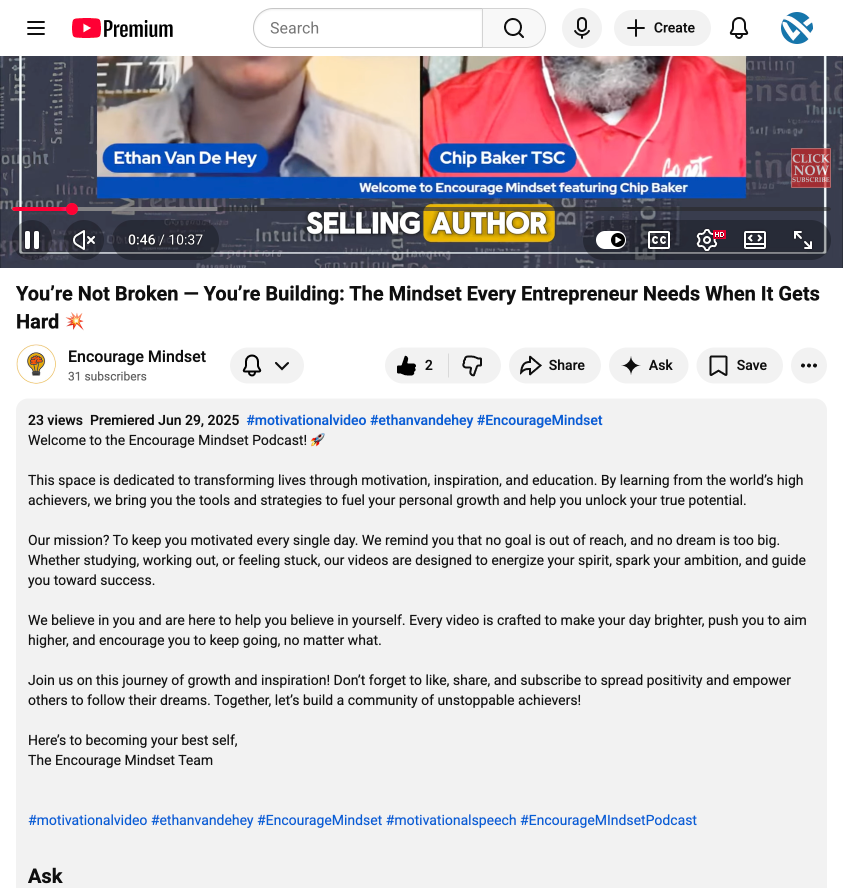
Before creating anything new, we pulled the full inventory of existing posts from the WordPress REST API and cross-referenced them against every video on the YouTube channel. We checked the Videos tab, the Live tab, the Playlists, and even the Shorts (about 240 clips, roughly 7 per guest). The goal was to find the gaps — which episodes had articles and which did not. We found three uncovered episodes: Chip Baker, Dr. Lucy Johnson, and Matt LeBris.
This audit step matters because most people skip it. They start creating content without knowing what they already have. That leads to duplicate coverage of some topics and zero coverage of others. If you are building a content hub around a podcast, start by mapping what exists across both your website and your video platform. Use a spreadsheet, the WordPress API, or even just a checklist — but do the audit first.
Step 2: Pull the Transcript — Do Not Just Summarize the Title
For each uncovered episode, we opened the YouTube video and pulled the full transcript. Not a summary. Not what the title suggested the conversation was about. The actual word-for-word transcript, which we then read through to identify the specific stories, names, companies, turning points, and real experiences that make each conversation unique.
This is where most AI-generated podcast articles fail. They read the title, maybe skim a few minutes of transcript, and produce generic motivational content that could apply to any podcast episode. The result is hollow — it does not capture what the guest actually said, and it certainly does not give Google any unique entities to index.
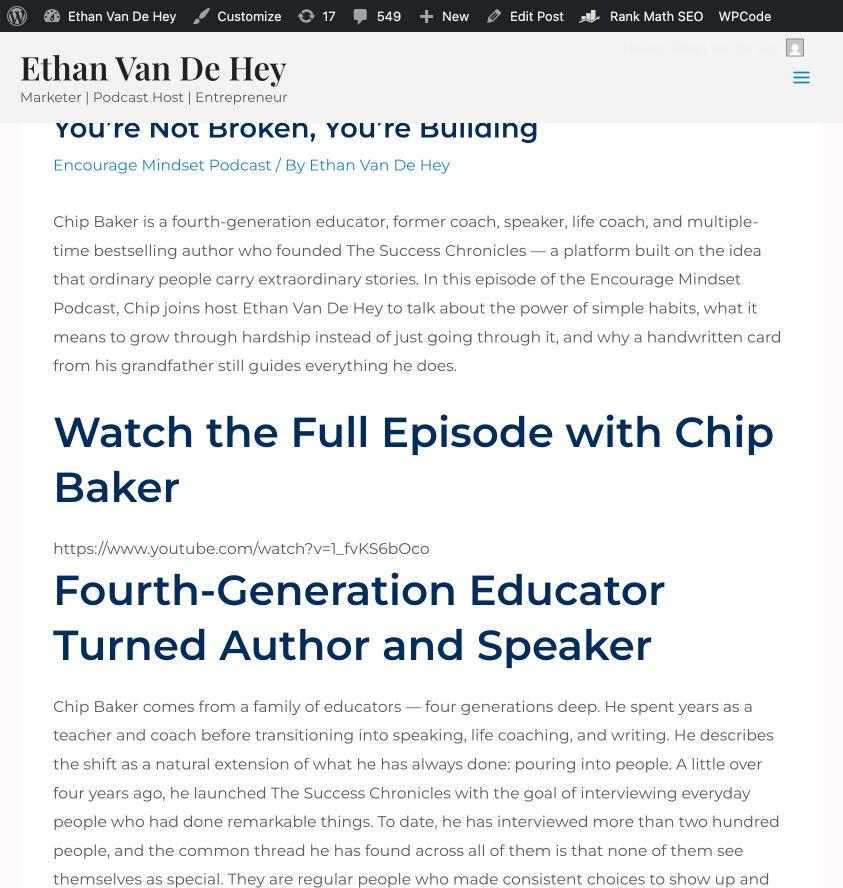
For example, when we wrote the article for Brock Mammoser’s episode, we did not write about “the importance of getting outside your comfort zone.” We wrote about how Brock cofounded Frost Buddy, an insulated drinkware brand, with his brother. How their slim can cooler pivot changed their entire business trajectory. How they built a Facebook community of over 10,000 members. How Brock studied at Indiana University’s Kelley School of Business and uses a profit-first financial approach. Every specific detail came from the transcript, and every detail gives Google another entity to associate with Ethan’s site.
Step 3: Write the Article Around Real Stories, Not Keywords
Each episode article followed a consistent format: an opening paragraph introducing the guest with their real credentials and background, an embedded YouTube video so visitors can watch the full episode, four to six H2 sections covering the major topics from the conversation, and a closing call-to-action linking to the YouTube channel and podcast archive. The H2 headings were not keyword-stuffed SEO titles — they were descriptive labels for what the guest actually discussed.
The key rule we followed: every paragraph must reference something the guest actually said. No filler. No generic advice that could have been written without watching the episode. If a section could apply to any podcast guest on any show, it was too generic and we rewrote it with specifics from the transcript.
This approach produces articles that are longer and more detailed than typical podcast show notes, but that is the point. Show notes are marketing. These articles are content — they stand on their own as valuable reading even for someone who never watches the video.
Step 4: Build a Tag Taxonomy That Reflects the Real Topics
Once all 45 episode articles existed, we needed to connect them. The first step was creating a tag taxonomy that actually reflects what these conversations are about. We created 55 tags total: 10 theme-based tags (entrepreneurship, leadership, overcoming adversity, discipline and habits, identity and purpose, mindset and confidence, career pivots, community and relationships, fitness and health, marketing and branding) plus 45 guest-name tags (one per episode guest).
Each episode post received its guest name tag plus two to three relevant theme tags. This was done programmatically through the WordPress REST API, which allowed us to tag all 45 posts in a single batch operation rather than clicking through the WordPress editor 45 times.
Why guest name tags? Because they enable tag archive pages that function like mini-profiles. If someone searches for “Brock Mammoser” and lands on Ethan’s site, the guest tag page shows every piece of content mentioning Brock — the episode article, any roundups featuring him, and potentially future content. It turns the site into a knowledge graph around these people and topics.
Step 5: Create Thematic Roundup Articles with Strategic Cross-Linking
Individual episode articles are valuable, but they are isolated by default. A visitor who reads one article has no reason to read another unless you connect them. That is where roundup articles come in.
We created six roundup posts, each clustering episodes around a shared theme: Overcoming Adversity — 7 guests who turned rock bottom into a breakthrough. Leadership — 8 guests who redefined what it means to lead. Daily Habits — 9 guests whose daily routines built real success. Identity and Purpose — 9 guests on finding who you really are. Entrepreneurship — 10 guests who built businesses from scratch. Career Pivots — 7 guests who made bold career changes and never looked back.
Each roundup article is not a listicle. Every guest section includes a paragraph that summarizes their specific story and then cross-links to other episodes that cover related themes. For example, in the Career Pivots roundup, Anthony Pierri’s section about going from pastor to marketer links to Alex Demczack’s episode about knowing your identity — because the two conversations share a common thread about aligning your career with your values. These cross-links are contextual, not random. They explain why two episodes relate to each other, which is exactly what intelligent internal linking should do.
Step 6: Internal Linking That Beats Link Whisper
Tools like Link Whisper automate internal linking by matching keywords. That is a decent starting point, but it misses the semantic connections that make internal linking actually useful for readers and for Google. When Ethan talks about adversity in one episode and resilience in another, a keyword-matching tool might miss the connection because the words are different. But the concepts are the same.
Our approach was to link based on conceptual overlap, not keyword matching. In the roundup articles, we connected episodes where guests discussed similar ideas using different language: Bradwin Jordan’s “breakthroughs” links to Dr. Lucy Johnson’s “small wins” because both guests are talking about incremental progress even though they use different vocabulary. Dave Gulas’s consistency principle links back to the Daily Habits roundup because the underlying lesson is the same.
We also added a “Related Episodes You Might Enjoy” section to the bottom of every single episode article — all 45 of them, updated programmatically via the WordPress REST API in three batches of 15. Each episode now shows three thematically related episodes plus links to any roundup articles that feature it. This creates bidirectional links: roundups point to episodes, and episodes point back to roundups and to each other.
This kind of linking does what Link Whisper cannot: it builds a topical map that Google can follow to understand not just what each page is about, but how all the pages relate to each other. The result is not 51 disconnected blog posts — it is a content ecosystem where every article strengthens every other article.
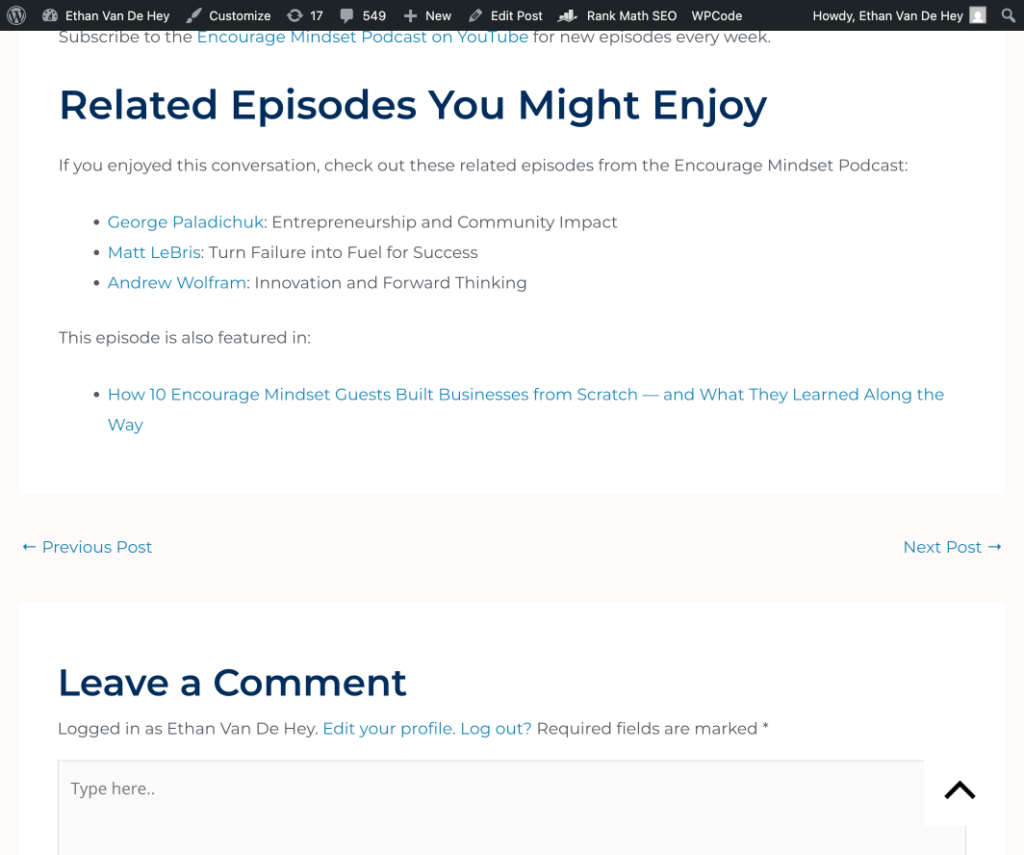
Below is what the “Related Episodes” section looks like on the live site. Every one of the 45 episode articles now has this at the bottom, creating a web of bidirectional links across the entire content hub.
The Numbers: What We Built in One Session
Here is the full inventory of what this process produced: 3 new episode articles written from YouTube transcripts for previously uncovered episodes (Chip Baker, Dr. Lucy Johnson, Matt LeBris). 55 tags created and applied — 10 thematic tags and 45 guest name tags — across all 45 episode posts. 6 roundup articles published, each featuring 7 to 10 guests with contextual cross-links. Over 100 internal links added across the roundup articles, connecting episodes to each other based on thematic relevance. 45 “Related Episodes” sections added to every individual episode article, each with 3 related episode links plus roundup backlinks. A tag-based taxonomy that enables discovery by topic or by guest name. A total of 51 published posts in the Encourage Mindset Podcast category, up from 42 at the start.
Why This Matters for SEO and AI Search
Google’s helpful content system rewards sites that demonstrate topical authority. A site with 51 interlinked articles about mindset, leadership, entrepreneurship, and personal growth — all anchored to real people with real stories — sends a strong signal that this site actually knows what it is talking about. The tag taxonomy gives Google structured pathways to crawl. The roundup articles create hub pages that consolidate topical authority. The guest name tags create entity associations that feed into Google’s Knowledge Graph.
For AI search tools like ChatGPT, Perplexity, and Google’s AI Overviews, the internal linking structure is even more important. These systems follow links to build context. When a roundup article about career pivots links to individual episodes and those episodes link back to other roundups, the AI can trace the full web of relationships and understand the site as a coherent source on these topics — not just a collection of disconnected posts.
The Meta: What It Actually Cost to Build This
This entire content ecosystem was built using AI-assisted browser automation — specifically, Claude operating a web browser through the computer use tool. The AI navigated between YouTube (to pull transcripts), WordPress (to create and publish posts), and the WordPress REST API (to batch-create tags and update posts programmatically).
The project spanned two conversation sessions totaling roughly 600 tool steps. The latest session alone was about 294 steps. Each step involves reading pages, clicking elements, writing and inserting content, running JavaScript, and taking screenshots along the way. At approximately 50,000 to 80,000 tokens per step for context and generation, the total token usage lands somewhere around 15 to 25 million tokens. At current Claude API pricing, that translates to an estimated $50 to $150 in compute cost — depending on the exact model tier and caching.
For perspective, a human content strategist doing this work manually — auditing 45 episodes, pulling transcripts, writing detailed articles, creating 55 tags, building 6 roundup posts with contextual cross-links, and adding Related Episodes sections to all 45 posts — would likely need 40 to 80 hours of focused work. At even a modest freelance rate, that is $2,000 to $8,000. The AI did it in a few hours of wall-clock time for under $150 in API costs. And every screenshot in this article was captured in real time during the actual session — this is not a hypothetical workflow, it is documentation of work that already happened.
How to Apply This to Your Own Podcast or YouTube Channel
This process works for any podcast, YouTube show, or video series. The steps are straightforward. First, audit your existing content by mapping every video against every article on your site. Find the gaps. Second, pull actual transcripts for each video and read them for specific stories, names, and details. Third, write articles based on what the guest actually said, not what you think the episode was about from the title. Fourth, build a tag taxonomy that reflects your real topics — do not overthink this, just look at what themes keep coming up across your episodes. Fifth, create roundup articles that cluster episodes by theme and include cross-links that explain why the episodes relate to each other. Sixth, review the internal linking across all posts to make sure every article connects to at least two or three others in a way that makes sense for a reader.
The whole point of content repurposing is that the content already exists. You recorded the conversations. The value is already there in the transcript. Your job is not to create something from nothing — it is to organize, connect, and present what you already have in a way that serves both your audience and search engines. That is what turns a YouTube channel into a content ecosystem, and a personal brand site into a topical authority.
If you want to see the finished product, visit the Encourage Mindset Podcast archive on ethanvandehey.com and click through a few of the episode articles and roundup posts. Notice how the tags, cross-links, and thematic clusters work together. That is what a real content strategy looks like — not a list of keywords, but a web of connected, specific, human stories.
Dennis Yu
Dennis Yu is the CEO of Local Service Spotlight, a platform that amplifies the reputations of contractors and local service businesses using the Content Factory process. He is a former search engine engineer who has spent a billion dollars on Google and Facebook ads for Nike, Quiznos, Ashley Furniture, Red Bull, State Farm, and other brands.
Dennis has achieved 25% of his goal of creating a million digital marketing jobs by partnering with universities, professional organizations, and agencies. Through Local Service Spotlight, he teaches the Dollar a Day strategy and Content Factory training to help local service businesses enhance their existing local reputation and make the phone ring.
Dennis coaches young adult agency owners serving plumbers, AC technicians, landscapers, roofers, electricians, and believes there should be a standard in measuring local marketing efforts, much like doctors and plumbers must be certified.