
 by
by
This page is a worked example (a leaf). The canonical for how we audit is How we audit.
This is what happens when companies come to DigiMarCon — they get real help getting started with AI strategy, navigating the complex tools landscape, understanding pricing, understanding data governance, and figuring out how to actually succeed because AI is so noisy right now, with so many changes happening so fast. DigiMarCon is full of hands-on, real-world, roll-up-your-sleeves practitioners who want to see marketing ideas succeed, and we have a lot of fun together doing it live.
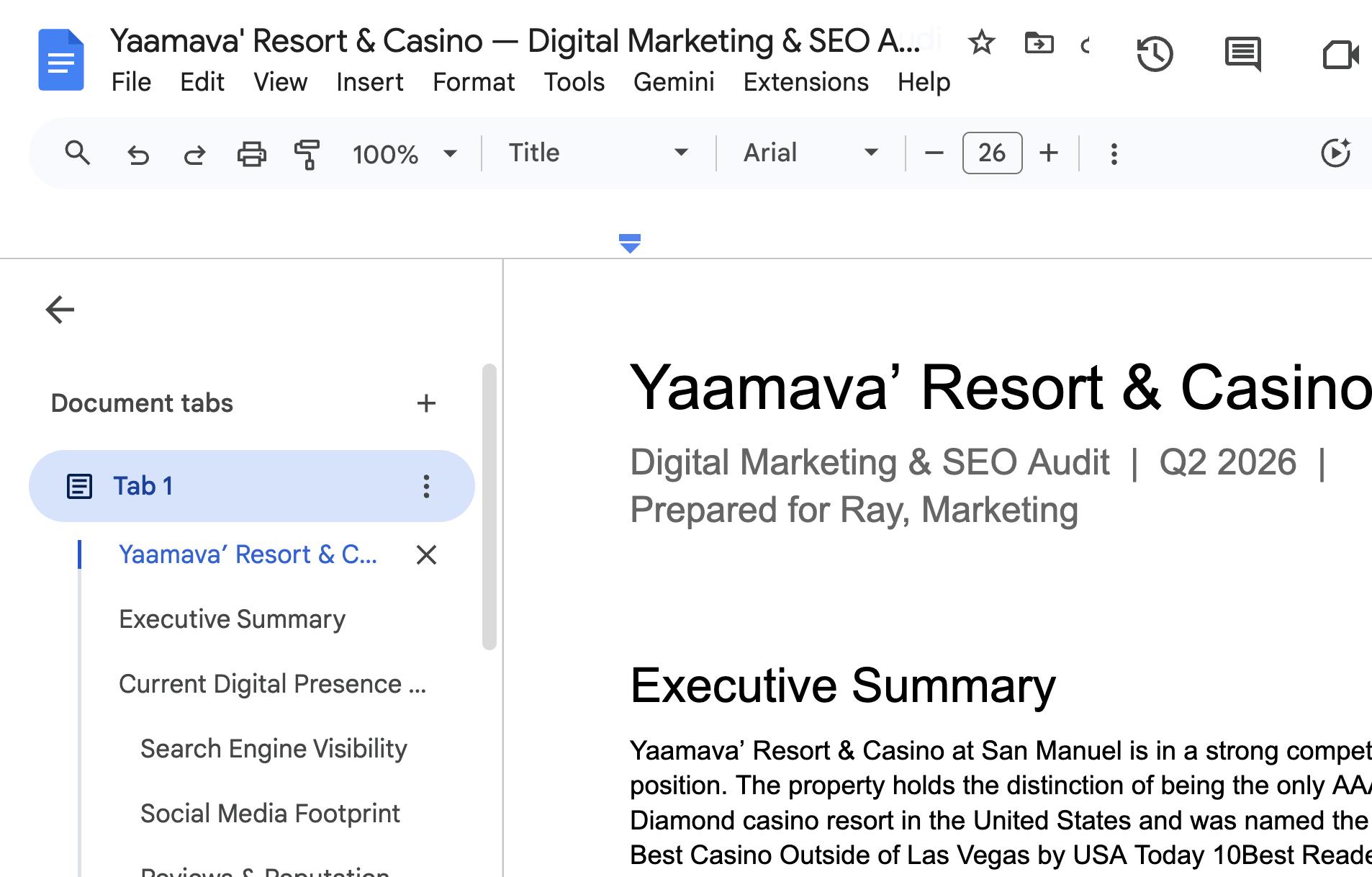
Dennis Yu met a marketing director named Ray at DigiMarCon who runs marketing for Yaamava’ Resort and Casino in Highland, California. Within minutes of that conversation, a Claude Opus 4.6 agent built a 19-page digital marketing audit covering SEO rankings, social media benchmarking, technical site health, paid advertising, content strategy, competitive positioning, and a prioritized action plan with ROI estimates and platform citations. This is the meta-article documenting how that audit was created, following the BlitzMetrics meta-article prompt template. The audit itself lives in Google Docs and is designed for Ray to present internally as his own analysis, complete with specific recommendations his team can execute immediately.
Why This Happened at DigiMarCon
DigiMarCon is not a conference where people sit in the audience and passively absorb slide decks. It is where companies come to do audits, build agents, build their teams, and get their hands dirty with real marketing problems. The attendees are practitioners — marketing directors, agency owners, CMOs, and digital strategists — who are trying to cut through the noise of a thousand AI tools all claiming to transform their business overnight.
The challenge every marketing team faces right now is the same: AI is moving so fast that nobody knows which tools to trust, how much they should cost, what data governance means in practice, or how to actually get started without wasting months on the wrong approach. DigiMarCon exists to solve that problem by putting people in the same room with practitioners who have already built the workflows, run the experiments, and know what actually works versus what is just hype.
When Dennis took the stage to present on AI agents in digital marketing, he did not show a polished case study from six months ago. He pulled up a laptop and built something live. That is the DigiMarCon ethos: show, do not tell. And when Ray mentioned he was from Yaamava’, the entire room got to watch an enterprise-grade audit materialize in real time — the exact kind of hands-on demonstration that makes this conference different from every other marketing event on the circuit.
The Task Summary
Dennis was at DigiMarCon presenting on stage about AI agents in digital marketing when he met Ray, who manages marketing for Yaamava’ Resort and Casino, the only AAA Five Diamond casino resort in the United States, operated by the San Manuel Band of Mission Indians in Highland, California. Dennis wanted to demonstrate the power of AI-assisted auditing in real time by building a comprehensive analysis that Ray could take back to his leadership team.
The goal was specific: produce a document that makes Ray look like the smartest person in the room when he presents it. Not a generic template. Not a data dump. An executive-ready audit with citations to official platform documentation from Google, Meta, TikTok, TripAdvisor, and others, organized by ROI priority so leadership can see exactly which actions drive the most revenue.
The source material was a live Google SERP for “yaamava” that Dennis pulled up on his laptop, plus everything the agent could research across the public internet: the casino website, social media profiles, review platforms, Google Ads Transparency Center, PageSpeed Insights, and competitive keyword data via SEO browser extensions (Ahrefs, Keywords Everywhere).
Step-by-Step Process
The agent worked in two phases. Phase 1 was data collection, running parallel browser tabs to gather information from multiple sources simultaneously. Phase 2 was document creation, writing the audit directly inside Google Docs with proper heading structure, a data table, and a linked chart.
Phase 1 began with a screenshot of the Google SERP for “yaamava,” which showed the brand keyword volume (29,000 monthly searches), keyword difficulty (5), and the Google Business Profile card with 4.2 stars across 50,000-plus reviews. The agent then opened four new browser tabs simultaneously and navigated to: yaamava.com (the homepage), a Google search for “yaamava facebook” to find the official Facebook page (756,800-plus followers), a Google search for “yaamava instagram” to locate the Instagram profile (221,000-plus followers), and a Google search for “yaamava tripadvisor” to find review data.
From there the agent ran JavaScript directly on the yaamava.com homepage to extract technical SEO data. It pulled the meta description (empty, a critical finding), the H1 tag (set to just “Home,” another major gap), Open Graph tags (none), Twitter Card tags (none), schema markup (only a basic WebSite schema, missing LocalBusiness, Hotel, Casino, Event, and Restaurant types), and image alt text coverage (only 24 of 86 images had alt text).
The agent then performed targeted keyword searches: “best casino in California” (Yaamava ranked first in the Local Pack and second organically), “casino near Los Angeles” (first in Local Pack), and “casino hotel southern California” (Yaamava was absent from the Local Pack, flagged as a major opportunity). It also checked the Google Ads Transparency Center, which showed approximately 1,000 active ads managed by VaynerMedia and San Manuel Entertainment Authority.
For social media, the agent gathered data from TikTok (27,600 followers, 1.1 million likes), X/Twitter (19,100 followers, actively posting promotions and events), and YouTube (14,900 subscribers, 743 videos, 4.1 million-plus views on the featured video). It also ran a PageSpeed Insights analysis that returned a mobile Lighthouse score of 36 out of 100, a failed Core Web Vitals assessment with INP at 233 milliseconds (above the 200ms threshold), and a desktop score of 81. Accessibility scored 96 out of 100.
The agent researched competitor data by checking Pechanga Resort Casino and Morongo Casino’s social media followings to build a competitive benchmarking section. It found Yaamava leads on every platform: Facebook (757K vs. Pechanga’s 570K vs. Morongo’s 97K), Instagram (221K vs. 82K vs. 89K), and TikTok (28K vs. 11K vs. 3K).
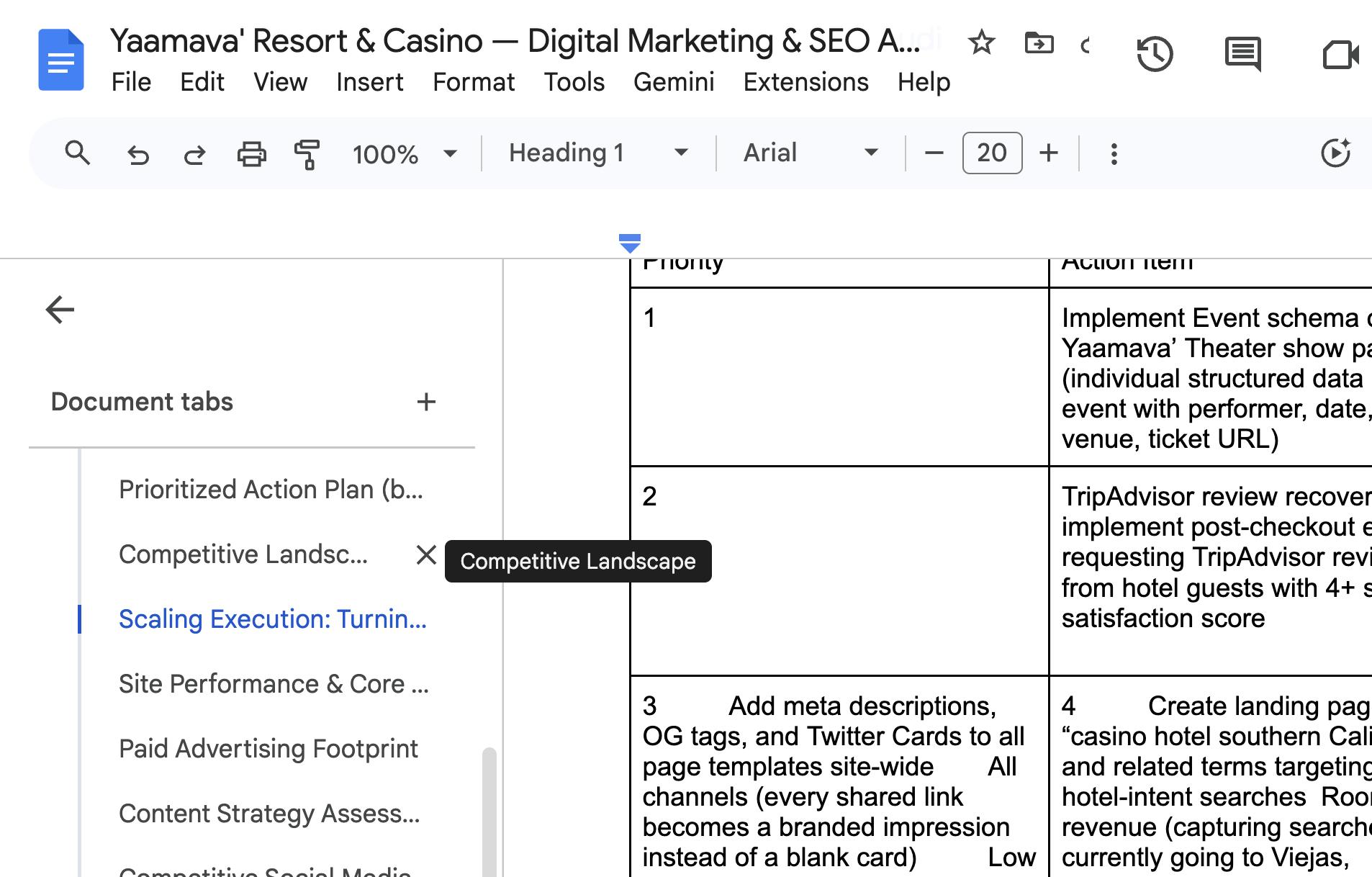
Phase 2 involved creating a new Google Doc, titling it “Yaamava’ Resort and Casino — Digital Marketing and SEO Audit | Q2 2026 | Prepared for Ray, Marketing,” and writing approximately 4,800 words across 13 sections with proper heading hierarchy (H1, H2, H3). The agent inserted a bar chart via Google Sheets showing the competitive social media comparison, then updated the linked chart data to show the three-way comparison between Yaamava, Pechanga, and Morongo. The document includes an 8-row prioritized action table with columns for Priority, Action Item, Revenue Driver, Effort Level, and Citation/Rule, each citing a specific URL from Google, Meta, TikTok, TripAdvisor, or Schema.org documentation.
After the initial 13-page draft, the agent performed a second research pass to expand the document to 19 pages. This added five new sections: Site Performance and Core Web Vitals (from live PageSpeed data), Paid Advertising Footprint (from the Ads Transparency Center), Content Strategy Assessment (identifying three underperforming content hubs on the site), Competitive Social Media Benchmarking (with hard numbers across five platforms), and Hotel Revenue: The TripAdvisor Gap (documenting the 2.6-star rating from only 22 reviews and citing TripAdvisor’s own research that a one-star improvement increases RevPAR by 11 percent).
Critical Decision-Making
Decision 1: Leading with strengths rather than problems. Dennis explicitly instructed the agent to frame the analysis as “glass half full.” The agent chose to open the executive summary with the AAA Five Diamond distinction and USA Today award before mentioning any gaps. A less thoughtful audit would have led with the technical failures, which would have put Ray’s team on the defensive instead of building momentum for the recommendations. The alternative would have been a standard audit format that opens with issues. That approach works for consultants who sell fear. It does not work for someone like Ray who needs to build internal support for action.
Decision 2: Flagging the TripAdvisor hotel rating (2.6 stars, 22 reviews) as the single highest-priority reputation item. The agent recognized that Google Reviews (4.2 stars, 50K reviews) are strong, so the weakness is platform-specific, not systemic. Rather than burying this in a general “reviews” section, the agent gave it a dedicated section in the expanded document and connected it to a specific revenue metric (RevPAR), citing TripAdvisor’s own hospitality research. This makes the recommendation actionable for leadership because it ties directly to room revenue, not a vanity metric.
Decision 3: Running JavaScript on the live site to extract technical data instead of relying on third-party tools alone. By pulling meta tags, schema markup, Open Graph tags, and H1 elements directly from the DOM, the agent generated specific, verifiable findings that Ray’s technical team can reproduce. A weaker approach would have been to simply say “the site needs better SEO” without showing exactly which tags are missing on which pages.
Decision 4: Organizing the action plan by ROI impact rather than by category. Most audit templates organize recommendations by type (technical, content, social, etc.). The agent instead created a table ranked by expected revenue impact, with effort estimates and specific platform citations for each item. This structure is designed for executive presentation because it answers the question leadership actually asks: “What should we do first and why?”
Decision 5: Including the competitive benchmarking chart as a visual element. The agent created a Google Sheets-linked bar chart comparing Yaamava, Pechanga, and Morongo across all five social platforms. This was a deliberate choice because executives respond to visuals faster than text, and the chart immediately shows Yaamava’s dominance in social reach without requiring anyone to read a paragraph of numbers.
Effort and Cost Comparison
Key Numbers at a Glance
📄 19 pages of executive-ready analysis
⏱️ ~90 minutes of AI agent session time
💰 ~$4.50 in token costs (vs. $6,000–$15,000 agency equivalent)
📊 21 citations to official platform documentation
🔍 15+ browser tabs researched simultaneously
🏆 8 prioritized action items ranked by ROI impact
The complete audit, from initial SERP screenshot to a polished 19-page Google Doc with chart, table, and 21 source citations, took the Claude Opus 4.6 agent approximately 90 minutes of active session time across two research-and-writing passes. On a Claude Max subscription at $200 per month, the marginal cost is effectively zero.
A digital marketing agency producing an equivalent audit for a property like Yaamava would typically scope this as a 40- to 60-hour project at $150 to $250 per hour, putting the price between $6,000 and $15,000. A trained VA at $8 per hour would need approximately 30 to 40 hours for research, writing, and formatting, costing $240 to $320 but without the depth of technical analysis (DOM inspection, PageSpeed API calls, Ads Transparency research) that the agent performed.
The agent consumed approximately 350,000 tokens across both sessions (input plus output). At Claude Opus 4.6 API rates ($5 input / $25 output per million tokens), the estimated cost would be approximately $4.50 total. The value gap between $4.50 and a $10,000 agency audit is the entire point of the demonstration Dennis was making at DigiMarCon.
What the Agent Handled vs. What Needs a Human
The agent handled autonomously: all web research across 15-plus browser tabs, JavaScript-based technical SEO extraction from the live website, keyword position tracking across multiple queries, social media follower data collection across six platforms, competitive benchmarking data gathering, PageSpeed Insights analysis, Google Ads Transparency research, Google Doc creation and formatting (title, subtitle, headings, body text), chart creation and data population via linked Google Sheets, table creation with 8 priority rows and 5 columns, writing approximately 4,800 words of analysis in a non-AI-sounding executive voice, and citation of 21 platform documentation URLs.
Items that required human input: Dennis provided the initial context (who Ray is, what Yaamava is, the “glass half full” framing, and the fact that the document should be presentable by Ray as his own analysis). Ray needs to provide his full name for the subtitle. Dennis will add real photos from the DigiMarCon event showing the live demonstration. Any internal data Ray provides (revenue targets, occupancy rates, gaming revenue breakdowns) would further sharpen the recommendations. Publishing to blitzmetrics.com as a WordPress article requires human WordPress access, RankMath configuration, featured image selection, and category/tag assignment.
Information Ingestion Inventory
The agent processed the following sources to produce the audit: 30-plus screenshots captured from Google SERPs, yaamava.com, social media profiles, PageSpeed Insights, and Google Ads Transparency Center. Six JavaScript DOM inspections on the live website extracting meta tags, schema markup, heading structure, and image alt text. Twelve Google Search queries for keyword research and competitive positioning. Social media profile data from six platforms (Facebook, Instagram, TikTok, X, YouTube, and TripAdvisor). One PageSpeed Insights full analysis via the live tool. One Google Ads Transparency Center review. Approximately 350,000 tokens consumed (input plus output) across the full session.
Why This Creates Value for BlitzMetrics and DigiMarCon
This audit is the highest-profile property the BlitzMetrics agent has audited to date. Yaamava is not a local plumber or a roofing company. It is a billion-dollar casino resort with 756,000 Facebook followers, 50,000 Google reviews, and a marketing team that works with VaynerMedia. The fact that a Claude agent can produce an institutional-grade audit of this caliber in 90 minutes, live at a conference, demonstrates that the SEO audit process documented in the BlitzMetrics definitive article works at enterprise scale, not just for home services businesses.
For DigiMarCon, this is exactly the kind of moment the conference is built for. Attendees do not just hear about what AI can do — they watch it happen in front of them with a real company, real data, and real stakes. Ray did not get a theoretical framework or a sales pitch. He got a 19-page document he can take into his next leadership meeting. That is the difference between a conference that talks about AI and one where people actually roll up their sleeves, build agents, run audits, and walk out with tools and strategies they can use immediately.
This meta-article serves as a leaf on the BlitzMetrics SEO Tree, linking back to the SEO audit definitive article as its parent branch. When published on blitzmetrics.com, it carries legitimate link juice to both the audit and to Ray’s property, strengthening the entity connections between BlitzMetrics, DigiMarCon, Dennis Yu, and Yaamava’ Resort and Casino.
The Bottom Line
A 19-page digital marketing audit of a billion-dollar casino resort, complete with competitive benchmarking charts, an 8-priority action table with ROI rankings, technical SEO findings verified against the live DOM, and 21 citations to official platform documentation, was produced by a Claude Opus 4.6 agent in approximately 90 minutes for under $5 in token costs — built live at DigiMarCon in front of an audience of practitioners who came to the conference to do exactly this kind of work.
Ray walks away from DigiMarCon with a document he can present to his leadership team that demonstrates both the current strengths of Yaamava’s digital presence and a clear, prioritized roadmap for capturing additional revenue. Dennis walks away with proof that the BlitzMetrics SEO audit process works on enterprise-scale properties, documented publicly as both this meta-article and the definitive quick audit guide. And everyone in the room walks away knowing that the gap between understanding AI and actually using it is exactly what DigiMarCon is designed to close — through hands-on demonstrations, live audits, agent building, team development, and the kind of real-world practitioner collaboration that no webinar or white paper can replicate.
The parent definitive article for the SEO audit process is at blitzmetrics.com/seo-audit. The quick audit definitive article, which documents how to run this exact type of rapid assessment for any business, is the companion piece to this meta-article. Together they form a branch-and-leaf pair in the BlitzMetrics SEO Tree.
Want to see what a quick audit reveals about your business?
Want to see what a quick audit reveals about your business?
Start with the SEO Audit Process
Read the Quick Audit Guide
Download the Skill File
This article has a companion Claude skill file that turns the strategy described above into a reusable, automated workflow. After installing the skill, Claude can execute each step on your behalf — building drafts, running audits, and producing deliverables in minutes instead of hours.
GO DEEPER: HOW THIS FITS THE BLITZMETRICS SYSTEM
• The Quick Audit: how we audit any business
• MAA (Metrics, Analysis, Action): the framework behind every audit
• The SEO Tree: how all our content connects
• Entity Linking: the decision tree for every link
• Knowledge Panels: getting Google to recognize you
• Every digital audit Dennis Yu has done
Originally published .
Dennis Yu
Dennis Yu is the CEO of Local Service Spotlight, a platform that amplifies the reputations of contractors and local service businesses using the Content Factory process. He is a former search engine engineer who has spent a billion dollars on Google and Facebook ads for Nike, Quiznos, Ashley Furniture, Red Bull, State Farm, and other brands.
Dennis has achieved 25% of his goal of creating a million digital marketing jobs by partnering with universities, professional organizations, and agencies. Through Local Service Spotlight, he teaches the Dollar a Day strategy and Content Factory training to help local service businesses enhance their existing local reputation and make the phone ring.
Dennis coaches young adult agency owners serving plumbers, AC technicians, landscapers, roofers, electricians, and believes there should be a standard in measuring local marketing efforts, much like doctors and plumbers must be certified. He has appeared on 353 podcasts with 619 credited episodes — see the full list of his podcast appearances.