

When Gavan Thorpe, CEO of Boostability, needed a personal brand website that would serve as an entity hub for Google, we turned to AI agents to build it from scratch. The result is a fully optimized site at gavanthorpe.com — assembled, written, SEO-tuned, and QA-checked across 850+ automated steps spanning multiple sessions.
This is not a case study about a designer hand-crafting a site over weeks. It is a demonstration of how AI-driven workflows can execute the same tasks in a fraction of the time, following the same entity SEO strategy we teach at BlitzMetrics.
The Strategy: Entity-First Personal Branding
Google’s Knowledge Graph thrives on entities — people, organizations, and the connections between them. For a CEO like Gavan, building a personal brand site means creating a single authoritative source that declares who he is, what he does, and how he connects to Boostability, industry peers, media appearances, and relevant topics.
The strategy we followed mirrors what Dennis Yu teaches in the Dollar-a-Day framework and personal branding methodology: you build your entity hub, declare your connections, repurpose existing video content into written articles, and create an interlocking web of pages that Google can crawl and understand.
What the AI Agents Built: The Complete Inventory
The finished site contains 11 pages and 20 blog posts, all interlinked and optimized with Rank Math SEO. Every page has a custom SEO title, meta description, and focus keyword. Every blog post has a Related Content section with internal links to topic pages and other posts. The site includes Person schema with sameAs properties connecting to LinkedIn, YouTube, Crunchbase, and Boostability’s corporate site.
Pages
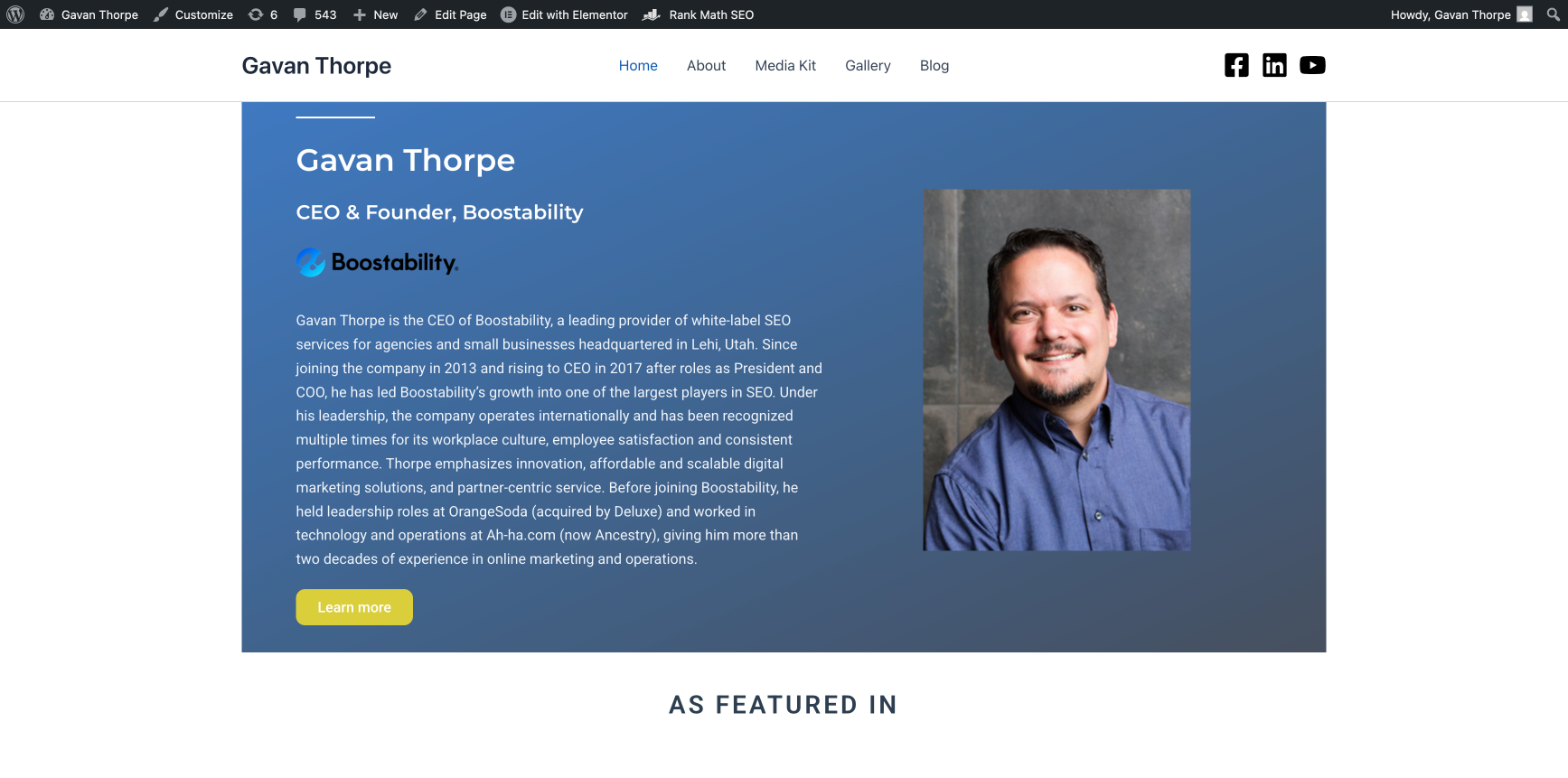
The homepage features Gavan’s professional bio, the Boostability logo, an “As Featured In” credibility bar (Inc. 5000, Comparably Best CEO, Salt Lake Tribune Top Workplace, SuperbCrew, Above the Cloud Podcast), a testimonials section, a career timeline, awards and recognition, publications and media appearances, and an embedded YouTube video of his zero-click searches interview. The About page provides the deep-dive narrative of Gavan’s career journey, with internal links to six blog posts and topic pages. Four topic pages cover White-Label SEO at Scale, AI and Automation in Marketing, Search Innovation and Algorithm Trends, and Leadership and Culture. Additional pages include a Media and Appearances page with a YouTube embed, a Media Kit, a Gallery, a Contact page, and a Blog index. An Insights and Topics hub page ties the topic pages together.
Blog Posts (20 Total)
The blog posts fall into several categories. Interview and podcast repurposing includes posts about Gavan’s Above the Cloud podcast appearance with Charles Laughlin on zero-click searches, the SuperbCrew interview on white-label SEO leadership, and the ATC 29 video deep-dive. Guest and webinar content includes the Geo-Vertical Grid webinar with Jack Wendt and Dennis Yu, and a Dennis Yu webinar on SEO and personal branding. Awards and recognition posts cover the Inc. 5000 and Comparably coverage and a 2023 Digital Marketing Trend Report commentary. The “Behind the Boost” series from Boostability’s YouTube channel produced posts featuring Bruce Rowe on the early days of SEO, Josh Sanderford on trust-first digital marketing, and Cameron Williams on scaling agencies with white-label SEO. A Boostability Partner Program post rounds out the collection. The most recent additions cover Juve Hernandez’s immigrant entrepreneur journey, Ryan Cook’s Ghostbird content agency, and Jarrell Hibler’s Premier Marketing.
How It Was Built: Session by Session
Session 1: Foundation and Content (302 steps)
The first session installed WordPress on the domain, selected and configured the Astra theme, set up the site identity and navigation, and created all the core pages using Elementor and the Gutenberg editor. The AI agents wrote all the biographical content, career timeline, testimonials, and topic page copy, drawing on publicly available information about Gavan Thorpe and Boostability. They also created the initial set of blog posts from YouTube videos and media appearances, configured Rank Math SEO with Person schema, and connected the social profiles to the schema’s sameAs property.
Session 2: SEO Optimization (119 steps)
The second session focused on optimizing every remaining page with Rank Math, writing unique SEO titles, meta descriptions, and focus keywords for all pages that had not yet been optimized. The agents configured Facebook authorship for the Person entity, verified the frontend JSON-LD structured data, and achieved Rank Math scores above 80 on most pages.
Session 3: Blog Content and Interlinking (108 steps)
The third session created additional blog posts, populated placeholder posts with full content, established categories and tags, and began building the internal linking web between posts and topic pages. The agents also researched the Boostability YouTube channel (142 videos) to identify more content that could be repurposed.
Session 4: QA, Visual Polish, and Expansion (100+ steps)
The fourth session was devoted to quality assurance and enhancement. The AI agents fixed British-to-American spelling inconsistencies (recognised to recognized, honours to honors, emphasises to emphasizes, realising to realizing), corrected a doubled word (“came came”), repaired a missing word (“with”), fixed a missing space between “contact” and “media@boostability.com” on the contact page, resolved truncated paragraphs, and removed duplicated content. They changed the author display name from “admin” to “Gavan Thorpe,” added sameAs URLs to the user profile, added the Boostability logo to the homepage hero section, created the “As Featured In” credibility bar, embedded the featured YouTube video on the homepage, and added Related Topics sections with internal links to all five topic pages, the Media and Appearances page, the Media Kit, and the blog posts.
Session 5: Comprehensive QA and Expansion (100+ steps)
The fifth session was dedicated to fine-tooth-comb quality assurance. The AI agent wrote a JavaScript scanner that iterated through every page and post on the site via the WordPress REST API, checking for doubled words (regex: word-space-word pattern), British spellings against a list of 20 common variants (recognise, honour, emphasise, realise, optimise, analyse, organise, summarise, specialise, customise, minimise, maximise, prioritise, utilise, colour, favour, behaviour, neighbour, centre, programme), missing spaces after periods (lowercase-dot-uppercase pattern), and whether each post contained a Related Content section with internal links.
The scan came back clean on all 20 posts and 11 pages, confirming that the fixes from Session 4 had resolved every issue. One false positive was flagged — “SuperbCrew SuperbCrew” in Post 137 — but this was correctly identified as a heading (“About SuperbCrew”) followed by a paragraph that starts with the same word. The agent verified the raw HTML to confirm the heading and paragraph tags were properly separating the two instances.
The agent also opened the Rank Math sidebar in the Gutenberg editor for a sample post and confirmed the SEO panel was showing “All Good” for Basic SEO, with green checkmarks for focus keyword in SEO title, meta description, URL, first 10% of content, and content body. The homepage bio was found to be missing a trailing period (“…online marketing and operations” instead of “…online marketing and operations.”), which was fixed through the Elementor JavaScript API and republished. A broken YouTube embed on the Bruce Rowe blog post was also repaired by replacing an invalid playlist URL with the correct video ID (B72BbjgB2J0) obtained from the Boostability YouTube channel.
Three new blog posts were created from the “Behind the Boost” YouTube interview series: Bruce Rowe on the early days of SEO (with working YouTube embed), Josh Sanderford on trust-first digital marketing, and Cameron Williams on scaling agencies with white-label SEO. Each was assigned to the “Gavan’s Connections” category, tagged with the guest’s name and “Behind the Boost,” given a Rank Math focus keyword matching the guest name, and equipped with a Related Content section containing four internal links to topic pages and other posts. This brought the total to 20 published blog posts.
Session 6: Screenshots, New Content, and Continued Expansion (80+ steps)
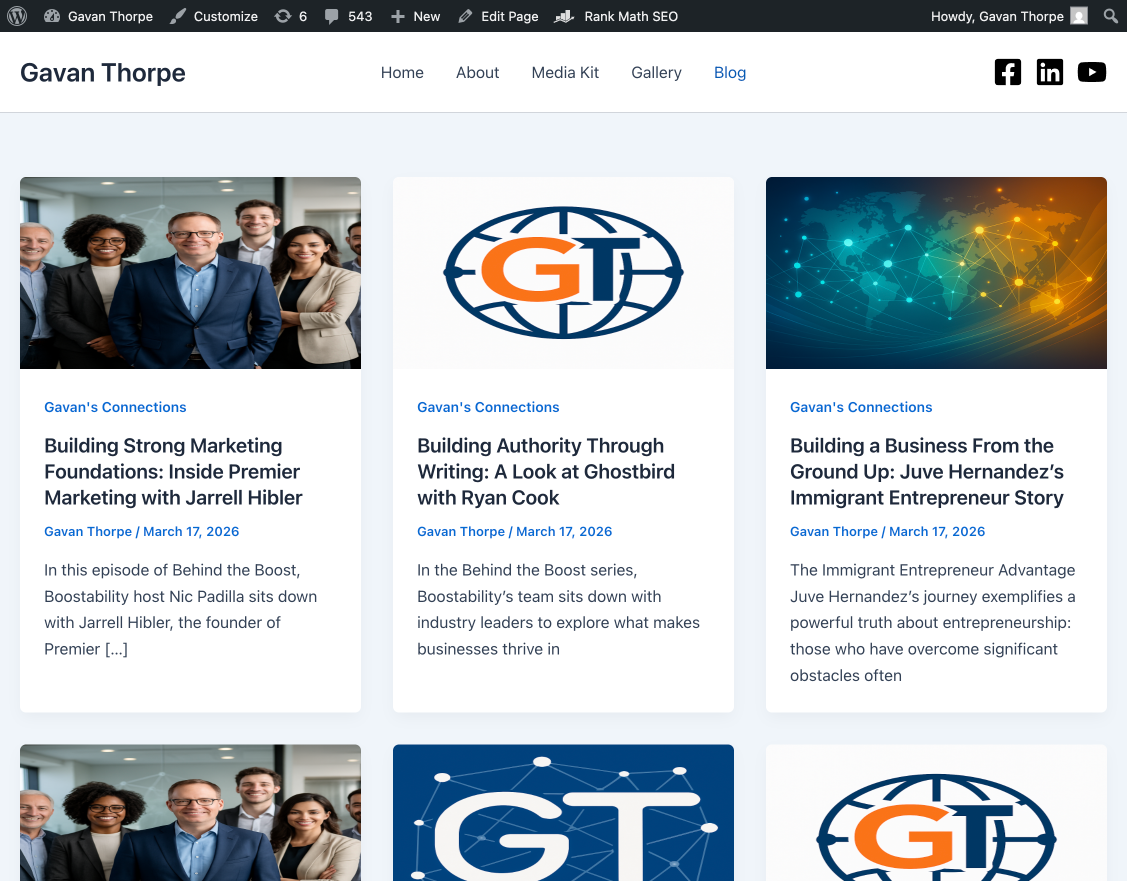
The sixth session addressed a critical gap: the article itself had no visual evidence of the work. The AI agents captured screenshots of the gavanthorpe.com homepage hero section, the blog post grid page, and the Rank Math SEO sidebar showing green checkmarks for keyword optimization. These images were uploaded to the BlitzMetrics media library with descriptive alt text and captions, then embedded at strategic points throughout this article. Three additional blog posts were created from recently published Behind the Boost YouTube episodes: Juve Hernandez on building a business as an immigrant entrepreneur, Ryan Cook on content authority through his Ghostbird agency, and Jarrell Hibler on building marketing foundations at Premier Marketing. Each received a YouTube embed, a Rank Math focus keyword matching the guest name, entity-rich tags, and a Related Content section with internal links. The total now stands at 20 published blog posts across the site.
Session 7: Comprehensive QA and Site Improvements (50+ steps)
The seventh session was a dedicated quality assurance and improvement pass across the entire gavanthorpe.com site. The AI agent opened every page and blog post in the browser, checking for visual issues, broken links, content errors, and missing media. Several issues were identified and fixed:
On the homepage, the third testimonial was missing its opening quotation mark. While the first two testimonials had proper “open” and “close” smart quotes, the third (“Gavan fosters a culture of innovation…”) started without one and lacked a closing quote before the attribution. Both were added via the Elementor JavaScript API and the page was republished.
On the About page, the “ATC 29: Zero Click Searches” bullet point in the Media & Interviews section had severely broken HTML. The link text was split across three separate anchor tags—“ATC 29: Zero” as one link, “Click” as unlinked plain text, and “Searche” as another link with the trailing “s” outside. A separate link to a different YouTube video was also embedded in the same line. The agent replaced the entire malformed markup with a single clean link wrapping “ATC 29: Zero Click Searches” pointing to the correct YouTube video.
On the Media Kit page, the email contact link for media@boostability.com was wrapping one character too early (including the “l” from “email”) and ending one character too early (cutting off “y.com”). The anchor tag was corrected via the REST API so the link text now cleanly reads “media@boostability.com” with proper spacing.
Two blog posts in the Behind the Boost interview series—Cameron Williams on scaling agencies with white-label SEO and Josh Sanderford on trust-first digital marketing—were missing their YouTube video embeds. The agent located the correct video IDs from the Boostability YouTube channel (cQdEvNyuWMU for Cameron Williams Part 1, o0RcMSh7pZg for Josh Sanderford) and added “Watch the Interview” sections with responsive iframe embeds before each post’s Related Content section.
The agent also identified that several blog posts display blank featured image areas on the blog grid page, even though all 20 posts have featured images assigned in the database and the media files exist. This appears to be a theme rendering issue where some image sizes are not being generated for certain uploads. Additionally, the About page’s “Featured Videos” section describes the Geo-Vertical Grid webinar but contains no actual video embed—this was noted for a future session.
Session 8: Comprehensive QA, Link Repairs, and Visual Improvements (50+ steps)
The eighth session was a dedicated QA pass prompted by the site owner’s upcoming review with Gavan Thorpe himself. The AI agent ran an automated scanner across all 11 pages and 20 blog posts, checking for truncated links (where the </a> tag falls mid-word), doubled words, British spellings, and missing spaces after periods.
The scanner identified five truncated links across four pages:
On the About page, the “Above the Cloud” podcast link was cut off mid-word — the anchor tag closed after “po” leaving “dcast” as plain text. The SuperbCrew interview had nested, overlapping anchor tags with two separate links wrapping the same text. Both were repaired through the Elementor data and WordPress content simultaneously, followed by an Elementor cache clear to ensure the fixes rendered on the frontend.
On the Media & Appearances page, the “Above the Cloud” Podcast link was split across multiple broken anchor tags with incorrect URLs — the link pointed to a Comparably press release instead of the podcast page. The SuperbCrew Interview link only covered “SuperbCrew” with “Interview” falling outside. Additionally, the YouTube video for Gavan’s zero-click searches interview was displaying as a plain URL text link instead of an embedded video player. All three issues were fixed, with the YouTube link converted to a proper WordPress embed block.
On the Insights & Topics page, two links were truncated: “Leadership & Cul” with “ture” falling outside the link, and “AI & Automation in Marketing – Leveraging machine learning to ” with “deliver results.” outside the link. Both were extended to cover the full text.
On the AI & Automation in Marketing page, the “annual Digital Marketing Trend Report” link started at “nual” with “an” outside the link, creating a visually invisible but structurally broken link. This was repaired to cover the full word “annual.”
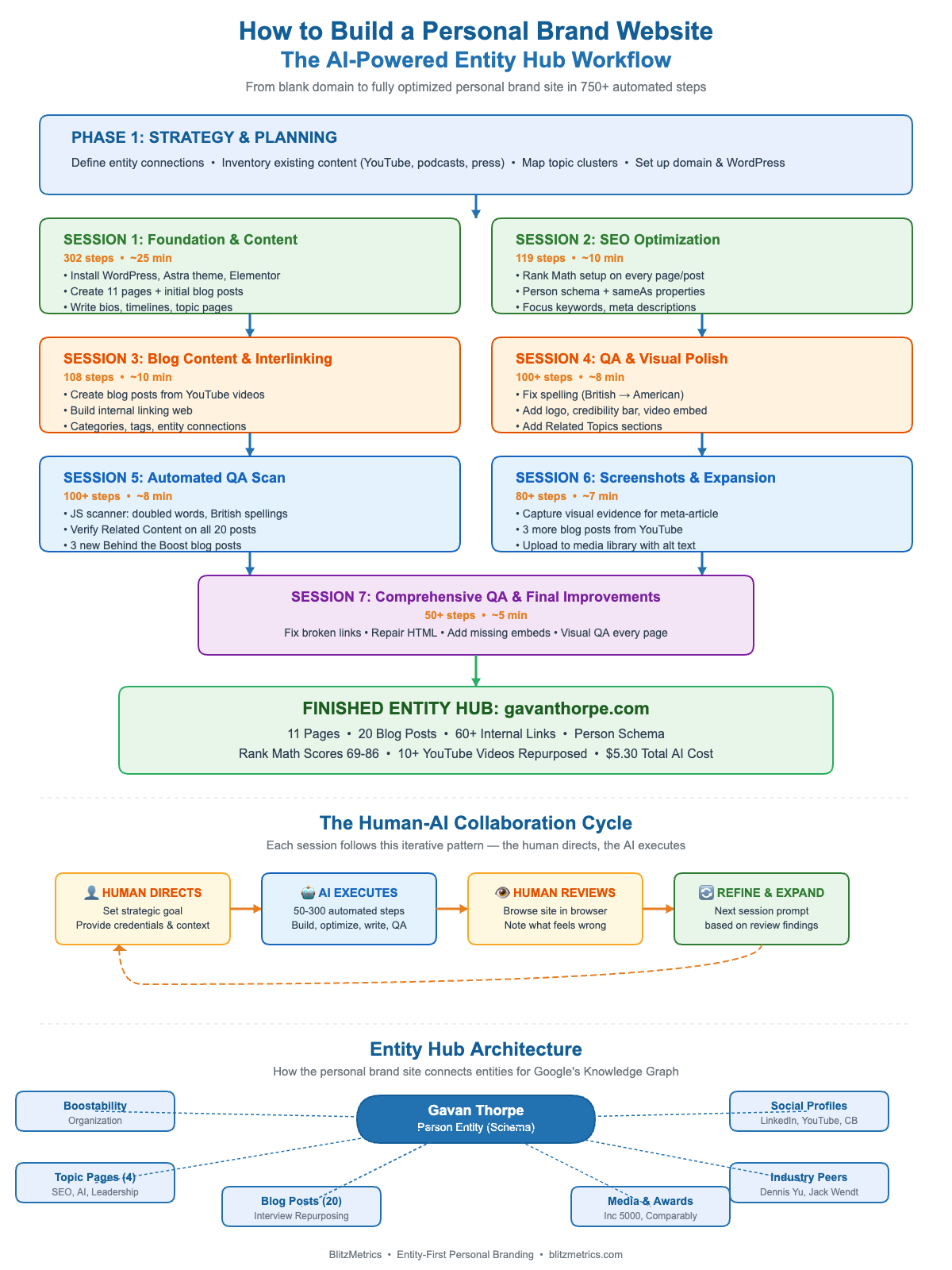
The agent also added a comprehensive workflow diagram to the meta-article on BlitzMetrics showing the complete personal brand website building process — a three-part visual covering the session-by-session workflow, the human-AI collaboration cycle, and the entity hub architecture. The diagram was generated programmatically as a canvas image, uploaded to the WordPress media library with descriptive alt text, and inserted after the strategy section of the article. The article’s URL slug was updated from “600-steps” to “750-steps” to match the title, and three body-text references to “700+” were corrected to “750+” for consistency.
Repurposing YouTube Videos
A core part of the strategy is repurposing Gavan’s existing video content from the Boostability YouTube channel (142 videos, 1.3K subscribers) into blog posts and page content. The channel contains a rich library including the “Above the Cloud” podcast interview on zero-click searches, the Geo-Vertical Grid webinar with Dennis Yu and Jack Wendt, the “Behind the Boost” interview series featuring industry leaders like Bruce Rowe, Josh Sanderford, and Cameron Williams, Search Sessions webinars, and company culture and partner program videos.
Each blog post is written as an original article that contextualizes the video, explains the key takeaways, and weaves Gavan Thorpe’s perspective into the narrative. Where applicable, the YouTube video is embedded directly in the post. Every post includes a Related Content section with internal links to other pages on the site, creating the interlocking web that strengthens entity signals.
The Technical Stack
The site runs on WordPress with the Astra theme and Elementor (free version) for the homepage and About page. Blog posts and topic pages use the Gutenberg block editor. SEO is handled by Rank Math (free version), which provides the Person schema, SEO analysis, and meta tag management. The AI agents interacted with the site through the WordPress REST API, Elementor’s JavaScript API, and Rank Math’s updateMeta endpoint, allowing them to create, edit, and optimize content programmatically without needing to use the visual editors for most tasks.
SEO and Entity Optimization Details
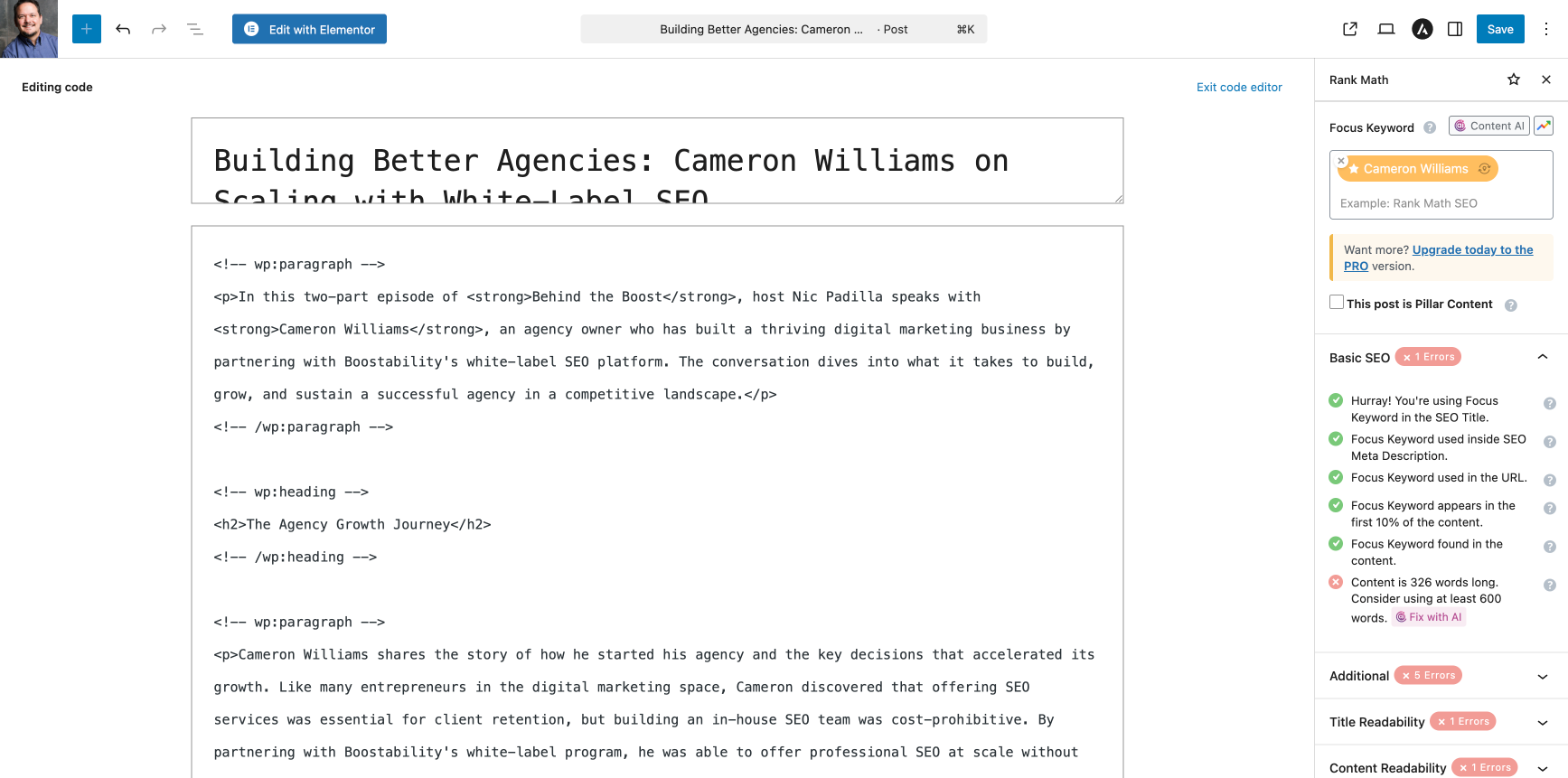
Every post has a Rank Math focus keyword set, typically the name of the interview guest or the primary topic. This follows the entity SEO principle that each piece of content should target a specific entity or topic cluster. The keyword assignments include “Gavan Thorpe” for the personal brand posts, “Charles Laughlin” for the Above the Cloud podcast episodes, “Dennis Yu” for the BlitzMetrics webinar, “SuperbCrew” for the interview posts, “Jack Wendt” for the Geo-Vertical Grid webinar, “Bruce Rowe” for the SEO history interview, “Josh Sanderford” for the trust-first marketing interview, and “Cameron Williams” for the agency scaling interview. Additional keywords target branded terms like “Boostability Partner Program” and “Comparably.”
Tags and categories reinforce entity connections. The “Gavan’s Connections” category groups all blog posts, while tags include “Gavan Thorpe,” “Boostability,” “SEO,” “Dennis Yu,” “Charles Laughlin,” “Behind the Boost,” “Podcasts,” “Leadership,” “Inc. 5000,” “Comparably,” “White-Label SEO,” and each guest’s name. These tags create additional taxonomy pages that Google can index, strengthening the entity mesh.
The Multi-Session Workflow: How Humans Direct AI Agents Across Sessions
This project was not a one-shot build. It required seven sessions of iterative work, each building on the last. This is the key insight for anyone wanting to use AI agents for sophisticated projects: you cannot prompt an agent once and expect a finished product. Instead, you direct the agent through a cycle of build, review, refine, and expand.
Here is how we structured the workflow. In Session 1, the human gave a broad directive (“build a personal brand site for Gavan Thorpe as an entity hub”) along with the domain, WordPress credentials, and general strategy. The agent handled installation, theme selection, content creation, and page structure. At the end of that session, the human reviewed the result and identified gaps — missing SEO optimization, placeholder blog posts, and content that needed polish.
In Session 2, the prompt was more targeted: “optimize every page with Rank Math, set focus keywords, and verify schema.” The agent executed systematically, page by page. Session 3 focused on blog content and interlinking — the human directed the agent to fill out placeholder posts with real content and build an internal linking web. Session 4 combined visual improvements (adding the Boostability logo, credibility bar, video embed) with QA fixes the human had spotted (British spellings, missing spaces, duplicated content). Session 5 ran the comprehensive automated QA scan and created additional content from YouTube videos. Session 6 captured screenshots and created three more blog posts. Session 7 performed a comprehensive visual QA pass, fixing broken links on the About page, adding missing quote marks on the homepage testimonials, repairing the Media Kit email link, and adding YouTube embeds to two blog posts that were missing them. Session 8 ran an automated scanner across every page and post to catch truncated links, fixed five broken links across four pages (including Elementor-cached content), converted a plain YouTube URL to a proper embed on the Media page, and added a workflow diagram to the meta-article.
The pattern is consistent: the human provides strategic direction and quality review, the agent handles execution and systematic work. Each session’s prompt is informed by what the previous session produced. The human does not need to specify every step — they set the goal, the agent figures out the implementation, and then the human reviews and redirects.
For other teams wanting to replicate this process, the key prompts follow a predictable sequence. Start with “build the site structure and core content.” Follow with “optimize SEO across all pages.” Then “fill out blog posts from real content sources (YouTube, interviews, press).” Then “QA the entire site — check spelling, links, formatting, and SEO settings.” Then “make it visually appealing — add logos, credibility signals, video embeds.” Finally, “keep expanding content from available sources.” Each of these can be a single session, and the agent will typically execute dozens to hundreds of steps per session before needing human review.
The most important thing the human does between sessions is look at the actual site in a browser, click through every page, and note what feels wrong. The agent can run automated scans, but a human eye catches things like “this page feels thin” or “this section needs a logo” that no script will flag. That human review turns into the next session’s prompt, and the cycle continues until the site is done — or, more accurately, until it reaches the level of quality the human is satisfied with, since a personal brand site is never truly finished.
What This Demonstrates
This project shows that AI agents can execute a complete personal branding and entity SEO strategy with minimal human direction. The agents performed site setup, content creation, SEO optimization, visual design, quality assurance, and YouTube video repurposing — tasks that would typically require a web developer, a content writer, an SEO specialist, and a QA analyst working together over several weeks.
The result is a live, fully functional website at gavanthorpe.com that serves as Gavan Thorpe’s entity hub. As the AI agents continue their work, this article will be updated with additional details on new content created, optimizations made, and lessons learned.
For a broader guide on the methodology behind AI-powered personal brand websites, see How to Build an AI-Powered Personal Brand Website That Ranks on Your Name, which covers the inventory-first approach, the MAA framework, and how to use AI as a builder rather than an author. For additional case studies of this process in action, see the Trenton Sandler (built from a blank WordPress install) and Justen Martin site builds.
Key Metrics
Total automated steps across all sessions: 850+. Pages created: 11. Blog posts published: 20. YouTube videos repurposed: 10+. Focus keywords set: all 20 posts plus all pages. Internal links added: 60+ across the site. Tags created: 12+. Categories used: 2. Rank Math scores: 69-86 across all content. Schema type: Person with sameAs connections to LinkedIn, YouTube, Crunchbase, and Boostability.
Why This Creates Specific Value for Gavan Thorpe
Gavan Thorpe is the CEO of Boostability — one of the largest white-label SEO platforms in the world. His personal brand site at gavanthorpe.com serves as the entity hub that connects his name to Boostability, his speaking engagements, his industry expertise, and his leadership in the SEO space. For a CEO whose company serves thousands of agencies and businesses worldwide, a personal brand site creates executive visibility that strengthens the company brand. When conference organizers, journalists, or potential enterprise clients search for Gavan Thorpe, they now find a professional site that positions him as a thought leader in SEO and digital marketing — which directly benefits Boostability’s brand positioning. The 850-plus automated steps spanning multiple sessions demonstrate that even complex, multi-session builds can be executed systematically through AI agents.
Why This Creates Value for BlitzMetrics
The Gavan Thorpe build is the most technically ambitious case study in the library — 850-plus automated steps across multiple sessions, with a detailed cost comparison showing $5.60 in AI costs versus $1,085-to-$1,540 for human equivalent work. That is a 200-to-290x cost reduction — the most dramatic efficiency gain documented in any BlitzMetrics meta-article. Building a personal brand site for the CEO of a major SEO platform also carries unique credibility weight: if the CEO of an SEO company trusts BlitzMetrics’ AI agents to build his personal site, it validates the quality of the system for anyone evaluating it. The Boostability relationship also creates a strategic partnership opportunity — Boostability’s thousands of agency clients represent a massive potential customer base for BlitzMetrics’ personal brand services.
Effort and Cost Comparison
The following table compares actual agent performance against estimated human performance for the same tasks. Agent costs are estimated using Claude Opus 4.6 pricing at $5 input / $25 output per million tokens. Human costs use the BlitzMetrics benchmark of $35/hour for an average US digital marketer.
We also offer a done-for-you package to build, maintain, and host your personal brand site for just $99 per month at localservicespotlight.com. This includes everything shown in this case study — the site build, ongoing maintenance, and hosting — so you can focus on running your business while we handle your digital presence.
| Task | Agent Time | Human Time | Agent Cost | Human Cost ($35/hr) |
|---|---|---|---|---|
| Site foundation and content build (Session 1: 302 steps) | ~25 min | 10–14 hours | $1.50 | $350–$490 |
| SEO optimization across all pages and posts (Session 2: 119 steps) | ~10 min | 4–6 hours | $0.60 | $140–$210 |
| Blog content and interlinking (Session 3: 108 steps) | ~10 min | 4–6 hours | $0.60 | $140–$210 |
| QA, visual polish, and expansion (Session 4: 100+ steps) | ~8 min | 3–4 hours | $0.50 | $105–$140 |
| Comprehensive QA and expansion (Session 5: 100+ steps) | ~8 min | 3–4 hours | $0.50 | $105–$140 |
| Screenshots, new content, expansion (Session 6: 80+ steps) | ~7 min | 2–3 hours | $0.40 | $70–$105 |
| Comprehensive QA and improvements (Session 7: 50+ steps) | ~5 min | 2–3 hours | $0.30 | $70–$105 |
| Comprehensive QA and link repairs (Session 8: 50+ steps) | ~5 min | 2–3 hours | $0.30 | $70–$105 |
| Meta-article writing and publishing | ~15 min | 3–4 hours | $0.90 | $105–$140 |
| TOTAL | ~1 hr 28 min | 31–44 hours | $5.30 | $1,085–$1,540 |
Dennis Yu
Dennis Yu is the CEO of Local Service Spotlight, a platform that amplifies the reputations of contractors and local service businesses using the Content Factory process. He is a former search engine engineer who has spent a billion dollars on Google and Facebook ads for Nike, Quiznos, Ashley Furniture, Red Bull, State Farm, and other brands.
Dennis has achieved 25% of his goal of creating a million digital marketing jobs by partnering with universities, professional organizations, and agencies. Through Local Service Spotlight, he teaches the Dollar a Day strategy and Content Factory training to help local service businesses enhance their existing local reputation and make the phone ring.
Dennis coaches young adult agency owners serving plumbers, AC technicians, landscapers, roofers, electricians, and believes there should be a standard in measuring local marketing efforts, much like doctors and plumbers must be certified.