
 by
by
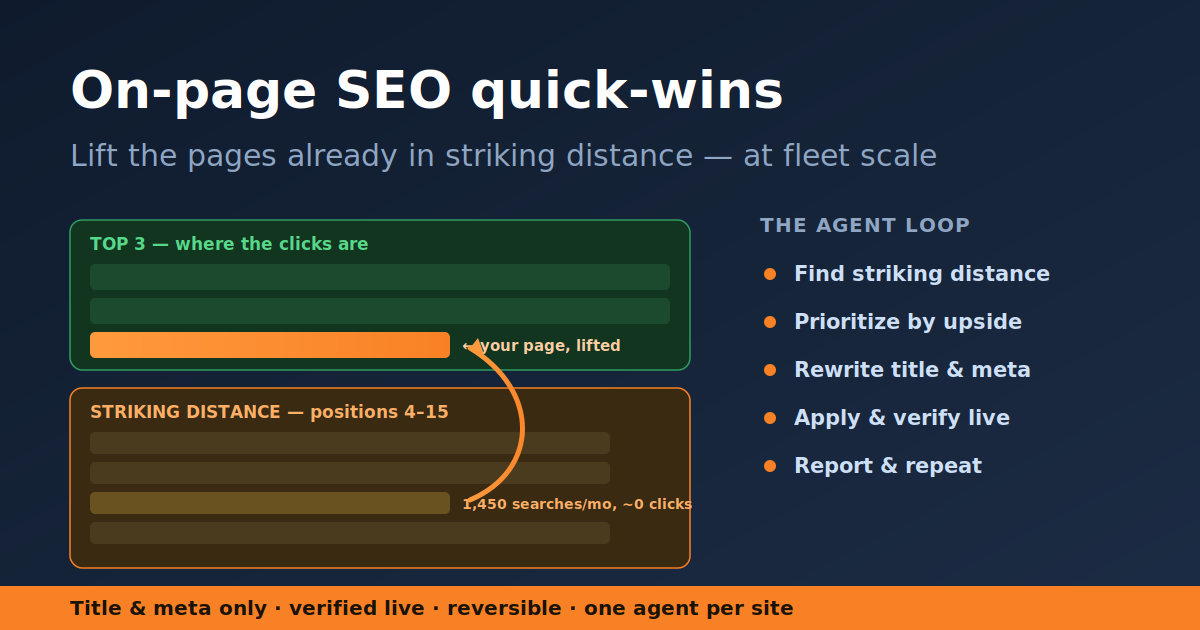
Open the rankings report for any site that has been publishing for a few years and you will find the same quiet waste: pages sitting at position 8, 9, or 11 for terms real people search every day, catching almost none of the clicks. The page already earned Google’s trust. It just isn’t phrased to win the click. This is the cheapest traffic in SEO, and once you see the pattern you can hand it to an agent and run it across every site you manage.
Who this is for: anyone responsible for more than one site — an agency team, a network operator, or a business owner with a cluster of properties — who wants more organic traffic without writing new content or chasing links. The work here is small, safe, and repeatable, which is exactly why it scales.
The quiet waste: across the Spotlight network of local-service sites, one page ranked 9th and 10th for a set of terms worth 1,450 searches a month — and captured barely a couple dozen clicks. The page was fine. Its title never used the word people were actually typing.
Start with pages already in striking distance
“Striking distance” means positions 4 through 15 — off the top, but close. A page down at 40 has a content or authority problem you cannot fix with a title tweak. A page at 8 is one good title away from the top three, where the clicks actually live. That narrow band is where the quick-wins hide.
Pull every keyword a site ranks for in that band with real search volume, straight from a rank tracker or Search Console. Sort by volume. You are looking for pages that rank for a term people want but sit just below the fold of page one.
Prioritize by opportunity, not by gut
Not every near-miss is worth touching. Score each page by three things at once: how much the term is searched, how close to the top it already sits, and how weak the competition is. High volume, near the top, low difficulty — that is a real quick-win. High difficulty at position 14 is a content project, not a title edit.
Group the keywords by the page that ranks, because one page often ranks for several near-miss variations. Add that volume up and the true prize gets obvious. The best targets rank for a cluster of related terms at once, so a single title change lifts all of them together.
The upside is not small. Positions one through three take the large majority of clicks; everything below splits the scraps. Two of that page’s terms alone are worth 700 and 600 searches a month. Phrasing the title for what people actually search lifts the click-through right away, and the sharper relevance gives Google a reason to nudge the page upward over the following weeks — all from an edit that takes two minutes and touches no content.
Rewrite the title and meta to match intent
Here is where most of the win comes from. Read the query and ask what the searcher wants, then make the title say it in the first few words. Someone typing a brand plus the word “reviews” wants a verdict, not a how-to. Someone typing a name wants to know who that person is. Match the phrasing they used.
In the example above, the page was titled around how to use a tool. The searches were for the tool’s name and the word review. Front-loading the exact term and adding “review” closed the gap without a word of new content. Then replace any meta description that is a placeholder or cut off mid-sentence with one complete, honest line that earns the click. The rule that keeps this safe: never claim anything in a title that the page does not actually deliver.
Apply the change and verify it went live
Push the new title and meta through your SEO plugin, then confirm it rendered on the public page. A saved setting is not a live change — caching, the wrong page ID, or a plugin quirk can swallow it silently. Re-fetch the page, read the real title tag back, and only then call it done. Keep the old text so any change reverts in one step.
This discipline is what makes the work trustworthy at scale. Every edit is title-and-meta only, so the blast radius of a mistake is a single snippet, and every edit is checked against the live page before you move on.
Hand the whole loop to agents
Because the steps are identical for every page and every site, they belong to an agent, not a person clicking through dashboards. One agent per site pulls the striking-distance list, drafts the improved title and meta, applies them through the plugin, verifies each one live, and reports back what it changed. A lead agent collects those reports into a single view of the whole network.
We run our fleet this way. Agents already handled Search Console across the fleet, and the same pattern that lets an agent tell a real attack from spam lets it sort a genuine ranking opportunity from a page best left alone. The human sets the guardrails and approves the batch; the agents do the repetitive miles.
The takeaway is simple: your best traffic opportunities are pages you already own. Find the ones in striking distance, phrase them for the searcher, verify the change, and let agents run it across every property on repeat.
Put this to work on your sites
If you manage a network of local-service sites and want to know how much traffic is stranded in striking distance right now, get a quick audit — the same review our agents run across the Spotlight network, page by page, site by site.
Originally published .
Dennis Yu
Dennis Yu is the CEO of Local Service Spotlight, a platform that amplifies the reputations of contractors and local service businesses using the Content Factory process. He is a former search engine engineer who has spent a billion dollars on Google and Facebook ads for Nike, Quiznos, Ashley Furniture, Red Bull, State Farm, and other brands.
Dennis has achieved 25% of his goal of creating a million digital marketing jobs by partnering with universities, professional organizations, and agencies. Through Local Service Spotlight, he teaches the Dollar a Day strategy and Content Factory training to help local service businesses enhance their existing local reputation and make the phone ring.
Dennis coaches young adult agency owners serving plumbers, AC technicians, landscapers, roofers, electricians, and believes there should be a standard in measuring local marketing efforts, much like doctors and plumbers must be certified. He has appeared on 353 podcasts with 619 credited episodes — see the full list of his podcast appearances.