
 by /
by /

Every once in a while I meet someone who makes me feel like I’m the one who’s behind, and I’ve spent a billion dollars on ads and been building things on the internet since before most people had email. Sardor Umarzinov is one of those people.
Sardor is the founder and CEO of Home Alliance Ecosystem Group, an AI-enabled platform for the home services industry. He has rolled up more than a dozen home service companies with over $100 million in revenue, he sits on roughly six million customer records built up over the last 10 to 15 years, and in the last three or four months alone he has vibe coded more than 200 products.
So I sat down with Sardor over a pizza. Instead of just talking about building software, we built a real contractor marketing audit platform live, start to finish, before the pizza got cold. What follows is everything he showed me: the mindset, the exact stack, and the lessons any entrepreneur can steal.
Watch the full episode
The full 25-minute build, start to finish.
It started with a Pac-Man game
Sardor’s first vibe coded app wasn’t a $100 million idea. It was a Pac-Man game for his kid.
“I was just playing with it,” he told me. Then he advanced it into a time-management product. Then a health app that pulls data from the Oura Ring, from the Libre glucose monitor, from lab blood tests, all in one place. He was building some of these between sets at the gym.
Here’s what I want our young entrepreneurs to take from that. He didn’t start with the big platform. He started with a toy, got his reps in, and let the ambition of the projects grow with his skill. If you’re waiting for the perfect idea before you start, you have it backwards. Start with the Pac-Man.

Every problem is a product waiting to happen
The best part of talking to Sardor is that every story turns into a product.
He told me about a customer who was on the do-not-call list. Home Alliance doesn’t do cold calling, they only reach existing customers to say, “Hey, is it time for your maintenance?” But one SMS or callback annoyed this particular customer, and she filed a complaint. Most operators would eat the headache and move on.
Sardor documented the entire case and turned it into a go-to-market TCPA protection platform, a subscription product for other home service companies who face the exact same risk.
“I love it,” I told him, “when you solve one thing and it becomes a product because other companies have the same problem.” Now he has a SaaS.
That’s the whole game. As a founder, you can’t solve a problem you’ve never faced. When you live inside an ecosystem, a dozen companies, $100 million a year of contractor jobs, you run into problems constantly. Each one is a product you can build once and sell to everyone else who has it.
The real moat is your data
Sardor is a genuinely good vibe coder. But that’s not his advantage, and he’d tell you the same.
“It’s not that he’s an amazing vibe coder, although he is,” I said while we were talking. “It’s that he understands, from a strategy standpoint, what the advantage is.” The advantage is the data.
Six million customer records over 10 to 15 years. That’s a moat you cannot fake with a Semrush export or an Ahrefs pull, because anyone can do that now, AI can do that. A real moat is your own customers’ data, their entire journey, sitting in a warehouse you own.
And here’s the trap most businesses fall into: when you sign up for someone else’s CRM, ServiceTitan, HouseCall Pro, RingCentral, that platform owns your data. Sardor took 10 years and nearly signed a $400,000-a-year deal with ServiceNow before deciding to build his own platform, Apollo, so he’d own everything.
“When you have your own, you own the data,” he said. “That data is really priceless.”
Now he’s building a copilot on top of those six million records, one that doesn’t just flag a problem for his agents and contractors, but tells them what to do about it. The more it’s used, the smarter it gets; the smarter it gets, the bigger the moat. That’s recursive self-improvement, and Sardor has the underlying data assets to actually pull it off.
How we vibe coded a real platform over one pizza
Here’s the part that will change how you work.
I told Sardor about a common problem: a plumber in Denver whose phone isn’t ringing. His SEO agency does a bad job, his Google Ads aren’t converting, and nobody can tell him where his money is actually going. I wanted an agent that audits all of that and then fixes it. So Sardor built it in front of me. Three tools, one pizza:
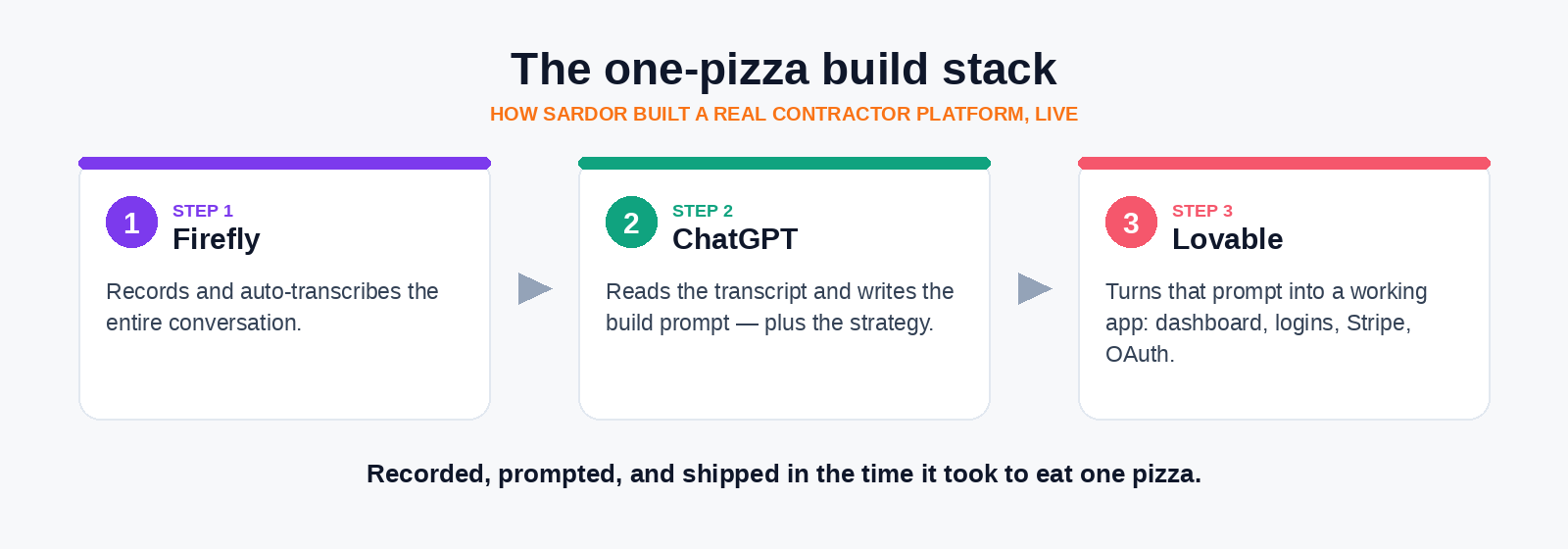
1. Firefly to record and transcribe the whole conversation, so none of the thinking got lost.
2. ChatGPT to take that transcript, reason through the strategy, and write the build prompt. He loaded the full conversation as a PDF and let it think. It came back and named the product itself, “the CFO for contractor marketing spend,” “the Bloomberg Terminal for home service growth.” That was the moment it clicked.
3. Lovable to actually build it. He dropped ChatGPT’s prompt into a new Lovable project, and it started coding, the dashboard, the multi-tenancy, the logins, Stripe payments, email auto-responders, OAuth into Google Analytics, Meta Business Center, and CallRail.
In a few minutes we had a working dashboard on screen. “It took us like one pizza to build a platform,” Sardor said. He’s right. The workflow is the lesson here: record the thinking, let a strategy model turn it into a spec, let a builder turn the spec into software. Swap in whatever tools you like; the logic is what matters.

Audit first, and calculate the ROAS agencies won’t
What the platform actually does is simple and badly needed. A contractor connects his accounts, Google Ads, Bing, Meta, his Google Business Profile, call tracking like CallRail or CallTrackingMetrics, and his MCC. The platform then identifies which keywords and search terms are actually driving return on ad spend, which campaigns to scale, and which to shut down.
Most agencies can’t do this. Not because they’re lying, but because they never get access to the underlying numbers in HouseCall Pro or ServiceTitan, so they can’t calculate real ROAS. They’ll happily rank you number one for a keyword nobody searches, and call that a win.
“They just sell you, ‘Oh, I gotta bring you to the top of Google,'” Sardor said. “But what happens after, nobody really knows.”
Put everything in one place, tie the ad spend all the way to the booked job, and the truth shows up fast.
Build the MVP fast, harden it later
I asked Sardor the obvious question: is this real, or is it a nice-looking prototype with fake data? He was honest about it.
Lovable is where he builds the MVP, the alpha and beta. It creates beautiful prototypes fast, but the security might not be there yet. Once a product is real, his rule of thumb is about 100-plus accounts, he hands it to his IT team to rebuild it properly: staging and production, GitHub and Supabase on the back end, AWS to scale, all the DevOps.
And he stress-tests it in the most practical way I’ve heard. “I tell my IT team, ‘Go break it,'” he said. “If they can, anyone can.” Whatever weak spots they find, they fix.
Prototype at the speed of conversation. Productionize when the traction is real. Don’t confuse the two.
Measure your team by how many tokens they use
This one stopped me. Sardor tracks how many tokens his team uses as a core metric, weekly and monthly.
Right now his ratio is about 100 to 1: half a million dollars on payroll, five thousand on tokens. He wants to get to 10 to 1, then 1 to 1, and eventually flip it to 1 to 10, more tokens, less labor.
His biggest problem? Two-thirds of his people use almost no tokens. Some of the old-school developers think they’re smarter than the tools. So he’s pushing everyone to use more, with unlimited access, and a simple standard that matches what we tell our own people: if you’re not doing ten times the work you did last year, you’re not using AI correctly.
Our own Upwork for AI agents
Where this is all heading, and what Sardor and I started scheming about over the pizza, is a marketplace for agents. You build an agent that audits a contractor or runs a task, you publish it into a marketplace like a little Upwork, and other people hire it for five dollars a job. The agents with the best reviews get featured and promoted, and the people who built them earn a commission every time their agent works.
We’re basically becoming the managers for the agents we create. That’s the next frontier, and people like Sardor are the ones who’ll build it.
Where to find Sardor Umarzinov
If any of this resonated, go learn from Sardor directly. You can find him at sardorumarzinov.com, search “Sardor Umarzinov” on Google, or check out his Founder to Founder podcast for founders. You can also see the ecosystem he’s built at homealliance.com, look at the About page and you’ll find him on YouTube, Facebook, and LinkedIn.
The most important thing I took from Sardor is this: start with a real business problem. He didn’t build 200 apps by accident. He sees a problem in one of his companies, a TCPA complaint, a broken ROAS report, builds a tool to fix it, and then sells that tool to everyone else with the same problem. That’s what entrepreneurship is.
“With AI, you can do anything,” Sardor said. “As long as you can speak your thoughts, you can build it.”
So go order your pizza. Talk your idea through with ChatGPT or Claude, let it write you the prompt, drop it into a builder, and see what you’ve made by the time the pizza’s done. Then let us know, we want to see you win.
Dennis Yu
Dennis Yu is the CEO of Local Service Spotlight, a platform that amplifies the reputations of contractors and local service businesses using the Content Factory process. He is a former search engine engineer who has spent a billion dollars on Google and Facebook ads for Nike, Quiznos, Ashley Furniture, Red Bull, State Farm, and other brands.
Dennis has achieved 25% of his goal of creating a million digital marketing jobs by partnering with universities, professional organizations, and agencies. Through Local Service Spotlight, he teaches the Dollar a Day strategy and Content Factory training to help local service businesses enhance their existing local reputation and make the phone ring.
Dennis coaches young adult agency owners serving plumbers, AC technicians, landscapers, roofers, electricians, and believes there should be a standard in measuring local marketing efforts, much like doctors and plumbers must be certified. He has appeared on 353 podcasts with 619 credited episodes — see the full list of his podcast appearances.