
 by
by

Before a prospect ever talks to you, Google and AI have already decided who you are. They pull your reviews, your mentions, your old profiles, your competitors’ claims, and they render a verdict. That verdict shows up in search results, in AI answers, in the little knowledge panel next to your name.
Most founders have no idea this is happening. And they have even less idea how to change the verdict.
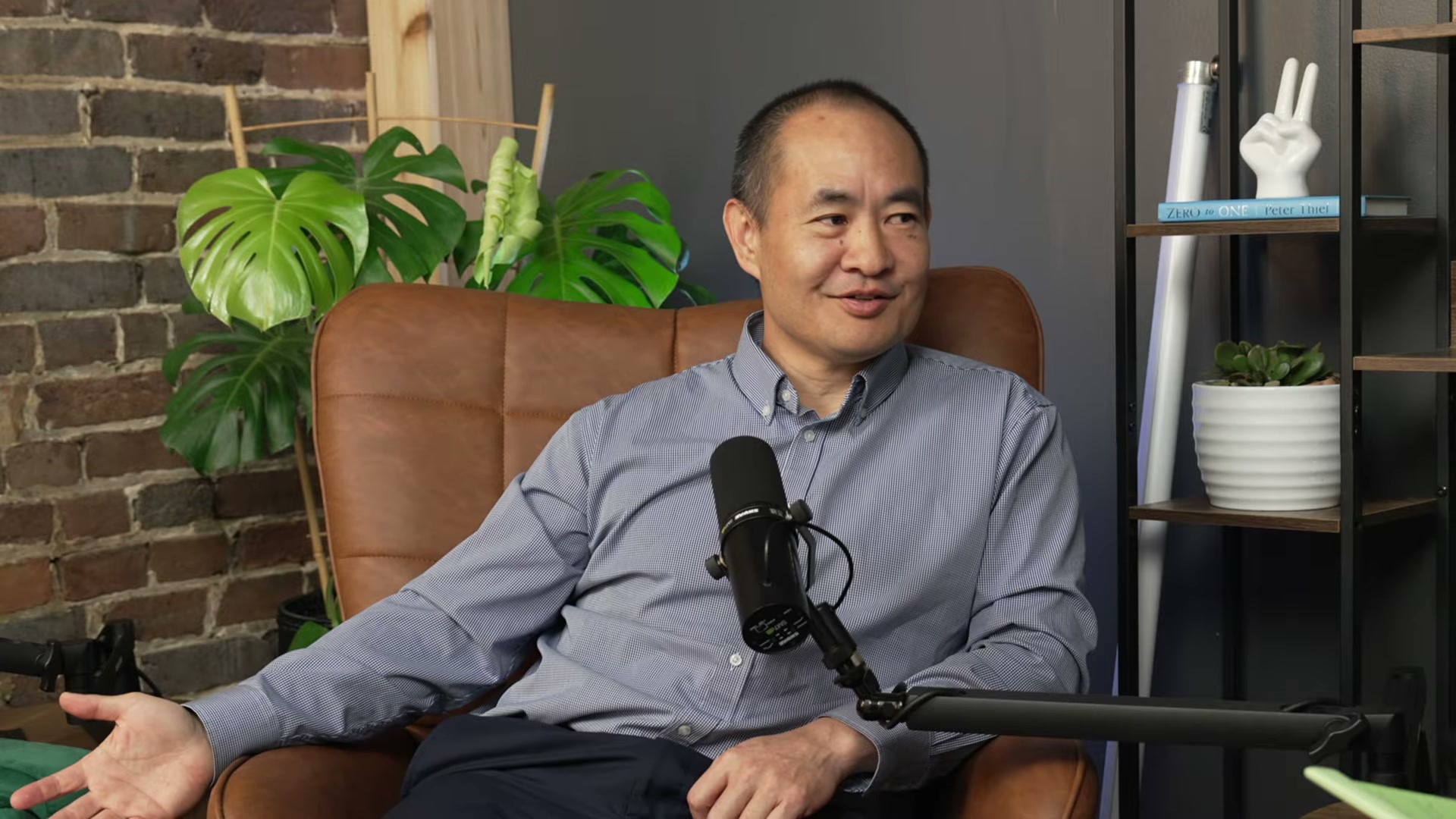
I sat down with Joshua Collier on The Josh Collier Show to walk through exactly how this identity system works — and what regular business owners can do about it. Watch the full conversation here, then read on for the pieces that matter most.
Everything online has an ID number
Here is the part most marketers miss, including the ones who call themselves SEO experts:
“Even these people that claim to be experts in SEO, they have no idea what a KGM ID is.”
A KGM ID — a Knowledge Graph Machine ID — is the identifier Google and AI systems attach to every entity on the internet. Here is how I put it to Josh:
“Every person, every company, every product, every location… even the dog parks you go to has an ID associated with it, right?… it’s basically like the government assigns a number to you, right? But the AI and the internet has that on every asset, entity, everything.”
Think of it like a social security number for everything. Google’s system does not really see “Joshua Collier the podcast host.” It sees an ID, and attached to that ID is everything the internet has ever said about him — which is exactly why Josh has a problem. There is a jazz singer with a similar name. There is Jacob Collier, the famous musician. When the information attached to your ID is thin or confused, the machine guesses. And it guesses wrong.
The fix starts with understanding that you are not managing a website. You are managing an ID.

Marketing is proof, not pitch
“Most people think marketing is just having a better sales pitch and running ads. I look at it as where’s the proof?”
That one sentence reframes the whole game. Google’s E-E-A-T standard — experience, expertise, authority, trust — is not a vibe. It is a measurement of evidence. The businesses that win are not the ones shouting loudest. They are the ones with the most proof attached to their ID.
In the interview, I tell the story of Brady Sticker, who runs Church Candy:
“So now if you Google Brady Sticker, you see him and a knowledge panel. But if you Google Brady Sticker two years ago when we first started doing this, you saw Tom Brady stickers.”
Two years of collecting proof — real mentions, real coverage, real evidence of who Brady is and what he does — turned a name collision with an NFL quarterback into a full knowledge panel. Here is my role in stories like this one, in my own blunt words:
“I’m just an amplifier of Brady.”
That is the job. You do not invent authority. You find the real proof that already exists, organize it, and amplify it until the machines can see it clearly.

The algorithm is a mirror, not a judge
This is the part that makes people uncomfortable:
“So don’t go blame the algorithm, right? Don’t be like a fat person blaming the scale, okay? It’s you, bro. It’s what you’re doing.”
I open TikTok and show what I see: golf videos, mountain climbing. Not because TikTok decided I am a golfer, but because that is what I click on. Every feed — TikTok, Google, AI answers — personalizes to the person looking. The algorithm reflects behavior back. It does not invent it.
Then there is the story that proves how deep this goes. After speaking at a Global Media Forum and riding in a president’s armored motorcade, I Googled my own name from Azerbaijan: photos of me beside the president. I Googled the exact same name from Armenia, across an ethnic conflict: verdicts that I am “evil,” a “puppet,” a “useful idiot” who was bribed. Same man. Same facts. Opposite truths.
There is no single Google verdict on you. Identity online is a kaleidoscope, and it changes with whoever is looking. That is why chasing one “true” ranking is a losing game. What works instead:
“Well, if you’re very clear on who your niche is, if you’re very clear on who you’re connected to and who you serve and the values that you have, then the algorithm works in your favor.”
And when the tactics change — and they always change — this is what survives:
“Who you actually are, the real trust and proof and evidence of that is what carries forward when all the AI is melted away.”
Take inventory before you build anything
Before spending a dollar on marketing, my advice is to do something most founders never do: ask AI for a full inventory of what it already knows about you.
“Surface everything, the good, bad, and the ugly.”
When my team ran this on Josh, it came back 18 pages long. Eighteen pages of mentions, appearances, connections, history — most of which Josh had forgotten about or never knew existed. You cannot fix what you cannot see, and you cannot amplify proof you have not collected.
Then comes the part almost nobody expects: the fastest way to build your own authority is to build someone else’s. I describe making a short video honoring David Carol and his company Dope Marketing — no ask, no pitch, just recognition. It pulled 400,000 views on YouTube.
“My intent was to honor him.”
That is the whole philosophy in one line. The principle behind it:
“Personal brand is not you talking about yourself. It’s about how you elevate other people.”
Your brand is a bank account
Here is my definition, and it is worth reading twice:
“So if I look at your personal brand, it’s not what you say about yourself. It’s the sum of every positive or negative mention from anyone that has ever worked with you, that has bought from you, that knows you… If I were to sum up all of those, that’s your personal brand. That’s kind of like a bank account. And Google tracks it — there’s actually a number. It’s called a confidence score.”
Every review, every testimonial, every podcast appearance, every client win anyone ever posted — deposits. Every complaint, every inconsistency, every dead profile — withdrawals. Google keeps score whether you participate or not.
Which leads to the rule that stings:
“Well, if your products and services are as good as you say they are, I should mainly like 99% I should be seeing what other people say about your coaching program, about your AI software, about, you know, how good of a plumber you are instead of you saying that you’re a great plumber. Doesn’t that look a little weird and a little douchy if it’s just you talking about your stuff?”
Ninety-nine percent of what people find about you should be other people talking about you — not you talking about yourself. I live this:
“I don’t work on my personal brand because other people do it for me.”

The founder playbook: from agency to exit
The conversation closes with the pattern I have watched play out across dozens of founders, told through Marco Sipilo’s story. Marco started with what I call a “dog’s breakfast” of random clients, then niched into concrete flooring, built to 300+ clients, gave away a free course, a book, and a podcast — and then launched HVACquote.ai, a software product for the same niche. Three hundred customers at $350 a month inside a year, bootstrapped, while a $12M-funded competitor lost.
Agency proves the playbook. Content and proof build the authority. Software scales it. Then comes the exit — and my one-line lesson on selling a company:
“The terms are more important than the price.”
An earnout with good terms beats a bigger headline number with bad ones. Every time.

What to do this week
You do not need a rebrand. You need an inventory and a proof habit. Here is the short version:
- Google yourself. Search your name and your business name. Screenshot what comes up — including what AI overviews and chatbots say about you. That is your starting verdict.
- Ask AI for the full inventory. Prompt it to surface everything it knows about you and your business: the good, the bad, and the ugly. Save it.
- Fix inconsistencies. Your name, your business name, your location, your description — the same everywhere. Confused machines guess wrong.
- Start a proof file. Every review, mention, client win, podcast appearance, and testimonial goes into one knowledge base. This is the raw material everything else is built from.
- Stop talking about yourself. Honor someone this week — a client, a partner, a peer. Make something that elevates them. Watch what comes back.
- Ask the machine directly. My closing challenge: ask AI “what do you say about how to start building a KGM ID?” Then do what it tells you.
The machines have already decided who you are. The only question is whether you are going to manage that decision — or let the internet’s random noise manage it for you.
Watch the highlights
We cut the sharpest moments from this interview into Shorts — each one a standalone lesson:
- Stop Blaming the Algorithm
- Your Personal Brand Is a Bank Account
- 99% of What People See Shouldn’t Be You
- Google Gave Everything a Social Security Number
- Never Cold Email Again
Recorded with Trent Denson at Spread the Positive in Murfreesboro, Tennessee. Related reading: Diamonds in the Rough: How We Unlocked Joshua Collier’s Hidden Authority and Building Joshua Collier’s Entire Brand Ecosystem — Every Step Documented. More on the interview at joshcollier.ai.
Originally published .
Dennis Yu
Dennis Yu is the CEO of Local Service Spotlight, a platform that amplifies the reputations of contractors and local service businesses using the Content Factory process. He is a former search engine engineer who has spent a billion dollars on Google and Facebook ads for Nike, Quiznos, Ashley Furniture, Red Bull, State Farm, and other brands.
Dennis has achieved 25% of his goal of creating a million digital marketing jobs by partnering with universities, professional organizations, and agencies. Through Local Service Spotlight, he teaches the Dollar a Day strategy and Content Factory training to help local service businesses enhance their existing local reputation and make the phone ring.
Dennis coaches young adult agency owners serving plumbers, AC technicians, landscapers, roofers, electricians, and believes there should be a standard in measuring local marketing efforts, much like doctors and plumbers must be certified. He has appeared on 353 podcasts with 619 credited episodes — see the full list of his podcast appearances.