
 by

Dennis Yu and Paul Ryazanov recorded this conversation together in Manchester, England. Watch the full ten minutes above, or read the key ideas below.
Experience is an AI advantage when decades of relationships, judgment and proof are fed into AI tools that multiply them. Most people over 60 assume the opposite. They think AI belongs to the young, the technical and the people who can write code.
Dennis Yu, co-founder of BlitzMetrics and CEO of Local Service Spotlight, makes the case that they have it backwards. He made it in a conversation with Paul Ryazanov, co-founder and CEO of MageCloud Agency, founder of Ecommerce Camp UK and an international conference speaker on ecommerce and conversion since 2012. Paul started his career in 2003, long before anyone had a chatbot. That’s exactly why his question in the middle of the conversation matters, and why Dennis’s answer is worth reading slowly.
A 74-year-old photographer built five AI agents over breakfast
Dennis opens with a story from the day before the recording. He was in Azerbaijan with his friend Reza Deghati, the Iranian-French photojournalist whose work has run on 25 National Geographic covers. Reza is 74. Over breakfast at the Fairmont, he told Dennis he didn’t know what to do about AI.
“I have 2.5 million photographs and I have to deal with being able to book travel and I need a personal assistant that can figure out where I’m shooting next and what client and what event.”
Reza listed the roles he needed: a video editor, a strategist, a graphic designer and someone to manage a huge database of his work. He didn’t know how to build agents. Dennis installed Wispr Flow and a few other tools on Reza’s MacBook Pro, and by the end of the meal Reza was talking to his own agents.
The lesson Dennis drew from that breakfast is the core of the whole video. A new photographer can buy the latest camera. They can’t buy the relationships Reza has with heads of state, or the proof of a career spent shooting all over the world.
“Because he has the relationships, because he’s worked with a lot of these people, because he has the experience and the proof of having done this all over the world, the AI is a multiplier of that.”
That’s the reframe. AI doesn’t replace experience. It multiplies whatever you bring to it, and someone with 40 years of relationships brings a lot more than someone with four.
Ask the question ChatGPT and Claude have been waiting for
Most people use a chatbot like a search box. They ask a narrow question and get a narrow answer. Dennis suggests a different first conversation, one that points the AI back at you:
“Based on everything that you know about me, all of my experience, what are things about me that I don’t even realize that are strengths of mine, that are opportunities, who are some of the key relationships in my network that I should probably reach out to because there’s something that we could do together.”
He calls this the question ChatGPT and Claude have been “dying to be asked.” The tools are obedient by default. They answer only what you ask. If you never ask about your hidden strengths or the relationships you’re sitting on, they’ll never volunteer it.
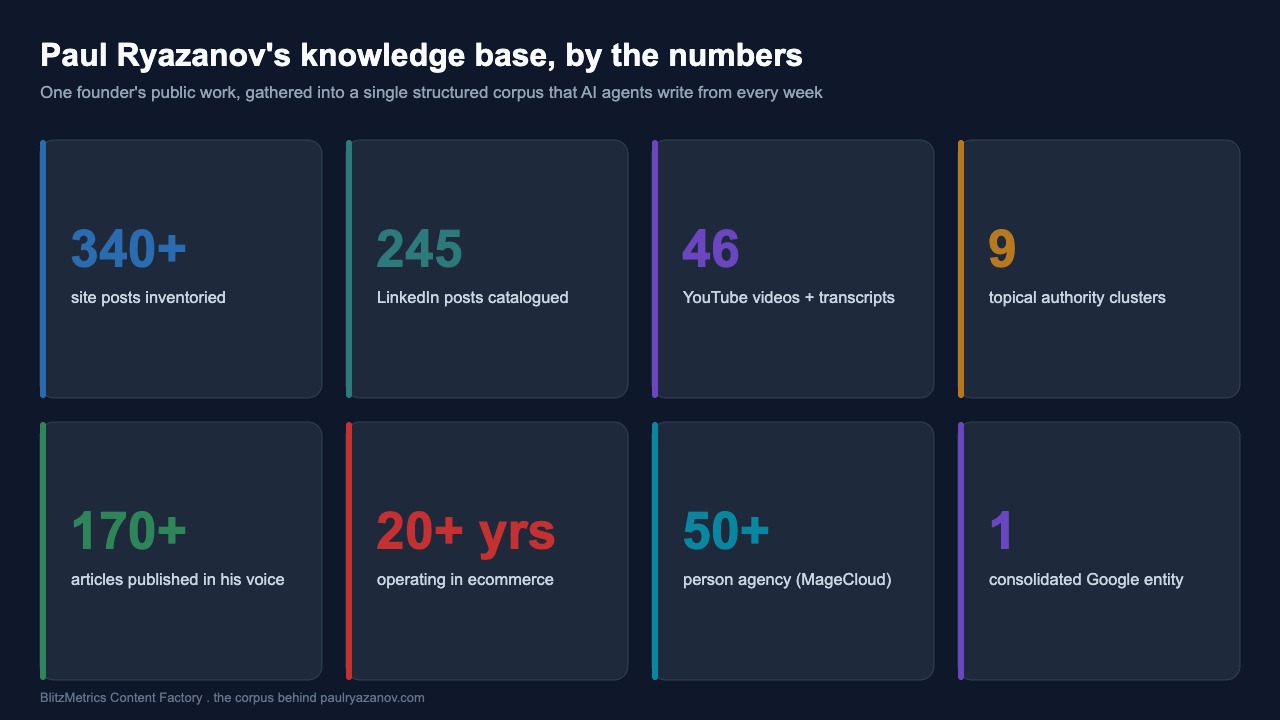
This is the same idea behind the ecommerce knowledge base built for Paul. Paul had a decade of LinkedIn posts, recorded talks and articles. Once that experience was structured, it became something an agent could actually work with, and the value had been there the whole time.
Describe the goal and let the agent work out the plan
The biggest thing that holds experienced people back is the belief that AI is technical. Dennis pushes hard on that.
“People keep thinking it’s like writing Python scripts. No… I don’t even write any code anymore, right? What I do is I think strategically and I talk to it.”
His point is that the whole job of an agent is the goal, not the method. You might not know how to do something. You can still describe what you want done, and the agent will work out the steps and explain them as it goes.
Reza ran into this firsthand. He needed to install scripts at the command line to troubleshoot some programs, something even Dennis says he isn’t technical enough to follow. Reza’s instinct was that he needed his IT person. Dennis told him to ask Claude instead. Claude gave him code to paste in, asked for a screenshot to check whether it worked and walked him through several rounds of fixes until the problem was solved.
“You have the IT person. It’s right there on your computer. You can ask it. And that’s the unlock.”
For someone in their 60s or 70s, the skills that matter are the ones they’ve been practicing for decades: thinking clearly, asking good questions, communicating a plan and managing people to get it done. Those are exactly the skills that make an AI agent useful.
Paul’s question: what if your whole career happened before AI?
Halfway through, Paul asks the question a lot of viewers are probably thinking.
“How would you start, like, if I’m 60 years old, my whole life, it’s pre-AI… I don’t have anything on my, you know, emails.”
It’s a fair challenge. Reza had 2.5 million photographs to work from. Plenty of experienced professionals don’t have a digital trail at all. Dennis’s answer is to have the AI interview you, one question at a time, about your mission, your fears, your strengths and your blind spots, and to tell it to be direct with you. We broke that answer down step by step in a companion piece on how to let AI interview you, including the exact wording Dennis used.

Why experience is an AI advantage: your relationships
Dennis is blunt about where older professionals stand against younger ones and against the machines themselves.
“We’re never going to out code the young adults. We’re never going to beat the AIs at the work or the programming. What’s the advantage that we have? It’s always relationships.”
He also references a point from Igor Ivitskiy, whom Paul interviewed separately about agencies and AI: personality and the intangible things that come with a long career are what the AI multiplies. Dennis, who mentions he’s 51, says he’s watched friends in their 60s do exactly this. They spent years consulting, then turned everything in their heads into a “second brain” and started businesses that now earn more than the consulting did.
The advice in this part of the conversation is plain. Start talking to ChatGPT, get whatever your expertise is out of your head and into a form the AI can work with, and build a new business on it. It’s a direct line from a lifetime of knowledge to a product that people can buy access to, which is the same idea Dennis covers in turning your knowledge into AI agents.
Stop typing and start talking
The last practical tip is about how you talk to the tools. Dennis is emphatic that you shouldn’t treat AI like a Google search box.
“Don’t type at it. This is not the Google search box. You speak at it.”
He recommends Wispr Flow, a free voice dictation app, over the built-in dictation in Windows or macOS. You hold the function key down while you talk and let go when you’re done. Earlier that evening Paul had watched Dennis do it, rambling at an agent for about three minutes with no tidy outline, and then watched the agent work through dinner on what he’d said.
That messy, spoken context is the point. Dennis says people are surprised at the depth they get when they talk to the AI like a person, correct themselves mid-sentence and add the thing they forgot. You don’t need a perfect prompt. You need to say what’s on your mind. If you want to see what that looks like at scale, Dennis shows his own setup in his Claude, ChatGPT and Grok agents at work.
Experience is crude oil and AI is the refinery
Dennis closes with a metaphor. Thirty years of experience is raw material, like crude oil or coal pulled out of the ground. AI is what refines it.
“It is not a technical thing. It is an amplifier.”
For Paul, a founder who built MageCloud over more than a decade and has spoken at PubCon, BrightonSEO and MeetMagento, that refining has already started. His knowledge base turned years of posts and talks into material that agents can search, cite and repurpose. This conversation with Dennis is part of that same body of work, and it’s how BlitzMetrics approaches every recording through the Content Factory: one conversation, turned into assets that keep building trust.
Try it this week
The video description gives a starting prompt you can say out loud in your own words:
“Interview me about my experience, strengths, blind spots and what I want to do next. Ask questions one at a time. Help me turn what I know into a clear next step.”
Then do what Dennis asks at the end of the video and let him and Paul know what you found. You can follow Paul’s work on Paul Ryazanov’s YouTube channel and read more about how his body of work was organized in how we built Paul’s knowledge base with AI.
Originally published .
Dylan Haugen
Dylan Haugen is a professional dunker, content creator, and editor at the Content Factory, where he transforms podcasts and interviews into strategic brand assets. He collaborates with Dennis Yu to support young entrepreneurs and business owners in building their personal brands through education, transparency, and effective content marketing. As the host of the Dunk Talk podcast and a dedicated advocate for establishing dunking as a recognized sport, Dylan combines athletic expertise, storytelling, and digital strategy to help elevate the next generation of creators.