
 by
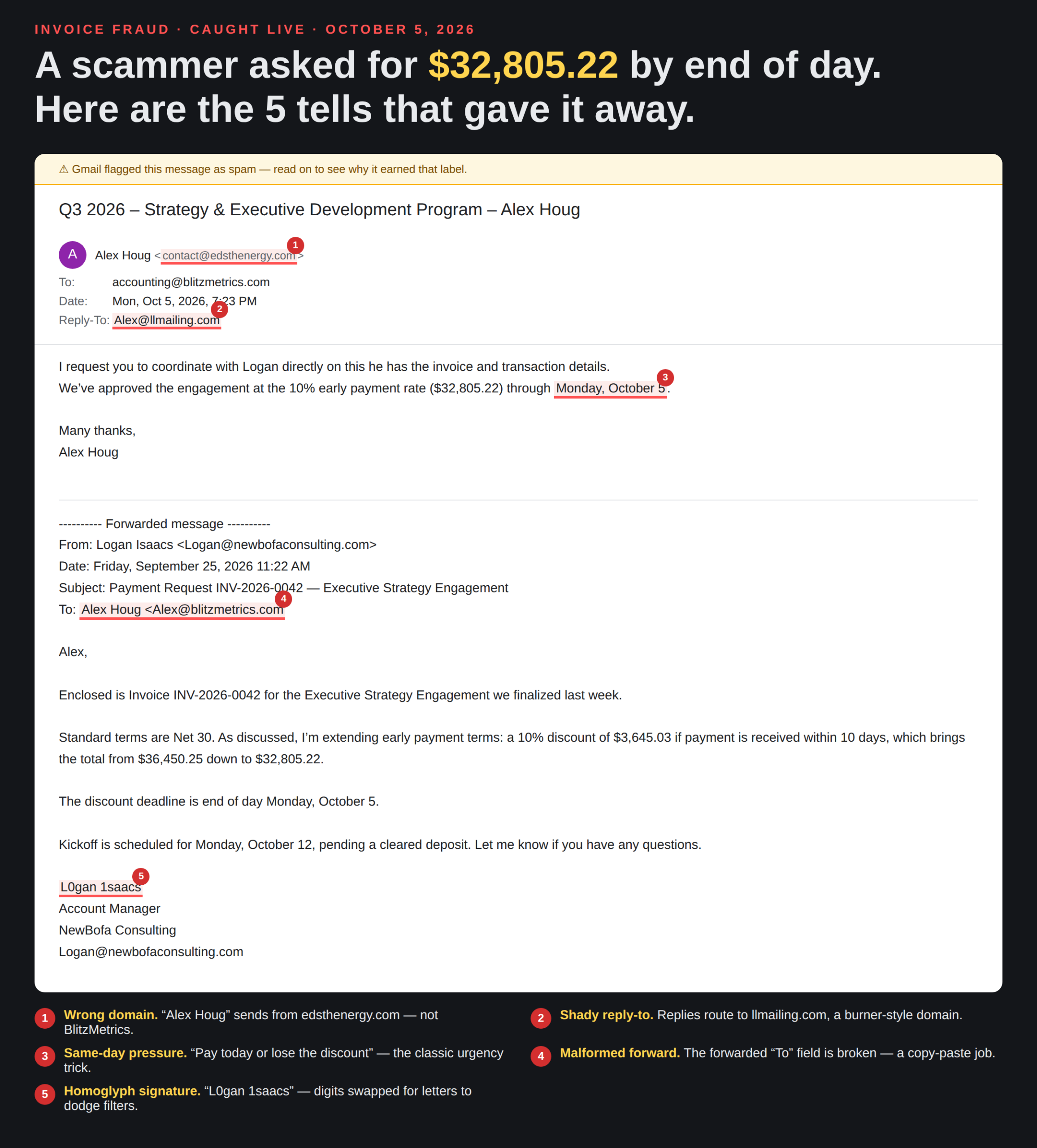
If you searched “Dennis Yu scam,” here’s your answer: I’m the one the scammers targeted. On October 5, 2026, someone tried to invoice my company $32,805.22 with a fake invoice — and I’m publishing the whole thing, screenshots included, so you can spot the next one.
The email that landed in our accounting inbox

We didn’t pay. Gmail flagged it as spam before anyone even opened it.
Read it carefully. It looks almost legitimate. That’s the point. Here’s the play-by-play:
Someone calling himself “Alex Houg” writes to our accounting team, forwarding a payment request from “Logan Isaacs” at “NewBofa Consulting.” Invoice INV-2026-0042. An “Executive Strategy Engagement” for $36,450.25, generously discounted to $32,805.22 if we pay within 10 days. Discount deadline: end of day Monday, October 5. Kickoff scheduled for October 12, “pending a cleared deposit.”
Professional tone. Specific numbers. A forwarded thread for credibility. Urgency to short-circuit your thinking.
It’s all fake. Here are the five tells.
The 5 red flags
1. The sender domain is wrong. The email claims to be from “Alex Houg.” But it was sent from contact@edsthenergy.com. Alex Houg is a real person I actually know. He has nothing to do with edsthenergy.com. Scammers steal real names because a familiar name makes you lower your guard.
2. The Reply-To goes somewhere else entirely. Hit reply on this email and your response goes to Alex@llmailing.com, a burner-style domain that has nothing to do with anyone in the message. That’s where the scammer actually reads your replies. Always check Reply-To. It’s the cheapest tell in the book.
3. Same-day pressure. “The discount deadline is end of day Monday, October 5,” the day the email arrived. Legitimate vendors don’t manufacture same-day ultimatums. Urgency is the scammer’s favorite tool because it stops you from doing the one thing that kills the scam: verifying.
4. The forwarded thread is broken. Look at the “forwarded” headers: To: Alex Houg <Alex@blitzmetrics.com. The closing bracket is missing. Real forwarded messages don’t have malformed headers. This one was typed up, not forwarded.
5. The signature uses digits instead of letters. “L0gan 1saacs.” That’s a zero and a one where the O and the L should be. These are called homoglyphs, and they’re deliberate: they help the email dodge spam filters that look for known scammer names, and most people skim right past them.

Why this almost works
This scam isn’t aimed at me. It’s aimed at a busy bookkeeper at 4 PM on a Monday.
It goes to the accounting inbox, not the CEO. It uses a name that sounds like it could be a real vendor. “NewBofa Consulting” even sounds a little like Bank of America if you’re skimming. The numbers are specific enough to feel real ($3,645.03 discount, not a round number). And the “10% early payment discount” gives the victim a reason to hurry. You’re not just paying a bill, you’re “saving money” by paying fast.
The FBI calls this business email compromise, and it costs American businesses billions every year. The defense is boring and it works: verify through a channel the scammer doesn’t control.
What to do when one of these lands in your inbox
- Never pay from the email alone. Call the vendor at a phone number you already have. Not one from the email.
- Check the actual sender domain, not the display name. Display names are free. Domains cost money and leave trails.
- Check the Reply-To. If replies route somewhere the sender never mentioned, walk away.
- Treat urgency as a red flag, not a reason. Real invoices don’t expire in hours.
- Forward it to your team as a teaching moment. That’s what this article is. The next person who sees one will recognize it in seconds.
I break down scams like this all the time
This isn’t my first rodeo. If you want to train your eye, here are more scams I’ve dissected on this site:
- This Roofing SEO Scam Needs to Stop: the $15,000 AI-generated Wix site that can destroy your Google rankings
- The $15,000 Roofing SEO Scam: AI Wix Sites That Don’t Rank
- Can You Pay to Remove a Bad Google Review? The $375 Scam Explained
- AI SEO Is a Scam: When the People Selling “ChatGPT Rankings” Can’t Even Rank Themselves
- Empathy Firm: Gavin Lira and Grant Lira Boast How They Run a Fake PR Agency
And if you came here wondering whether I’m running a scam. Now you know exactly where I stand. I publish the scams. I don’t run them.
Dennis Yu, October 5, 2026
Originally published .
Dennis Yu
Dennis Yu is the CEO of Local Service Spotlight, a platform that amplifies the reputations of contractors and local service businesses using the Content Factory process. He is a former search engine engineer who has spent a billion dollars on Google and Facebook ads for Nike, Quiznos, Ashley Furniture, Red Bull, State Farm, and other brands.
Dennis has achieved 25% of his goal of creating a million digital marketing jobs by partnering with universities, professional organizations, and agencies. Through Local Service Spotlight, he teaches the Dollar a Day strategy and Content Factory training to help local service businesses enhance their existing local reputation and make the phone ring.
Dennis coaches young adult agency owners serving plumbers, AC technicians, landscapers, roofers, electricians, and believes there should be a standard in measuring local marketing efforts, much like doctors and plumbers must be certified. He has appeared on 353 podcasts with 619 credited episodes — see the full list of his podcast appearances.