
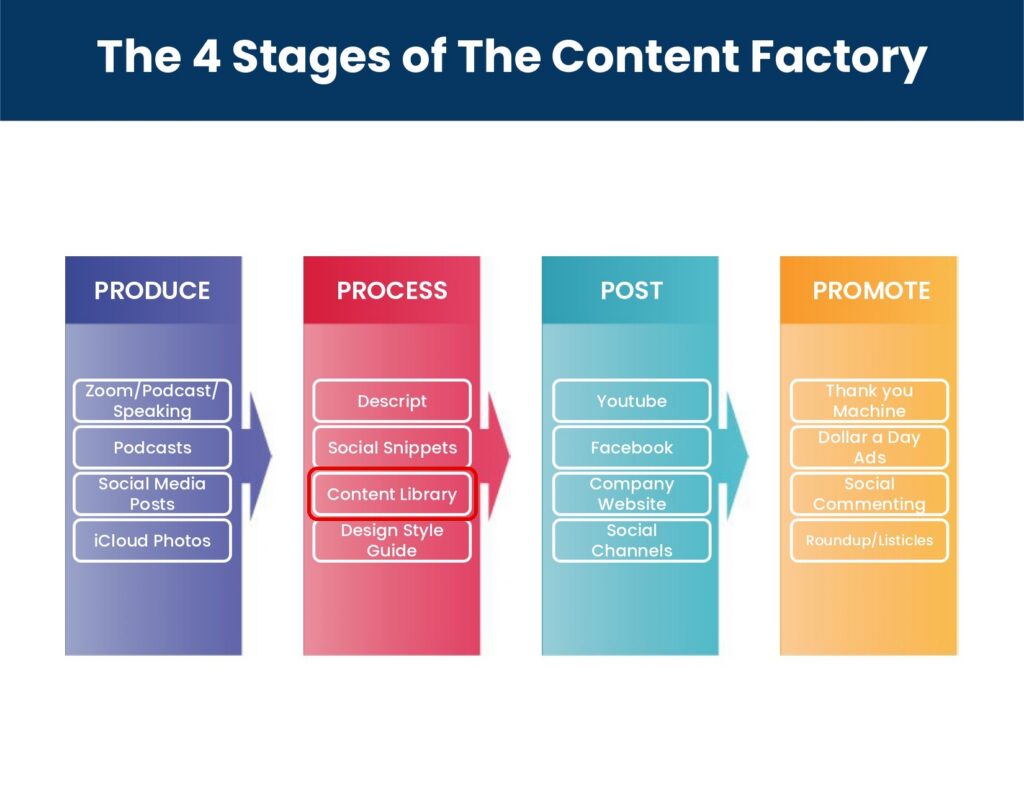
Where this sits in the Content Factory: Process — Content Library. The full system: The Content Factory.
A content library is one list of everything you have made. It holds every article, video, talk and photo, and the people in them. With a good list, you never make the same thing twice. You can find any story in seconds, and you can thank the people who helped you. Most companies keep this list by hand, so it is always out of date. We let software agents keep ours up to date every day. People only make the choices.
The short version
- One place owns each kind of knowledge. Everything else is a copy a program makes.
- Agents rebuild the lists every day from those sources, and fix what they can.
- People see a one-screen summary and are asked only for what an agent cannot do.
- Every rule below is borrowed from a management method that already works.
The seven rules
We did not invent these. Each one comes from a method that already runs large operations well, and the link after each rule goes to the source. The longer list of methods our agents borrow, and the proven next steps they let us take, is in Borrowed, Not Invented.
- One master for each kind of knowledge. Pages, recordings, people, proof, speaking and methods each have one home, written on a one-page map. If two places disagree, the map says which one wins. Borrowed from the single source of truth in data management.
- Derive the list; never keep it by hand. Every website already publishes a sitemap that lists every page. Copying it into a spreadsheet is double work that goes stale the next day. Our old hand-kept tabs held 44% of our 6,199 pages. We did not fill in the rest: we froze those tabs as history and let the agent read the sitemaps. Borrowed from lean thinking, where extra inventory and extra processing are waste.
- A list earns its place only if someone works it, and if an agent can work it, the agent does. A list handed to a busy person is a to-do that ages. Borrowed from Google’s site reliability engineers, who eliminate toil: manual, repetitive work a machine could do.
- People see exceptions, not lists. The summary people read fits on one screen: the counts, and which agent works each list. The full lists live in GitHub, where the agents read them. The team hears from the agent only when something changed or needs a person. Borrowed from management by exception.
- One owner per list, named by its function. The library agent builds the lists, the website agent owns renames and sitemap fixes, the server agent owns redirects for old addresses, and the content agent owns the stories about people we have never written about. Who does the job today sits beside the function, so a list never dies when a person leaves. Borrowed from Amazon, where small teams have single-threaded ownership.
- Mechanisms, not good intentions. The refresh runs on a schedule. It stops itself when a site suddenly lists far fewer pages or a page fails to load, it reads back everything it writes, and tests prove each rule. Borrowed from Amazon’s mechanisms: a tool, its adoption, and inspection.
- Agents decide two-way doors; people decide one-way doors. Renaming a page title can be undone, so the agent does it and saves the old title. Deleting a page or publishing a private story cannot, so a person decides. Borrowed from Jeff Bezos’s one-way and two-way doors (Amazon’s 2015 letter to shareholders).
What we stopped doing
- Keeping page lists by hand. The sitemap is the list.
- Handing people long worklists. The summary shows counts and owners; the rows stay with the agents.
- Chores on rows in frozen tabs. History stays history.
- Our 2021 checklist, in which an assistant copied a template and searched five social networks by hand. That page now points here.
What the agents did on the first day
On November 4, 2026, the first full run did this across our four websites:
- Listed 6,199 pages, one row each, with topics, the Content Factory stage and the people named.
- Renamed 48 page titles that still used our retired company name, plus 6 search-result titles and a page heading. Every old title is saved, so any rename can be undone.
- Found 1,375 old dennisyu.com links with a date in them that now show “not found”, with each page’s new address ready for one redirect rule.
- Found 4 working sales pages missing from a sitemap, and 5 sitemap entries that lead nowhere.
- The next day, found that blitzmetrics.com’s post sitemaps were being served from cache files frozen a week earlier: 44 posts were listed twice and 49 newer posts were missing. The agent cleared the cache without changing a setting, and every post was listed again. The lasting fix is with the website agent.
- Ranked the 347 people we know but have never written about, strongest relationship first, for the content agent.
How it fits the Content Factory and the Nine Triangles
The Content Factory has four stages: Produce, Process, Post and Promote. The content library is the memory of the Process stage. It is how the next video, article or boost starts from what already exists instead of from scratch.
In Nine Triangles terms, the library runs on Metrics, Analysis, Action: the counts, the daily change, and the fix. It runs on Do, Delegate, Delete: every ask to a person passes all three first. And it runs on Content, Checklist, Software: this page is the content, the seven rules are the checklist, and the skill below is the software.
Copy it for your own business
- Write down where your knowledge already lives: your website’s sitemap, your video channel, your recordings folder, the people you work with.
- Make a one-page map with one row per kind of knowledge: its one master and the function that owns it.
- Install the free content-library-keeper skill and let an agent run it every morning.
- Let the agent work the lists. Ask people only for access and for judgment.
The full method, with the commands, the guards and the tests, is in the public guide on GitHub. It is the same skill our agents run.
Why a content library matters
The idea has not changed since we first taught it: power comes from other people’s words. Collect each mention, keep it where you can find it, and boost the best ones. What changed is who keeps the list.

The 3×3 videos that fill it
From the same course: the first nine videos a business needs. Three why videos build awareness, three how videos earn consideration, and three what videos ask for the sale. Each one becomes a row in the library.


Related: Borrowed, Not Invented (the management methods our agents run on) · the Canonical Directory (one concept, one public URL) · Persistent Agents (why a skill needs a schedule and a check) · A Skill Is a Function. An Agent Is a Person. · How to Create a Definitive Article