
 by
by
Anatomy of a Smear Campaign: Fact-Check the Attacker, Not the Attack
Someone sends you a hit piece about a person you were about to hire — or about you. Here are the six forensic checks that tell you in twenty minutes whether the author is real. A walkthrough of an actual case: mine.
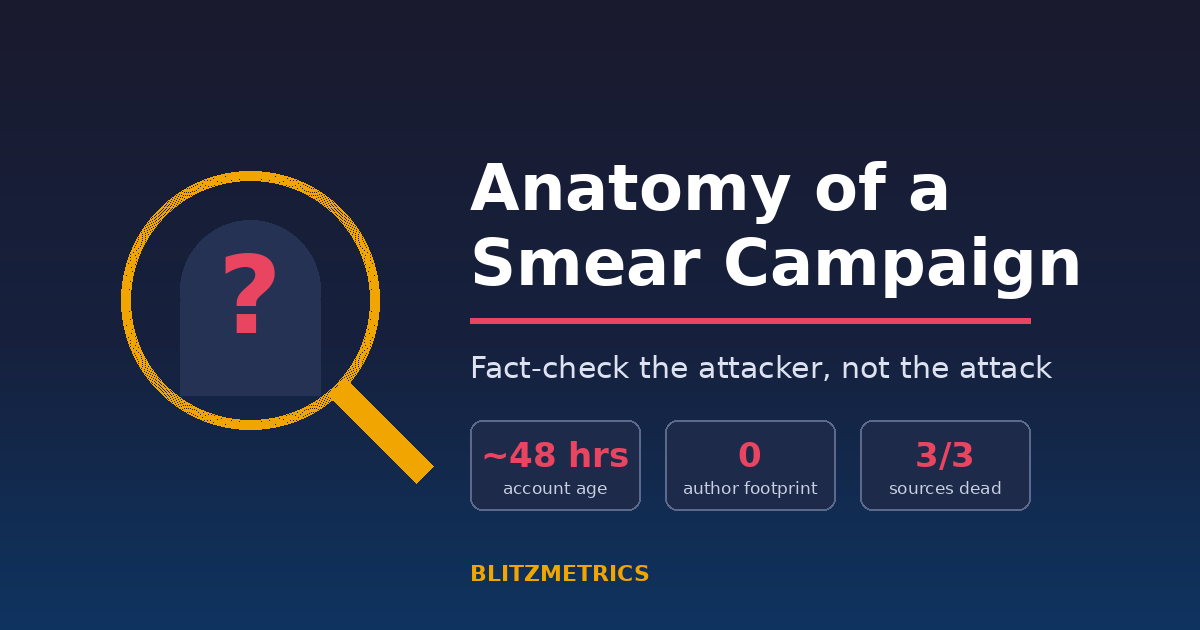
~48 hrsaccount age when it “exposed” me
0anything else its author ever wrote
3 / 3sources it cites — all dead
1024×1536the AI headshot’s giveaway size
Every few months a friend sends me a link. “Hey — someone wrote this about you. Is it true?” These are people who have known me for years. They have eaten dinner at my table. And still, an anonymous article on a site they have never heard of puts a flicker of doubt in their eyes. That flicker is the entire product. So instead of explaining myself one more time, I am going to dissect the thing in public — author, avatar, sources, timeline — and hand you the same scalpel.
“Is it true?” is the wrong first question
The right first question is: who is telling me this?
Four months ago, an author named Jiro Solvek published a 740-word “deep dive” about me on Vocal.media, a publishing platform where anyone can open a free account and post. The piece strings together a decade of anonymous complaint-board posts into a story about my “reputation under fire,” using phrases like “a growing number of critics” and “some voices.” No names attached to any accusation. No dates. No documents.
Jiro Solvek does not exist.
That is not a figure of speech. There is no Jiro Solvek anywhere — no LinkedIn, no social profile, no byline on any other website, no record of the surname itself. A first name from Japan, a surname from nowhere. And it took about twenty minutes of ordinary checking to prove it, using nothing you don’t have access to right now.
The six checks, run on a real specimen
Everything below is verifiable by anyone. That is the point.
Search the author’s name in quotes
A real writer leaves a trail: other articles, a bio somewhere, a profile photo that matches across sites. “Jiro Solvek” returns nothing on the entire indexed web outside that one Vocal profile. Not thin — zero. Real people are messy; they leak footprints for decades. Fabricated people are clean.
Date the account, then date the article
The profile says “Joined February 2026.” Here is the part most people don’t know: the ID codes on uploaded profile images embed creation timestamps you can decode. This one decodes to February 25, 2026. The article’s header image was pulled from a stock-photo service on February 27, 2026. The account was roughly forty-eight hours old when it published its detailed “investigation” of me — and it has never published anything else, about anyone, before or since.
Inspect the profile photo
The author’s headshot is a friendly man in glasses on a blurred city street. Download it and look at the file: it is a PNG at exactly 1024×1536 pixels — a standard export size of AI image generators, not any camera. The skin is waxy, hair strands melt into the fake background blur, and the face conveniently matches the Japanese-sounding pen name. This person was rendered, not photographed.
Read the platform’s own labels
Vocal’s moderation system flagged the piece with its “AI-Generated” label and a content warning. The platform is telling you, right on the page, that a machine wrote it. The header image is generic stock. There are zero comments and zero reader reactions. Nobody read this. It was not written for readers — it was written to occupy a search result on a domain Google trusts.
Audit every source it cites
This is the check that breaks the whole thing open. The article cites, as its “review platforms,” two websites built on my own name: dennisyu.io and dennisyureviews.com. Both are dead. Not offline — the domains are no longer even registered. Its third source, a Medium post, returns a 410 error because Medium suspended the account behind it for violating its rules. Every single source the piece leans on has been removed or abandoned.
Ask the obvious question: who cites two obscure look-alike domains that no real reviewer ever heard of, as if they were established review sites? The person who built them. This is self-citation laundering — you create fake evidence on one site, then “report on” your own fake evidence from another, so a search result looks like independent corroboration. It is one hand washing the other, and both hands belong to the same person.
Put the dates on one timeline
A real backlash is spread across years and written by different people in different voices. A campaign clusters. The look-alike domains, a burst of one-star reviews from accounts with no purchase history, and the “deep dive” all landed inside one six-month window — and the same unusual phrase, “50+ victims,” shows up on the fake review domain, in a review, and in copy-pasted comments from throwaway social accounts. Different masks, one scriptwriter.
The EEAT inversion: they are the opposite of everything Google rewards
Search engines grade content on E-E-A-T — Experience, Expertise, Authoritativeness, Trust. Run the attacker through it.
| Signal | What Google wants to see | The anonymous attacker | Verdict |
|---|---|---|---|
| Experience | First-hand involvement: you did the thing, bought the thing, lived the thing | Never a customer, never met me; the piece itself concedes its sources “may not constitute proof” | Zero |
| Expertise | Demonstrated knowledge of the subject | Machine-written aggregation of decade-old complaint-board posts; platform-labeled AI-Generated | Zero |
| Authoritativeness | A track record others cite and link to | One article ever, zero readers, zero citations; authority borrowed entirely from the host domain | Zero |
| Trust | A real, accountable identity behind the words | Invented name, AI-rendered face, sources that are dead fake domains they likely built themselves | Zero |
Now the irony, because it is the whole story. The piece accuses me of fabricated credentials, hidden conduct, and attacking good people. Its author fabricated an identity, hid behind an AI face, and attacked a person under a mask. Every accusation is a confession of method. I publish under my own name, on my own site, with named clients on video, a public wall of audits built on verifiable data, and thirty years of work you can check. When I have criticized someone’s conduct, I signed my name to it and showed the documents. One of us stands behind every word with a real identity. It is not the “growing number of critics.”
The one-sentence test
Real critics sign their names, cite things that exist, and stick around to defend what they wrote. If a piece fails all three, you are not reading criticism — you are reading set decoration.
Why people do this — and why the targets are people like you
Nobody runs a months-long fake-persona operation for fun. There is always a payoff in mind.
| Motive | How it works | The tell |
|---|---|---|
| Leverage in a dispute | Manufacture the appearance of public outrage to pressure a settlement or a negotiation | Attack timing tracks the dispute’s calendar, not any customer event |
| The cleanup shakedown | An industry seeds or amplifies negative results, then sells you “reputation management” to suppress them — I have written about these pitches landing in my own inbox | The “help” arrives suspiciously soon after the harm |
| Grudge and envy | A former associate or failed competitor wants the story of your success revised | Insider vocabulary, but always anonymous |
| Because it costs nothing | AI text, a generated face, a free account on a high-authority platform: a smear that once took real effort is now an afternoon | Platform labels it AI-generated; nobody engages with it |
And the economics of the target: people search your name with words like “reviews” before hiring you, so a single planted page on a trusted domain can tax every deal you ever pitch. The attacker is not trying to persuade your friends. They are renting doubt, by the search result, from strangers who don’t know you yet.
How to protect yourself before it happens
Forensics answers “is it true?” Defense makes the question rare.
I published the full removal-and-response playbook — the actual reports I filed, which platform levers work, and in what order — in How AI Defends Your Reputation Against Anonymous Attacks. The short version: report policy violations precisely, rehab the review platforms with real customers, refuse to feed what you cannot remove, and monitor monthly so attacks get caught while they are small.
But the durable protection is structural, and it is the same system we build for every client whether or not anyone is attacking them: an entity home that makes your own site the source of truth for your name, a Knowledge Panel so Google itself vouches for who you are, a content engine publishing real proof every week, and a Personal Brand Score so your reputation is a measured number, not a feeling. A fabricated persona with one dead-sourced article cannot compete with page one full of your verifiable work. That is EEAT doing exactly what it was designed to do.
Keep this checklist
Next time anyone sends you a “did you see this?” link — about you, or about someone you were going to hire — run it.
| Check | Fabricated persona | Real critic |
|---|---|---|
| Search the author’s exact name | No footprint outside the one article | Years of messy, consistent trail |
| Account age vs. publish date | Days apart; nothing before or after | Long history, varied topics |
| Profile photo | AI-sized file, waxy render, or stock | Same real face across platforms |
| Platform labels & engagement | “AI-Generated” tags, zero comments | Real discussion, author replies |
| Click every cited source | Dead links, look-alike domains, circular citations | Named people, dates, documents that load |
| Plot the timeline | Everything clusters in one window, same phrases | Spread across years, different voices |
Twenty minutes. No tools you don’t already have. And when the piece fails the checklist, you have not just defended a reputation — you have identified an operation.
Want to see what a stranger finds when they search your name?
We audit personal brands the way this article audits an attacker: named sources, real data, receipts for every claim — scored on a 100-point rubric so you know exactly where you stand and what to fix.
Get your Personal Brand Score See real audits with receiptsOriginally published .
Dennis Yu
Dennis Yu is the CEO of Local Service Spotlight, a platform that amplifies the reputations of contractors and local service businesses using the Content Factory process. He is a former search engine engineer who has spent a billion dollars on Google and Facebook ads for Nike, Quiznos, Ashley Furniture, Red Bull, State Farm, and other brands.
Dennis has achieved 25% of his goal of creating a million digital marketing jobs by partnering with universities, professional organizations, and agencies. Through Local Service Spotlight, he teaches the Dollar a Day strategy and Content Factory training to help local service businesses enhance their existing local reputation and make the phone ring.
Dennis coaches young adult agency owners serving plumbers, AC technicians, landscapers, roofers, electricians, and believes there should be a standard in measuring local marketing efforts, much like doctors and plumbers must be certified. He has appeared on 353 podcasts with 619 credited episodes — see the full list of his podcast appearances.