
 by
by
I’ve audited hundreds of agencies—and most have no idea how to get their clients real customers and booked jobs.
The agency model fails home service businesses because it’s disconnected from what actually gets the phone to ring.
This applies to plumbers, HVAC companies, roofers, dentists, landscapers—anyone in a Google Local Service Ads (LSA) category.
I work directly with home service companies and audit their digital marketing. Here’s what I tell every business owner who feels burned by agencies or stuck with underperforming ads.
Your Agency Can’t Do SEO
Most agencies don’t understand how SEO works for local service businesses. They sell link packages, SEO audits, and cookie-cutter content—but that’s not what Google wants.
Google wants proof. They want to see real activity, local signals, and legitimate engagement.
If you’re a plumber in Chicago, Google’s checking if your traffic comes from Chicago, if your customers talk about you online, and if you’re connected to other Chicago-based businesses. That means:
- Real reviews from real customers.
- Active Google Business Profile.
- Location-tagged photos and check-ins.
- Mentions on Yelp, news sites, and directories.
- Community engagement on social.
Social media directly affects your rankings because Google sees everything. When someone posts a video, leaves a review, or tags your business, those are SEO signals.
So what actually works?
- Do great work that your customers talk about.
- Repurpose that content across social, ads, and your website.
- Use that proof to power your website, ads, and social media.
Everything we do in the Content Factory follows what Google prioritizes based on their own Quality Rater Guidelines—real signals, local relevance, and proven engagement.
That’s why it works.
Why the Agency Model Fails Home Service Businesses
Home service businesses get burned by agencies all the time. I hear it every day from HVAC, plumbing, roofing, and landscaping owners.
Here’s why: the typical agency is built like a car dealership.
Salespeople handle the pitch and close the deal. Then they pass your account to a back-office fulfillment team—usually outsourced to white-label agents. The salespeople don’t run the ads. The agents never talk to the business.
That two-tier model doesn’t work anymore.
To rank in Google or run effective ads, you need diagnostic expertise. You need someone who understands tracking, content, conversion, and targeting—not just someone who “manages accounts.”
Google and Facebook want a direct relationship with you. They want clean signals—real calls, actual booked jobs, and proof your business is legit. So agencies that act as middlemen are dying out.
Even our friends who once ran some of the biggest agencies in the country have exited the space because of this shift. The only way to survive now is for business owners like you to truly own your own marketing.
That doesn’t mean you can’t hire help—but it does mean you should never give up control. You can bring in qualified partners to assist with implementation, but they should never own your website, your ad accounts, or your Facebook pages.
Otherwise, you’re stuck in the outdated restaurant model—where the waiter (salesperson) and the cook (technician) are separated, and nobody knows what’s really happening.
That model is collapsing.
That’s why taking control of your marketing is necessary. You need to understand the pieces well enough to see where the gaps are. When you spot the gap, you can do something about it.
Why You Need to Own Your Marketing
When you depend on an agency, you’re not in control. They own your data, your ad accounts, your website—and you’re stuck.
We’ve seen too many agencies hold business owners hostage. When the client leaves, they lose everything.
It makes it nearly impossible to regain control without starting over. That kind of setup gives all the power to the agency and leaves the business owner vulnerable.
The only way to win is to take ownership.
You don’t need to be an expert, but you should know enough to spot when something’s off. It means understanding these core components:
- Goals: What counts as a lead?
- Content: What proof do you have?
- Targeting: Who are you trying to reach?
- Amplification: How do you distribute your content?
- Optimization: Are you learning and improving?
This is what we teach in the Content Factory—and exactly what we check in the Quick Audit.
What’s Actually Holding You Back?
If you’re running a home service business and wondering why your phone isn’t ringing, you don’t need a full agency overhaul to get started. You just need to know what signals Google’s actually looking for—and where yours are missing.
Here’s how to figure out what’s broken: go through these six areas to find where your biggest gap is. In each one, ask the right questions—and take the first step to fix it.
Digital Footprint
Are people finding and trusting you online? Your digital footprint is everything that shows up when someone searches for your business. If your details aren’t accurate or you’re missing key signals, Google won’t trust your business—and neither will potential customers.
Step 1: Check if your Google Business Profile is claimed and up to date.
Step 2: Search your name—do you have a Knowledge Panel?
Step 3: Look at your business listings across directories. Make sure your name, address, and phone number (NAP) are consistent everywhere.
Reputation
What do your customers say—and are you showing it off? Your reputation tells Google and customers whether you’re trustworthy. Positive reviews with real detail and community involvement are strong local signals. Even better if you respond to reviews and feature them in your content.
Step 1: Review your Google and Facebook reviews. Are they specific and detailed?
Step 2: Ask one happy customer this week for a video testimonial.
Step 3: Highlight your community involvement—photos, tags, or mentions on social or local news.
Social Media
Is your business active and visible? A dead Facebook Page or lack of proof content makes your business look inactive. Social media tells both Google and customers that you’re real and engaging locally.
Step 1: Make sure you’re posting from both your Business Page and Public Figure Page.
Step 2: Post a photo or video from a real job site today.
Step 3: Comment on or tag another local business to build trust and reach.
The goal is to show you’re connected to your community.
Digital Plumbing (Analytics Architecture)
Can you track where your jobs and revenue are coming from? Digital plumbing is the foundation of your marketing. If your tracking is broken, you’re flying blind—wasting money without knowing what’s working.
Step 1: Verify if form submissions and phone calls are being tracked.
Step 2: Review which campaigns or platforms are bringing in booked jobs.
Step 3: Fix or rebuild any tracking that’s broken so you stop guessing. This includes setting up UTM parameters and ensuring Google Analytics is configured properly.
Advertising
Are your ads generating real results—or just draining your budget? Too many home service businesses spend money on ads that don’t bring in real leads or booked jobs. The problem usually isn’t the platform. Poor targeting means your ads show to the wrong people. Weak creative means no one pays attention. Bad structure means the algorithm can’t optimize effectively.
You need to be deliberate. Every ad must tie to your Goals, Content, and Targeting.
Ads should bring in phone calls, and the only way to know if they’re working is through clear tracking tied back to revenue.
Step 1: Check if your targeting matches your service area and actual offerings. Step 2: Review which ads are leading to tracked calls or booked jobs.
Step 3: Simplify and restructure your campaigns so the algorithm works in your favor—fewer campaigns, better signals.
Overall Strategy
Is everything working together—or just disconnected tactics?
Most local businesses have bits and pieces, but nothing that works together. They throw money at random tools or agencies and hope something sticks. But disconnected efforts confuse Google—and cost you results.
Step 1: Compare your online presence to your top local competitors.
Step 2: Identify one clear goal (more calls, higher ranking, better reviews).
Step 3: Align your content, tracking, and budget around that one goal for 30 days.
Once you’ve identified where the gaps are, it’s time to see what success actually looks like.
These folks didn’t guess, and they didn’t blindly trust an agency to figure it out. They followed the same process you just read—and it worked.
Real Results from Real Contractors
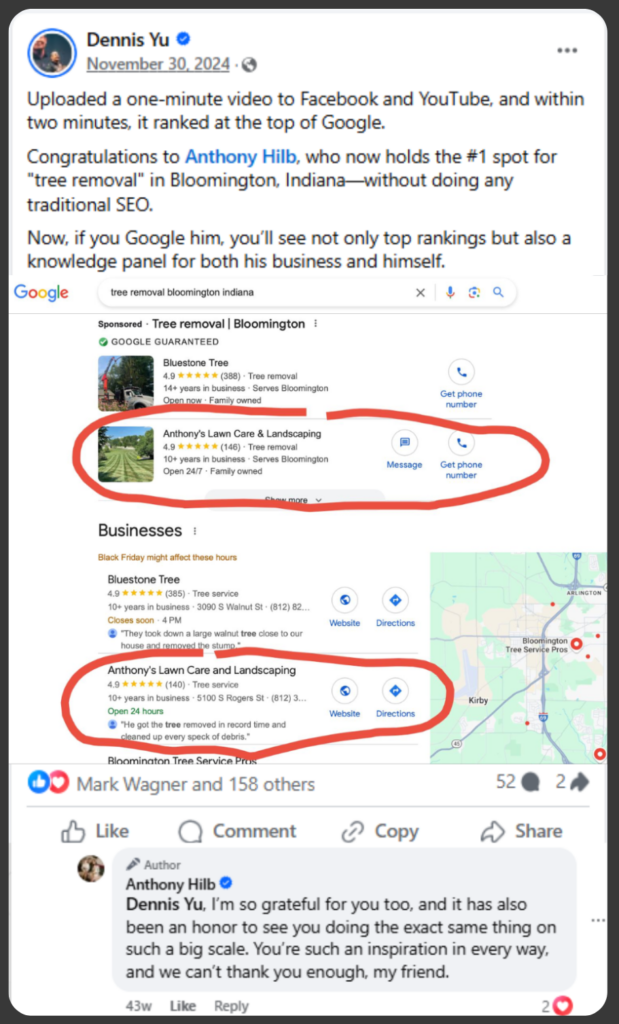
Anthony Hilb, who runs Anthony’s Lawn Care, a tree service in Bloomington, Indiana, used to struggle with visibility—until he followed this same checklist.
Now?
- He ranks #1 on Google for “tree removal” in his city.
- He has a full Google Knowledge Panel for both himself and his company.
- And people in town started recognizing him—he said it felt like becoming “a local celebrity.”
All without spending a dime on backlinks or shady SEO tricks.
Here’s what he did:
- Recorded a short video of an actual job site.
- Posted it to YouTube and Facebook, then boosted it using Dollar-a-Day targeting his city.
- Structured his content so Google could connect the dots.
It ranked in 2 minutes.
Sal Sciorta, who runs Plumbing Pros LLC, had a similar wake-up call.
“The second month, our revenue jumped 75%.
But I couldn’t even handle all the calls—I had to turn down 20% of the leads because we were booked two days out.”
“That was my big wakeup call. The work is there. I just needed the manpower.”
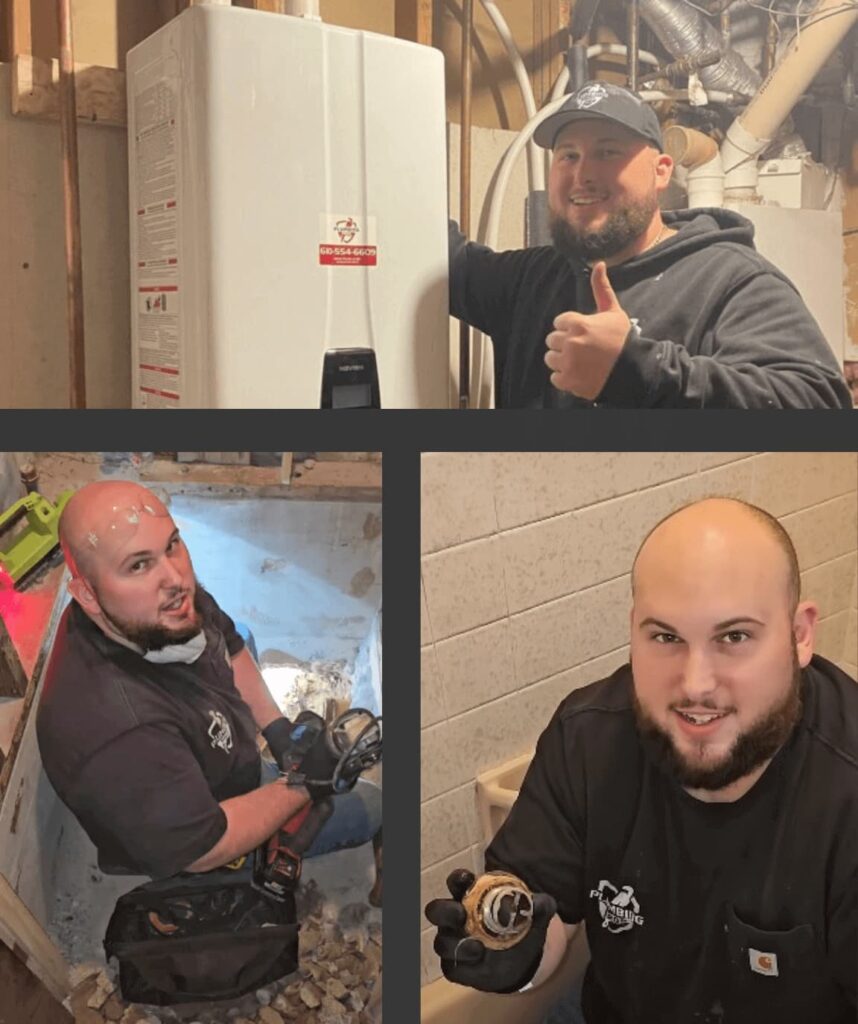
All he changed was how his marketing proved real work was getting done.
What to Do Next
Start by picking one of these six areas and fixing the biggest gap. For most businesses, it’s either weak tracking or lack of real content.
If you want a guided version of this audit—with benchmarks and side-by-side comparisons against top competitors—we’ve documented all six checks in a downloadable report.
👉 Run a Quick Audit to see what’s working, what’s not, and what to fix first.
Originally published .
Dennis Yu
Dennis Yu is the CEO of Local Service Spotlight, a platform that amplifies the reputations of contractors and local service businesses using the Content Factory process. He is a former search engine engineer who has spent a billion dollars on Google and Facebook ads for Nike, Quiznos, Ashley Furniture, Red Bull, State Farm, and other brands.
Dennis has achieved 25% of his goal of creating a million digital marketing jobs by partnering with universities, professional organizations, and agencies. Through Local Service Spotlight, he teaches the Dollar a Day strategy and Content Factory training to help local service businesses enhance their existing local reputation and make the phone ring.
Dennis coaches young adult agency owners serving plumbers, AC technicians, landscapers, roofers, electricians, and believes there should be a standard in measuring local marketing efforts, much like doctors and plumbers must be certified. He has appeared on 353 podcasts with 619 credited episodes — see the full list of his podcast appearances.