

Every podcast we cut becomes a YouTube video — and the description under that video is not an afterthought. It’s where a viewer decides to click a link, subscribe, or reach out to work with us. So we don’t write descriptions from scratch every time. We run them through the same system: 10 blocks, same order, every video. Only one block changes — the call to action — depending on which channel the video is for.
This is the whole playbook, written so two very different people land on the exact same result: the editor polishing the cut, and the AI agent that now drafts these descriptions. If you follow the blocks, you can’t really get it wrong.
The principle in one sentence: Start with what the episode is about and why it’s for the viewer, then swap in the one CTA that matches the channel. Everything else — Dennis’s links, the editing credit, the hashtag formula — stays the same.
The 10-block anatomy
This is the blueprint for every description. Always these blocks, always in this order. The only one that moves is Block 4, the CTA.
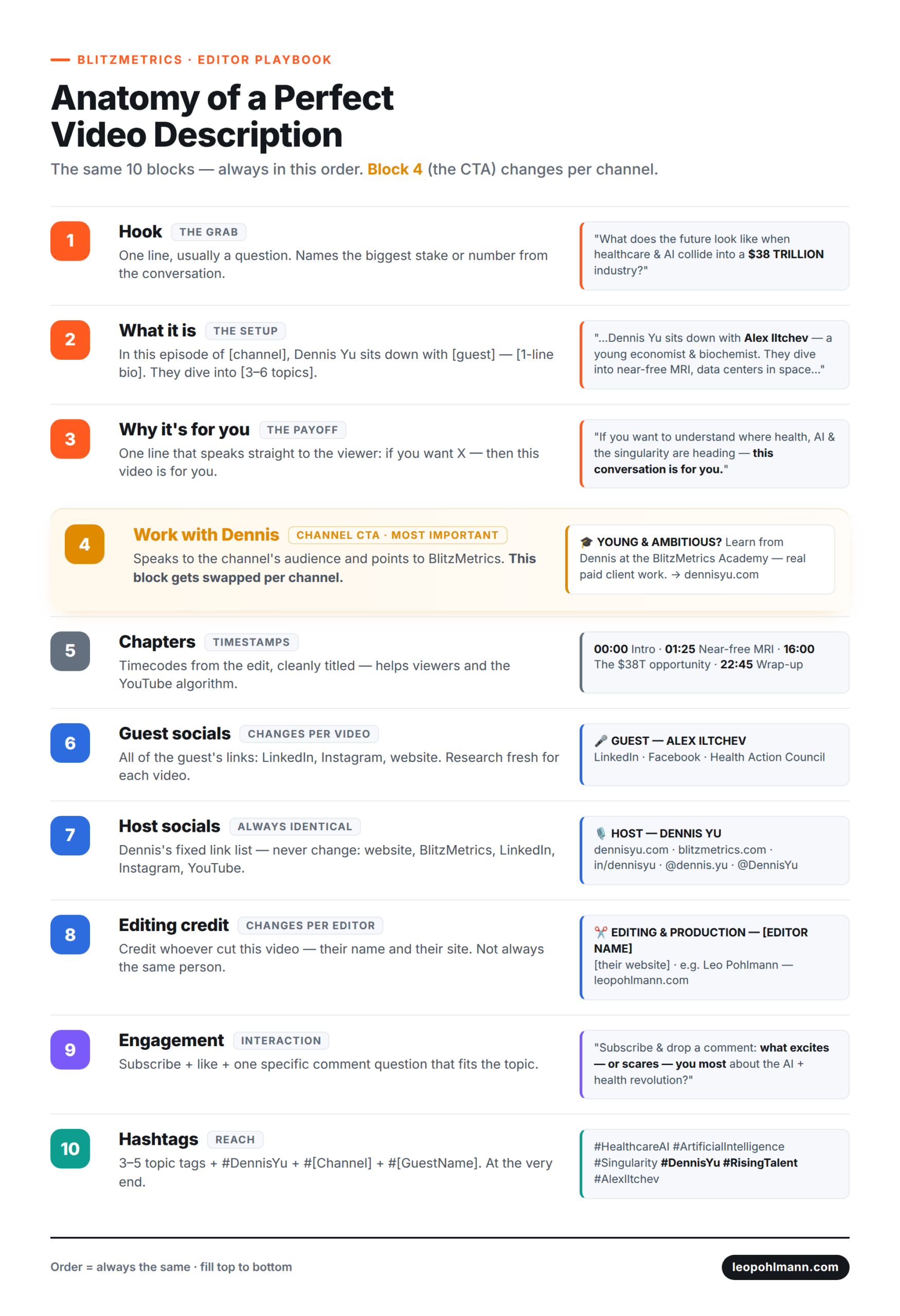
- Hook — one line, usually a question. Names the biggest stake or number from the conversation.
- What it is — “In this episode of [channel], Dennis Yu sits down with [guest] — [1-line bio]. They dive into [3–6 topics].”
- Why it’s for you — one line straight to the viewer: if you want X, this video is for you.
- Work with Dennis (CTA) — the most important block. Speaks to the channel’s audience and points to BlitzMetrics. This is the block that changes per channel.
- Chapters — timecodes from the edit, cleanly titled.
- Guest socials — all of the guest’s links. Changes every video.
- Host socials — Dennis’s fixed link list. Never change.
- Editing credit — the editor who cut this video: their name and site. Changes per editor.
- Engagement — subscribe, like, and one specific comment question.
- Hashtags — 3–5 topic tags + #DennisYu + #[Channel] + #[GuestName].
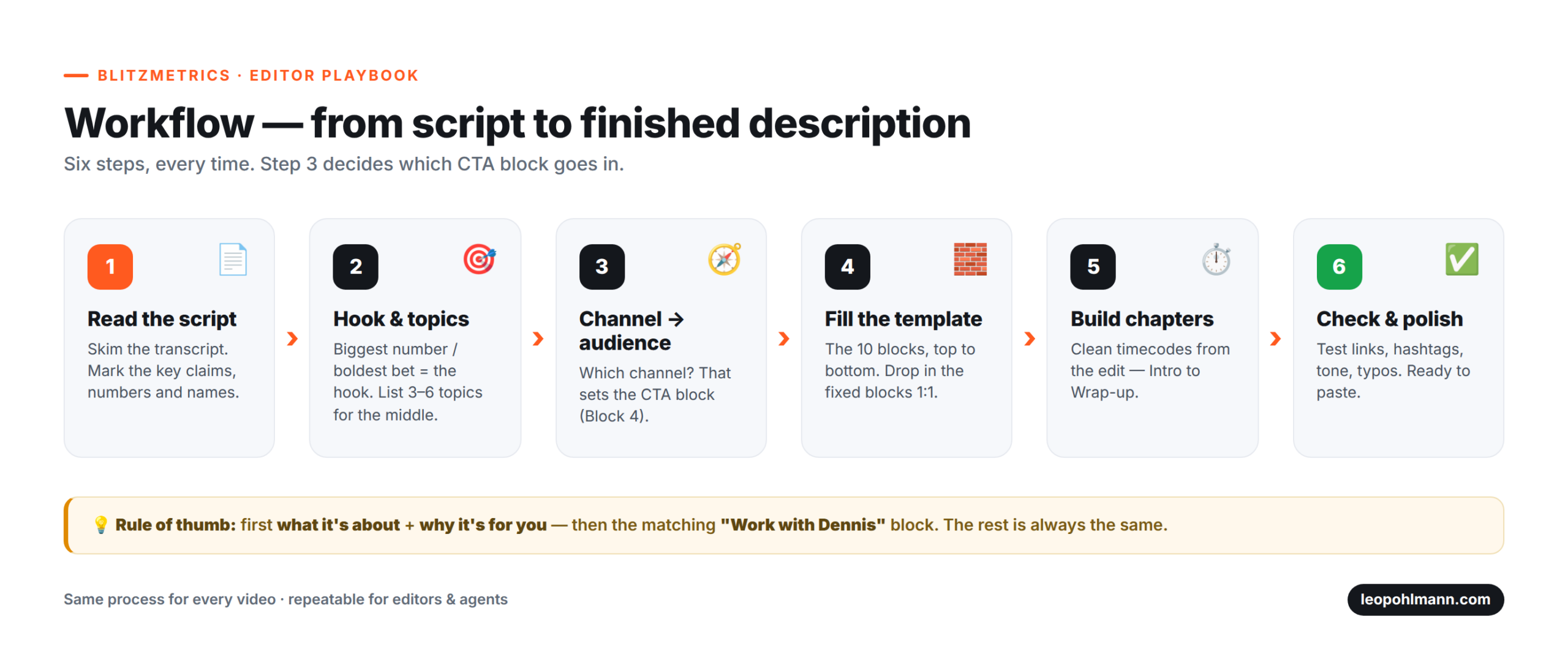
The workflow: from script to description
Six steps, every time. Step 3 is the only judgment call — it decides which CTA block goes in.
The one block that changes: your CTA
Block 4 is the only block that moves. Before you write it, ask one question: who watches this channel? Then drop in the CTA that speaks to them. Two live examples:
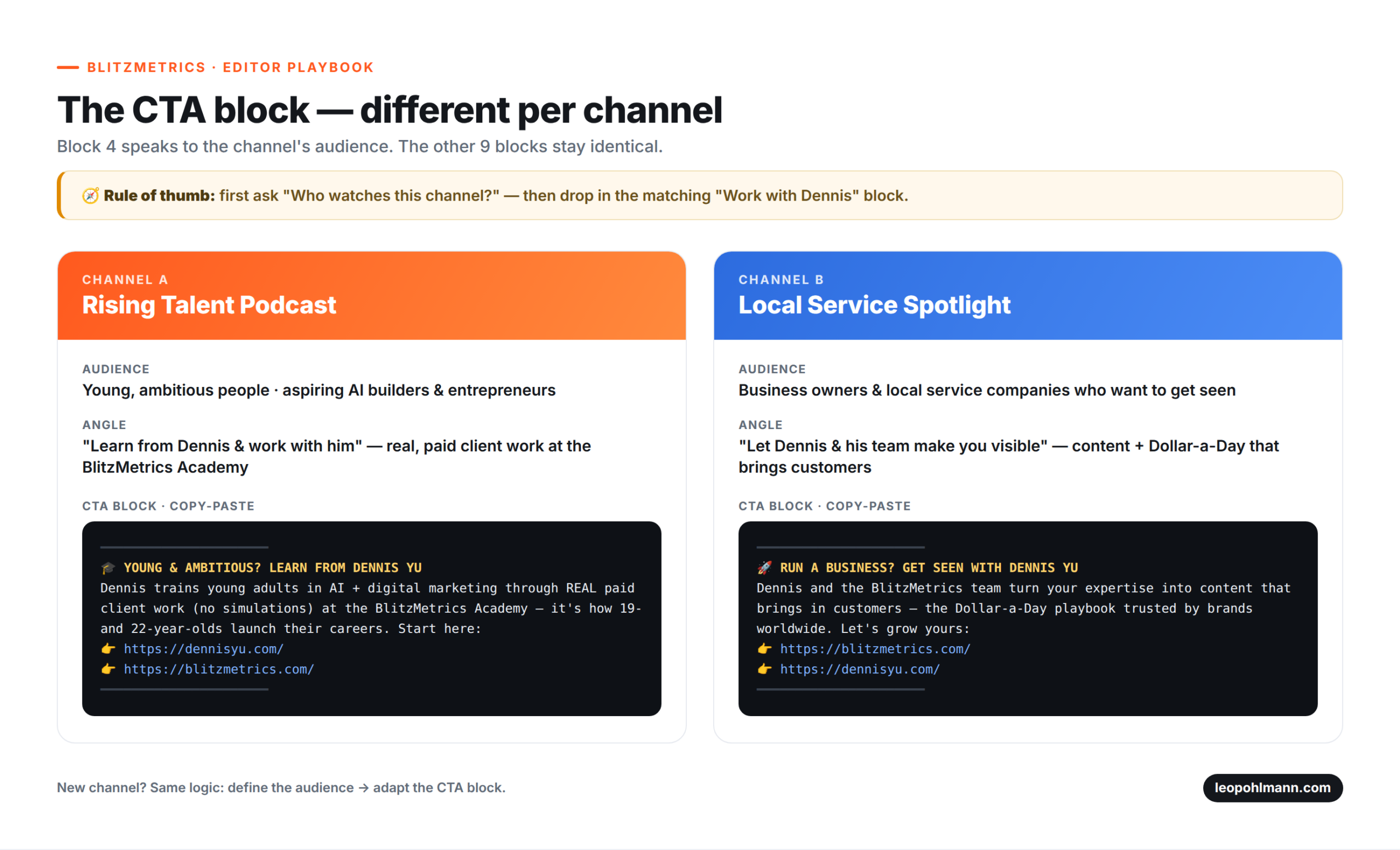
Rising Talent Podcast — audience: young, ambitious people and aspiring AI builders. The CTA invites them to learn from Dennis through real, paid client work:
━━━━━━━━━━━━━━━━━━━━━━━━━━━━
🎓 YOUNG & AMBITIOUS? LEARN FROM DENNIS YU
Dennis trains young adults in AI + digital marketing through REAL paid client work (no simulations) at the BlitzMetrics Academy — it's how 19- and 22-year-olds are launching their careers. Start here:
👉 https://dennisyu.com/
👉 https://blitzmetrics.com/
━━━━━━━━━━━━━━━━━━━━━━━━━━━━
Local Service Spotlight — audience: business owners who want to get seen. The CTA offers to do it for them with the Dollar-a-Day playbook:
━━━━━━━━━━━━━━━━━━━━━━━━━━━━
🚀 RUN A BUSINESS? GET SEEN WITH DENNIS YU
Dennis and the BlitzMetrics team turn your expertise into content that brings in customers — the Dollar-a-Day playbook trusted by brands worldwide. Let's grow yours:
👉 https://blitzmetrics.com/
👉 https://dennisyu.com/
━━━━━━━━━━━━━━━━━━━━━━━━━━━━
New channel? Same logic — define the audience, then write the one CTA that fits.
Why this works: your description in the SEO Tree
A description isn’t just copy for viewers — it has a job in the wider content system. In the BlitzMetrics SEO Tree, every asset has a place: the brand entity (Dennis Yu / BlitzMetrics) is the trunk, the definitive articles (Content Factory, Dollar a Day, the AI Builder Program) are the branches, individual videos and case studies are the leaves, and citations — Wikidata, the Knowledge Panel, schema — are the roots.
A video is a leaf, and its description is the stem that connects it back to a branch. When the description links to the relevant definitive article, names the entity consistently, and states the topic plainly, it passes topical signals up the tree — reinforcing E-E-A-T and helping both Google and viewers place the video. A description with no internal link is a leaf with no stem: it just floats.
That’s why the order of the 10 blocks isn’t arbitrary. The summary (block 2) states the topic for search; the host links and credit (blocks 7–8) carry E-E-A-T; the CTA and links (block 4) are the stem up to the branch; and 6–12 chapters per hour give search and retention something to grab. It all ladders up to the video’s Goal, Content, and Targeting (GCT).
Practical add-on: whenever it fits, link the description to the one BlitzMetrics article this video belongs under — the branch it’s a leaf of. That single internal link is the difference between a video that just plays and a video that feeds the tree.
What this article builds on
This playbook is a leaf on a bigger tree. Here are the branches it hangs from — link out to them from your descriptions, and link back to this once it is published:
- How to Publish a YouTube Video and Maximize Your Reach — the parent: where the description, chapters, and tags fit into the upload.
- The SEO Tree — how all your content connects so every page reinforces the next.
- The Topic Wheel — deciding what to create before you write the description.
- Money Pages vs. Blog Posts — which pages your links should point to.
- How to Create a Definitive Article — the branch articles your video leaves link up to.
Does a good description actually move the numbers? An honest look
Straight answer, because guessing here helps no one: a description is not what wins the view lottery — the title, thumbnail, and topic do. The Rising Talent Podcast, a brand-new channel (245 subscribers), shows it plainly. Public YouTube view counts, late July 2026:
| Rising Talent episode | Views |
|---|---|
| “He Quit Basketball at 20 to Build an AI SEO Startup” — Georg Aare | 625 |
| “He’s Closed 300+ Agency Deals — Billy Batt’s M&A Playbook” | 454 |
| “Meet Cam Hazzard: One of the 24 Best Dunkers in the World” | 49 |
| “He Built a $342M Company While Still in College” | 14 |
| “How a Small Injury Law Firm Uses AI Agents to Beat Big Insurance” | 8 |
| “Alex Iltchev on the $38 Trillion Future of Health & AI” — full playbook description | 5 |
| “…Dennis Yu & Justin Sonnenreich on AI Apprenticeships” | 0 |
The two breakouts (625 and 454) share one thing: a sharp, specific hook in the title — “quit basketball at 20,” “300+ deals.” Meanwhile the Alex Iltchev episode ships with a complete, fully-optimized description — the exact 10-block playbook above, 14 chapters, links, tags — and still sits at 5 views. On a small, young channel, the hook and thumbnail drive discovery; the description does not manufacture views by itself.
So why write a great one? Because it does three jobs the title can’t: it makes the video findable in search and Suggested as it ages (the summary, tags, and chapters get indexed), it holds attention through chapters (better retention feeds ranking), and it converts the viewers you do get by sending them up the tree to your offer. It’s the compounding-and-conversion layer — not the attention grab.
That the full system scales is not in doubt. On Dennis’s main channel (@DennisYu), where the same discipline runs on every upload, videos reach 343,000+, 117,000+, and 61,000+ views — and there’s a walk-through literally titled “How I Got 1,000,000 YouTube Views Without Going Viral.” The description is a required part of that machine: necessary, not sufficient.
Bottom line: pair a strong hook with a complete description. The hook earns the click; the description earns the search traffic, the watch time, and the next action.
The block that never changes
Copy-paste, never rewrite — just drop it in. Dennis’s link list:
🎙️ HOST — DENNIS YU
Website: https://dennisyu.com/
BlitzMetrics: https://blitzmetrics.com/
LinkedIn: https://www.linkedin.com/in/dennisyu/
Instagram: https://www.instagram.com/dennis.yu/
YouTube: https://www.youtube.com/@DennisYu
Hashtag formula: 3–5 topic tags + #DennisYu + #[Channel] + #[GuestName]. Keep it to about 6–8, all relevant to the video.
The editing credit — whoever cut it
This block is variable: credit the editor who actually cut the video — their name and their site. On a multi-editor team it changes from video to video, so don’t hard-code one person.
✂️ EDITING & PRODUCTION — [EDITOR NAME]
Website: [editor's website]
Example — Leo Pohlmann cut the episode below, so the credit reads:
✂️ EDITING & PRODUCTION — LEO POHLMANN
Website: https://leopohlmann.com
The template
The full skeleton. Replace the [bracketed] placeholders, drop in the channel’s CTA block, and you have a finished YouTube description.
[HOOK — one line, usually a question. Name the biggest number / the biggest stake.]

In this episode of the [CHANNEL], Dennis Yu sits down with [GUEST] — [1-line bio of the guest]. They dive into [TOPIC 1], [TOPIC 2], [TOPIC 3] and [TOPIC 4].

If you want to [PAYOFF — what the viewer walks away with] — this conversation is for you.

━━━━━━━━━━━━━━━━━━━━━━━━━━━━
[CTA BLOCK — drop in the one for this channel, see above]
━━━━━━━━━━━━━━━━━━━━━━━━━━━━

⏱️ CHAPTERS
00:00 Intro
[TC] [Chapter]
[TC] [Chapter]
[TC] Wrap-up

————————————————————

🎤 GUEST — [GUEST NAME]
[Platform]: [Link]
[Platform]: [Link]

🎙️ HOST — DENNIS YU
Website: https://dennisyu.com/
BlitzMetrics: https://blitzmetrics.com/
LinkedIn: https://www.linkedin.com/in/dennisyu/
Instagram: https://www.instagram.com/dennis.yu/
YouTube: https://www.youtube.com/@DennisYu

✂️ EDITING & PRODUCTION — [EDITOR NAME]
Website: [editor's website]

————————————————————

👉 If you got value from this, subscribe and turn on notifications so you never miss [topic].
👉 Like the video and drop a comment: [specific question about the topic].

#[Tag1] #[Tag2] #[Tag3] #DennisYu #[Channel] #[GuestName]
A finished example
Rising Talent Podcast, guest Alex Iltchev — exactly how the system looks when it’s filled in.
What does the future look like when healthcare and AI collide into a $38 TRILLION industry?

In this episode of the Rising Talent Podcast, Dennis Yu sits down with Alex Iltchev — a young economist and biochemist (Case Western Reserve University) working at the intersection of healthcare and artificial intelligence. They dive into near-free MRI technology, data centers in space, the US–China compute race, reversing aging, universal high income, and what a post-money world really looks like.

If you want to understand where health, AI and the singularity are heading — and why this generation is positioned to win — this conversation is for you.

━━━━━━━━━━━━━━━━━━━━━━━━━━━━
🎓 YOUNG & AMBITIOUS? LEARN FROM DENNIS YU
Dennis trains young adults in AI + digital marketing through REAL paid client work (no simulations) at the BlitzMetrics Academy — it's how 19- and 22-year-olds are launching their careers. Start here:
👉 https://dennisyu.com/
👉 https://blitzmetrics.com/
━━━━━━━━━━━━━━━━━━━━━━━━━━━━

⏱️ CHAPTERS
00:00 Intro
00:30 Meet Alex Iltchev — Cleveland & healthcare
01:25 The new near-free MRI technology
02:35 What excites Alex most about Health + AI
03:10 Elon Musk, Neuralink & "Jesus-level" tech
04:34 Abundance & reversing aging
05:40 Alex's background: biochemistry + economics
07:50 What the US economy actually runs on
08:10 Data centers in space
10:00 Whoever owns the compute wins (US vs China)
11:35 Investing early in Tesla & SpaceX
12:55 Model wars: Anthropic, Google, OpenAI & xAI
14:15 The truth about data centers, water & energy
16:00 The $38 trillion opportunity
18:15 Would you want to live forever?
19:15 Player of Games & a post-money world
22:00 From capitalism to a post-labor economy
22:45 Wrap-up

————————————————————

🎤 GUEST — ALEX ILTCHEV
LinkedIn: https://www.linkedin.com/in/iltchev/
Facebook: https://www.facebook.com/alex.iltchev/
Health Action Council: https://healthactioncouncil.org/who-we-are/our-team/alex-iltchev/

🎙️ HOST — DENNIS YU
Website: https://dennisyu.com/
BlitzMetrics: https://blitzmetrics.com/
LinkedIn: https://www.linkedin.com/in/dennisyu/
Instagram: https://www.instagram.com/dennis.yu/
YouTube: https://www.youtube.com/@DennisYu

✂️ EDITING & PRODUCTION — LEO POHLMANN
Website: https://leopohlmann.com

————————————————————

👉 If you got value from this, subscribe and turn on notifications so you never miss a conversation about AI, health and the future.
👉 Like the video and drop a comment: what excites — or scares — you most about the AI + health revolution?

#HealthcareAI #ArtificialIntelligence #Singularity #DennisYu #RisingTalent #AlexIltchev
Quality checklist
- Always: open with the hook + “why it’s for you”; match the CTA to the channel; paste Dennis’s link list 1:1; keep the editing credit; use real chapter timecodes; test every link before publishing.
- Never: swap the guest and host socials; reuse the same CTA on every channel; post a wall of text with no separators; use clickbait that doesn’t match the video; spam hashtags; edit Dennis’s fixed links.
For the AI agent
If an agent is drafting the description, this is the deterministic spec. Output the blocks in order. FIXED = copy verbatim; VARIABLE = fill from the script and research.
| # | Block | Type | Rule |
|---|---|---|---|
| 1 | hook | VARIABLE | One line, usually a question. Biggest number / boldest claim. |
| 2 | summary | VARIABLE | “In this episode of [channel], Dennis Yu sits down with [guest] — [bio]. They dive into [3–6 topics].” |
| 3 | why_for_you | VARIABLE | “If you want to [payoff] — this conversation is for you.” |
| 4 | cta | VARIABLE | Pick by channel. Rising Talent → young/AI-builder block; Local Service Spotlight → business-owner block; unknown → derive the audience. |
| 5 | chapters | VARIABLE | Timecodes from the edit. 00:00 Intro … Wrap-up. |
| 6 | guest_socials | VARIABLE | All of the guest’s links. Research per video. |
| 7 | host_socials | FIXED | Dennis’s link list, verbatim. |
| 8 | editing_credit | VARIABLE | The editor who cut this video — their name + site (e.g. Leo Pohlmann, leopohlmann.com). |
| 9 | engagement | VARIABLE | Subscribe + like + one specific comment question. |
| 10 | hashtags | VARIABLE | 3–5 topics + #DennisYu + #[Channel] + #[GuestName]. |
Description language is English (the channels’ audience). Separators: ━ around the CTA, — between credit groups. Output is plain text, ready to paste into YouTube. Machine-readable version:
{
  "order": ["hook","summary","why_for_you","cta","chapters","guest_socials","host_socials","editing_credit","engagement","hashtags"],
  "fixed": ["host_socials"],
  "language": "en",
  "cta_by_channel": {
    "Rising Talent Podcast": "young_ambitious_block",
    "Local Service Spotlight": "business_owner_block"
  },
  "host_socials": {
    "website": "https://dennisyu.com/",
    "blitzmetrics": "https://blitzmetrics.com/",
    "linkedin": "https://www.linkedin.com/in/dennisyu/",
    "instagram": "https://www.instagram.com/dennis.yu/",
    "youtube": "https://www.youtube.com/@DennisYu"
  },
  "editing_credit": {
    "variable": true,
    "format": "EDITING & PRODUCTION — [editor name] + [editor website]",
    "by_editor_example": { "Leo Pohlmann": "https://leopohlmann.com" }
  }
}
Playbook maintained by Leo Pohlmann for the BlitzMetrics channels. Each video’s editing credit goes to whoever cut it. Questions on a specific video? Start from the template above and fill top to bottom.
Leo Pohlmann
Leo Pohlmann works with the Local Service Spotlight team, where he runs the Content Factory process, turning founder interviews and podcasts into videos and articles. He is learning to build with AI in public, one project at a time.