
 by /
by /

Michael Krigsman is the founder and host of CXOTalk, a live interview series that has run close to 900 episodes and 569 guests since 2013, with an audience of more than 268,000 YouTube subscribers. He has been quoted in the media over 1,000 times and referenced in roughly 50 books and journal articles. Before this build, michaelkrigsman.com redirected to his show, his Google Knowledge Graph had two competing objects, and the panel subtitle called him a journalist. A Claude agent, directed by our team, built him a five-page personal brand site, two referenced Wikidata entities, a full JSON-LD entity graph across seven URLs, and 16 articles repurposed from his own transcripts. This is the first-hand account of how the agent did it, in the order it happened, including every bug it hit and every decision it had to make.
This build runs the same playbook as Own Your Name on Google and the entity-authority method in Google Entities and Trust. It is the same shape as how we built Cam Hazzard’s site, and the entity-only sibling is how we optimized Trenton Sandler’s Wikidata. The steps here follow the meta-article prompt template, so read those for the general method. This piece is the specific build.
The Task
The agent was handed a name with real authority and no home for it. Michael has a twenty-year public record: more than a thousand columns for ZDNet on why enterprise technology projects fail, a run as founder and CEO of the analyst firm Asuret, a Wall Street Journal byline, and a decade of on-the-record interviews with the executives running the Fortune 500. None of it pointed at a site he controlled.
In scope: a personal brand site separate from his company, a clean entity in the knowledge graph, structured data on every URL, and a content engine that turns his interviews into articles in his own voice. Out of scope: anything that needed his Google login, his passwords, or a factual claim the agent could not source to something Michael actually said or wrote.
The order was deliberate. Build the site first so a canonical URL exists. Declare the entity second so Google has an object to bind to. Run the content engine third so the entity gains depth. Fix positioning last, after the owner reviewed it. That sequence is the spine of the whole build, and it is why the Wikidata work sits in the middle rather than at the start.
Source Material Ingestion
CXOTalk publishes human-edited transcripts of every episode, so the agent never had to invent an opinion for Michael. It built a master index of all 922 episode slugs from the sitemap, distilled 30 recent episodes into structured dossiers, and read the full transcripts for the repurpose set directly from cxotalk.com. Auto-generated YouTube captions were ignored on purpose, because they garble names, numbers, and company names. The rule was strict: every quote in Michael’s name has to trace to a published transcript.
Reading 922 transcripts verbatim would have been slow and expensive, so the agent split the work. A cheap pass indexed and distilled the corpus, and a focused pass read the repurpose set in full. The index means any future article can start from the right episode in seconds instead of a search, and the distillation captured the recurring patterns in his questioning without hoarding a decade of raw text.
His signature move on the show became the template for every article. He takes a guest’s abstraction and restates it as a concrete claim, then hands it back. The best lines live in the restatement, which is why the article format quotes the guest verbatim and then translates it in the next sentence. These are transcribed from the CXOTalk transcripts, not generated.
When we are prompting, we’re programming the AI.
Michael Krigsman, CXOTalk episode 883
Human in the loop then is not simply overseeing the machine and rubber stamping, but actually performing an ongoing critical evaluation of what the agent is doing based on your expertise and, very importantly, your judgment.
Michael Krigsman, CXOTalk episode 922
He also punctures jargon rather than repeating it. When a guest leans on a fashionable term, Michael puts teeth on it or drops it. That instinct is exactly what an E-E-A-T reviewer looks for, because it is evidence of first-hand judgment rather than surface summary.
So often we hear human in the loop as this kind of jargony buzzword, but you’re putting the accountability on that human in the loop, so there’s actually some teeth there.
Michael Krigsman, CXOTalk episode 922
One throughline shows up across a decade of episodes. Michael keeps telling AI guests that what they are describing echoes an older failure, and the question itself is his brand.
It sounds like you’re describing ERP and business process transformation from 25 years ago. How are we different today?
Michael Krigsman, CXOTalk
The Initial Site Build
The site is a fresh WordPress install on the Twenty Twenty-Five block theme. The agent drove every write from an authenticated browser using the REST API, posting to the pages and posts endpoints with the nonce read from the live admin session. No page builder, no drag and drop, just structured writes to the content endpoints.
await fetch('/wp-json/wp/v2/pages/16', {
  method: 'POST',
  headers: { 'Content-Type': 'application/json', 'X-WP-Nonce': wpApiSettings.nonce },
  body: JSON.stringify({ content: updatedHtml })
});
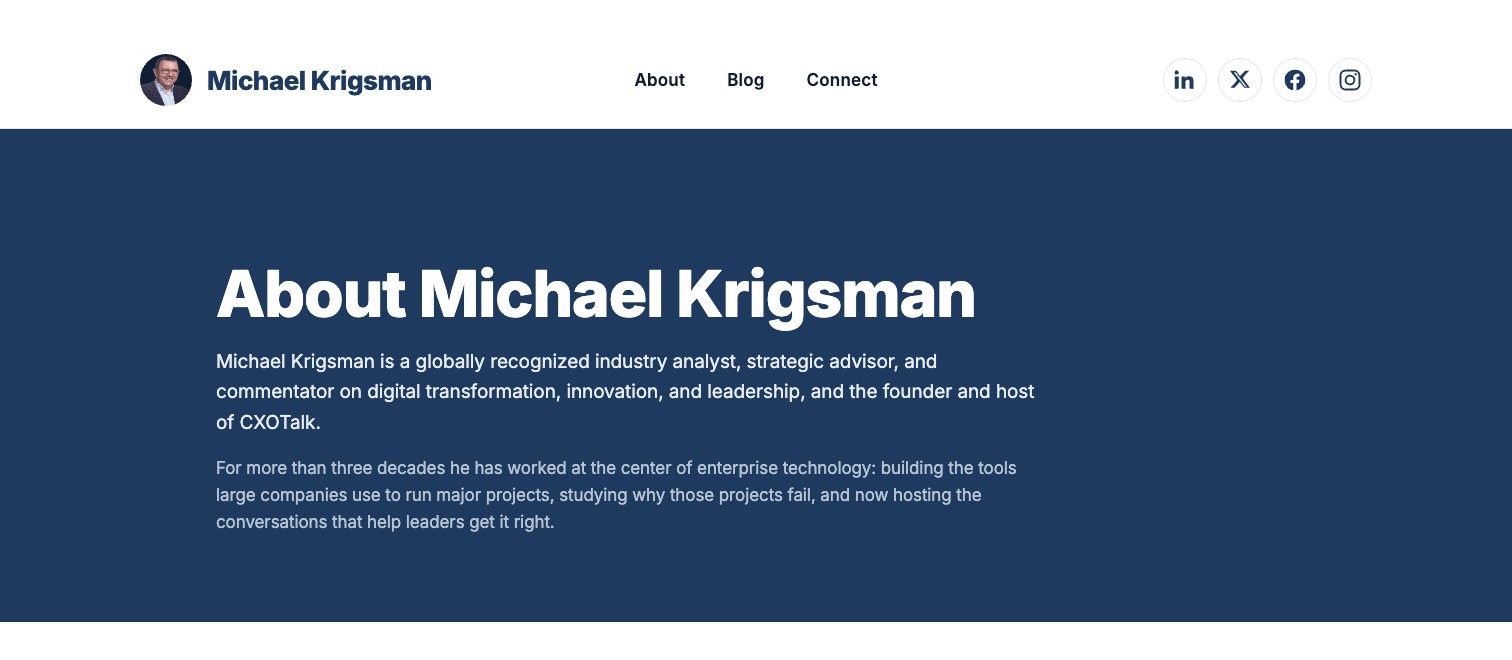
It built a home page, an About page with the full bio, a Connect page, and a blog styled to match the BlitzMetrics card layout, plus a design system: the brand blue, a square headshot logo, a favicon, and four social links carried consistently across the header, footer, and connect grid. The About page reads as a real analyst bio, with the ZDNet history, the Asuret years, and the CXOTalk record laid out for both a human reader and a machine.
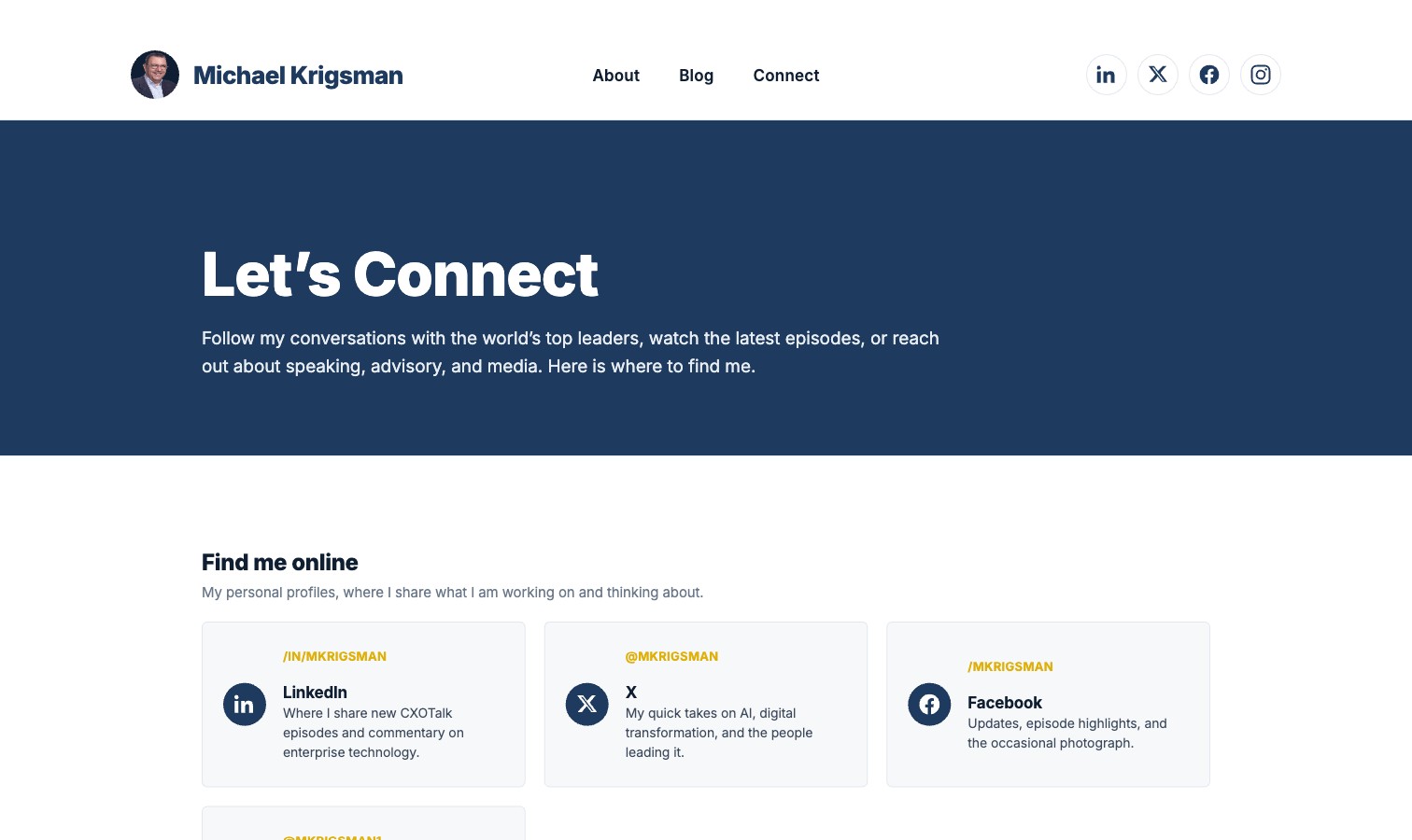
The Connect page is the social surface that feeds the entity graph. Every profile the site claims in schema also appears here as a card a human can click, so the sameAs array and the visible page agree with each other. That agreement is not cosmetic. When the machine-readable claims and the human-readable page match, Google has less reason to doubt either one.
The person and the company stay separate on purpose. Michael the analyst lives at michaelkrigsman.com. CXOTalk the show is its own object with its own site. Every first-class entity in a knowledge graph deserves its own home, and keeping them apart lets Google bind each one cleanly instead of collapsing the two into one blurred record.
Schema and Entity Setup
The entity spine is two linked Wikidata items the agent created and referenced: Q140501927 for Michael and Q140501968 for CXOTalk. They cross-reference, so Michael is the founder of CXOTalk and CXOTalk is his employer and notable work. The Michael item carries 29 statements with zero unreferenced claims and labels and descriptions in seven languages, and it holds his Google Knowledge Graph ID, which binds Wikidata and the panel object together explicitly.
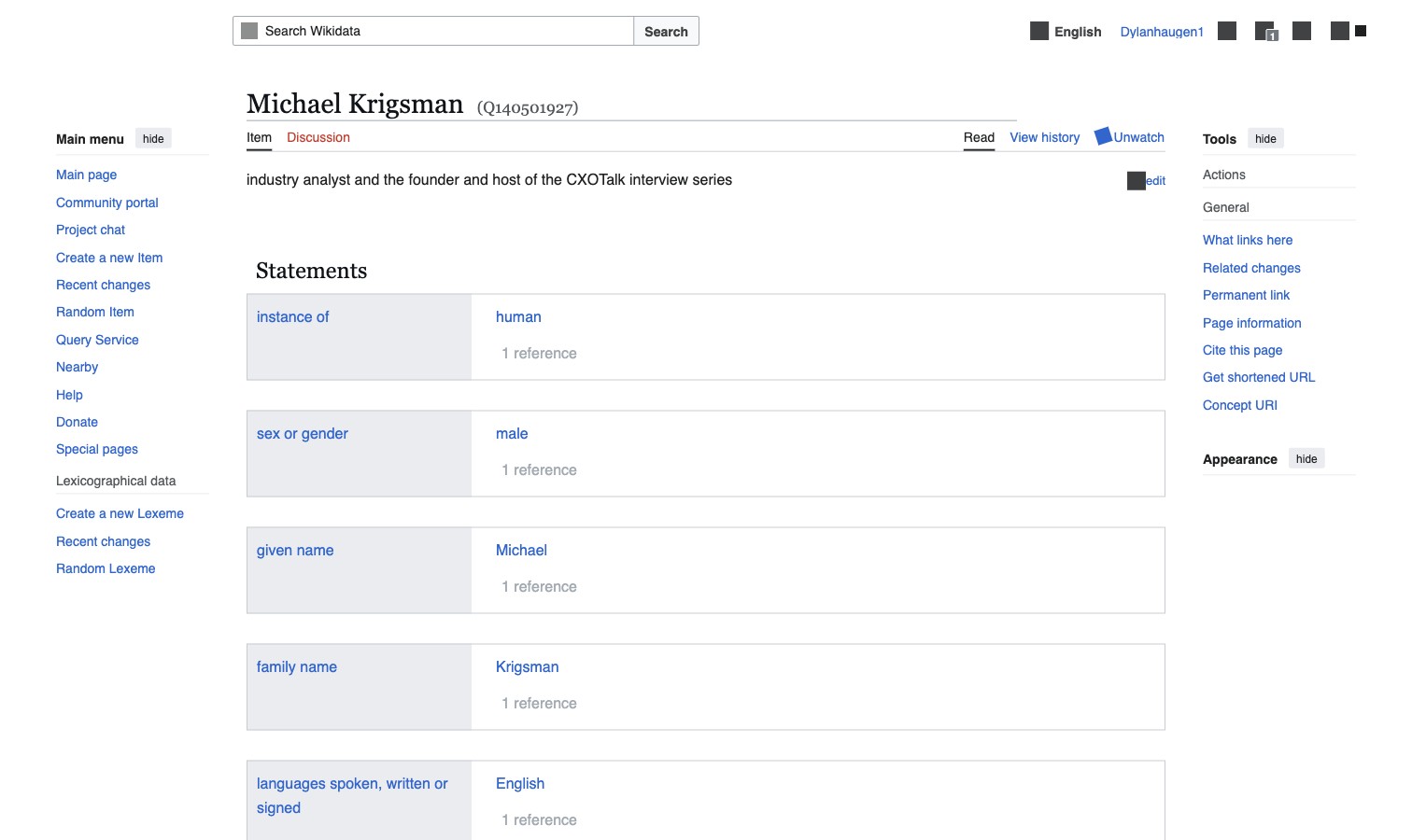
Notability was built to survive patrol, because the failure mode is real. A weaker item we built for a different client was deleted for failing notability, so this one leans on independent structured coverage: the ZDNet column history, a Muck Rack profile, a Google Scholar citations record, the Wall Street Journal publication, and roughly 900 episodes with 569 named guests. The agent deliberately omitted anything with no public source, such as date of birth and citizenship, rather than guess.
Wikidata writes went through the API, not the web forms, using the logged-in session token. The agent removed and edited statements with the same mechanism it would document for the next person.
// wbeditentity: set the description and the preferred occupation
api.post({ action: 'wbeditentity', id: 'Q140501927',
  data: JSON.stringify({
    descriptions: { en: { language: 'en',
      value: 'industry analyst and the founder and host of the CXOTalk interview series' } },
    claims: [{ mainsnak: { property: 'P106', datavalue: /* industry analyst */ },
               rank: 'preferred' }]
  }), token: csrfToken });
Every site URL carries JSON-LD that points back at the same entity through a shared identifier. The home page holds the full Person node; every inner page and post references it rather than redeclaring it. That shared @id is what lets any auto-generated plugin schema merge with the hand-rolled graph instead of fighting it.
{
  "@context": "https://schema.org",
  "@type": "Person",
  "@id": "https://michaelkrigsman.com/#person",
  "name": "Michael Krigsman",
  "jobTitle": "Industry Analyst",
  "sameAs": [
    "https://www.wikidata.org/wiki/Q140501927",
    "https://www.linkedin.com/in/mkrigsman/",
    "https://twitter.com/mkrigsman"
  ],
  "worksFor": { "@id": "https://michaelkrigsman.com/#cxotalk" }
}
Each repurposed article carries a BlogPosting node whose about and mentions arrays link to Wikidata QIDs, plus a VideoObject that matches the real upload date and duration. That is how an assistant learns that this article, this video, and this analyst are one authority rather than three loose strings.
"about": [
  { "@type": "Thing", "name": "artificial intelligence",
    "sameAs": "https://www.wikidata.org/wiki/Q11660" },
  { "@type": "Thing", "name": "digital transformation",
    "sameAs": "https://www.wikidata.org/wiki/Q1873419" }
],
"video": { "@id": "https://michaelkrigsman.com/why-most-ai-pilots-never-reach-production/#video" }
Beyond the entity nodes, the agent set the supporting plumbing that assistants read before they trust a page: an FAQPage block on the About page, Open Graph and Twitter card tags so a shared link renders with the right title and image, a clean XML sitemap, and a robots file that invites the crawlers rather than blocking them. None of it is glamorous, and all of it is what a machine checks first.
The Content Engine Across 16 Articles
The agent turned 16 CXOTalk episodes into standalone articles on Michael’s site. Each one is dated to the day the episode aired, so the archive reads as a real timeline instead of a launch dump. Every article opens with the tension-first cold open Michael uses on air, embeds the source video, quotes a named executive verbatim with a plain-English translation underneath, and links to at least two other articles to keep the cluster tight. Two live examples are Why Most AI Pilots Never Reach Production and What CIOs Get Wrong About AI Agents.
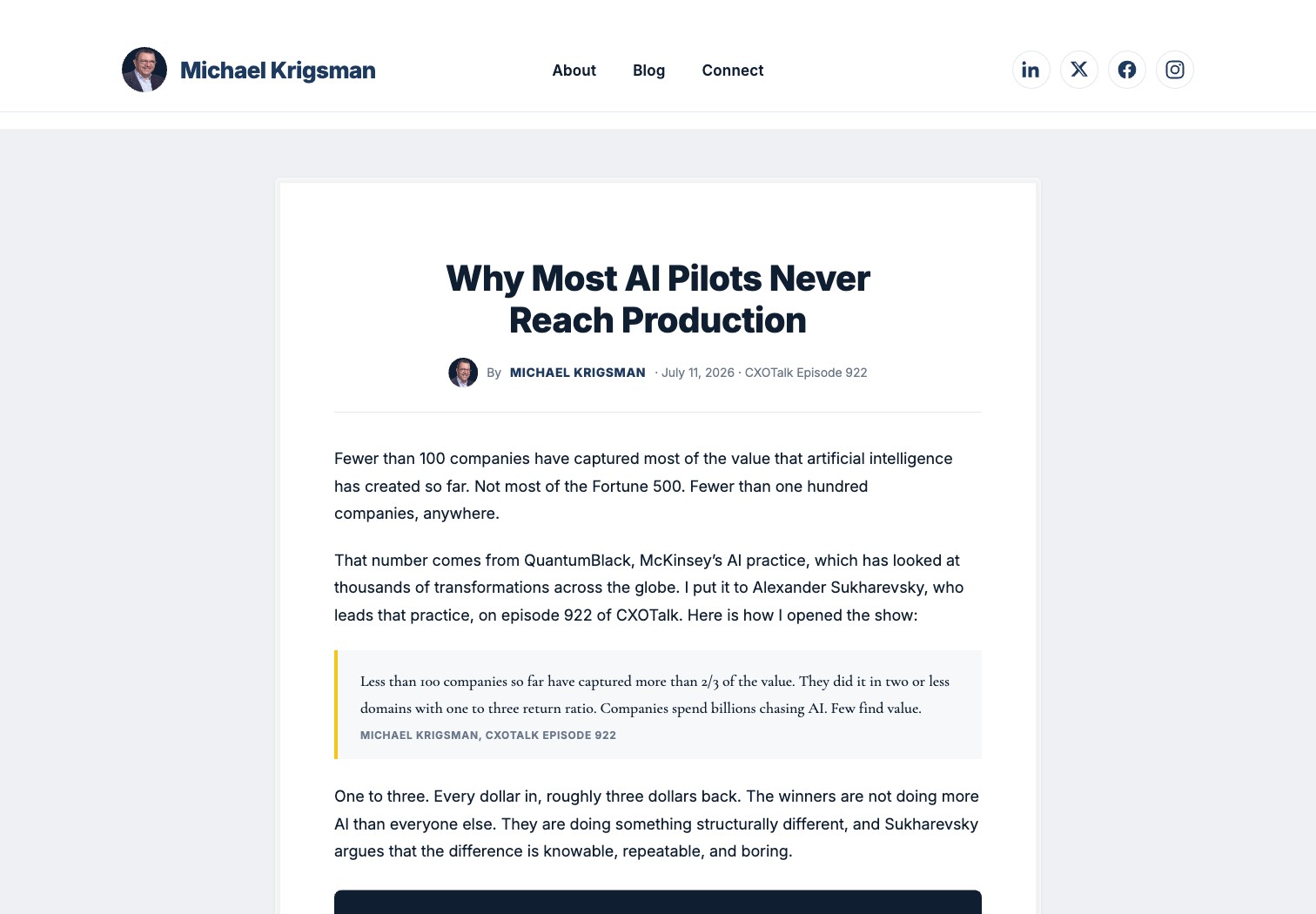
The cold open always pairs tension with a hard number, because the number is the reason to keep reading. This is Michael’s real opening line from the Box episode, transcribed from the transcript.
Every company wants AI agents, but few CIOs can run them safely at scale. Aaron Levie is co-founder and CEO of Box, which counts 68% of the Fortune 500 as customers.
Michael Krigsman, CXOTalk episode 921
Another opening, from his episode on AI strategy, does the same work in two sentences and states a claim most of the audience disagrees with.
Most executives see AI as just automation. That is wrong, and it explains why their AI strategies fail.
Michael Krigsman, CXOTalk episode 900
The interlinking is deliberate. Each article points to at least two siblings, so a reader who lands on one AI-governance piece finds the related ones on agents, on finance, and on security without leaving his site. For E-E-A-T, every article states plainly that Michael was in the room and asked the question, and it links the full episode and transcript so any claim can be checked. That is first-hand experience, sourced rather than asserted, which is exactly what a reviewer weighs when deciding whether a page deserves to rank.
The blog archive collects all 16 as cards with real episode thumbnails, matching the BlitzMetrics grid the client already trusted. The three starter posts WordPress ships with were deleted, and the grid was rebuilt to the real articles only.
The Positioning Pass
The last step was the one only the owner could trigger. After Michael reviewed the build, he flagged two things. His old records and the knowledge panel called him a journalist, which is not how he sees his work, and the show listed a co-founder he no longer wants associated with it. Both were positioning rather than bugs, and both got fixed at the source instead of papered over on the site.
For the journalist label, the agent edited Wikidata directly. It removed journalist and columnist as occupations, set industry analyst as the preferred value with a reference, and rewrote the description in seven languages to read industry analyst and the founder and host of the CXOTalk interview series. Because the panel subtitle re-derives from Wikidata, the correction lands where Google actually reads it. On the site, the single neutral mention of journalists in a list was reworded to technology leaders.
For the co-founder, the agent removed him from the show’s founder statement while leaving his own Wikidata item intact and unlinked. Nothing that could be restored was deleted, and the show now lists Michael as its sole founder. This is why positioning comes last in the order of operations. It depends on the owner seeing the finished entity before he can tell you what is wrong with it.
The QA Marathon: Real Bugs and the Fixes
Most of the work was not the first draft. It was catching what broke on a host and a theme the agent did not control, then recovering. Each bug below is one the agent actually hit.
The blank featured-image block on single posts
Symptom. After a post got a featured image, single-post pages showed a blank band roughly 430 pixels tall above the title.
Cause. Twenty Twenty-Five injects a post-featured-image block on singles and requests an uncropped thumbnail size, which rendered as empty space above the content.
Fix. The agent prepended a per-post hide rule, wrapped in an HTML block so the editor would not strip it.
<style>body.single .wp-block-post-featured-image{display:none!important}</style>
The template the account could not edit
Symptom. The clean fix for the block above is a single global template edit, but every attempt returned an error.
Cause. The site account could not manage templates and returned rest_cannot_manage_templates, so global CSS through a template part was off the table.
Fix. The agent accepted the constraint and applied the hide rule per post instead of globally. Slower, but it works within the permissions the account actually has, which is the real world most builds run in.
Thumbnails the firewall silently stripped
Symptom. Blog cards rendered with no images even though the markup was correct and the media existed.
Cause. The host firewall strips url() out of inline style blocks, so every CSS background-image thumbnail was quietly removed before the page reached the browser.
Fix. The agent switched from CSS backgrounds to real img tags, and learned those save reliably only from a fresh browser tab with a clean connection pool. It used window.name to carry the fetched card data across same-tab navigations, then posted the grid.
The REST write that would not land
Symptom. After many writes on one tab, REST POSTs stopped taking effect and the response hung.
Cause. The browser connection pool wedges after heavy reuse, and a stale nonce compounded it, returning rest_cookie_invalid_nonce.
Fix. Open a fresh tab, read a current nonce from wpApiSettings.nonce, and re-issue the write. The write lands even when the response appears to hang, so the recovery is to verify the change with a follow-up read rather than trust the POST response.
The Wikidata form that navigated away mid-write
Symptom. Editing several Wikidata statements in a row kept losing the session and stalling.
Cause. Submitting a Wikidata edit triggers a full page load that hangs the tab, so the next write starts from a broken state.
Fix. Re-navigate to a blank Wikidata page between writes to reset the tab, then issue the next API call with a fresh token. Treat each statement edit as its own clean transaction.
The Google Sheet that could not be edited in place
Symptom. The client keeps a shared content tracker as a Google Sheet, and it had fallen behind the live site: it was missing a new episode row and still marked six published articles as not started.
Cause. The connected Drive tool can read a sheet and create files, but it has no cell-write capability and cannot carry a 900-row payload inline, so it cannot edit an existing sheet in place.
Fix. The agent reconciled the tracker against the live site, rebuilt the corrected file, and handed back a one-step import that replaces the sheet contents while keeping its existing URL and sharing. The honest limit got named instead of faked, and the human got a clean path.
The screenshot that tainted the canvas
Symptom. The screenshots in this article were captured in-browser and uploaded to the BlitzMetrics media library, but the capture of a third-party page threw a security error on export.
Cause. A cross-origin image on the page taints the canvas, and a tainted canvas refuses to export to a data URL.
Fix. Hide the cross-origin images before capture, render the page to a canvas, stash the data URL in window.name so it survives the same-tab navigation to the other domain, then post it to the media endpoint. That bridge is how a build article gets its own screenshots without a human dragging files in.
// on the source page, after hiding cross-origin images
const canvas = await html2canvas(document.body, { useCORS: true, backgroundColor: '#fff' });
window.name = canvas.toDataURL('image/jpeg', 0.88);
// navigate the SAME tab to blitzmetrics.com/wp-admin, then:
const blob = await (await fetch(window.name)).blob();
const fd = new FormData(); fd.append('file', blob, 'shot.jpg');
await fetch('/wp-json/wp/v2/media', { method: 'POST',
  headers: { 'X-WP-Nonce': wpApiSettings.nonce }, body: fd });
The byline that read Written by in with nothing between
Symptom. Single posts printed the words Written by and in with the author and category fields missing between them.
Cause. The single template prints a post-meta pattern that assumes fields the posts did not populate, so the labels rendered around empty values.
Fix. The agent replaced the meta pattern with an explicit author line reading By Michael Krigsman plus the CXOTalk episode number, which matches how the show attributes its own work and doubles as a trust signal.
The white gutters on wide screens
Symptom. On wide monitors the content sat in a narrow column with large white gutters on both sides, which read as unfinished.
Cause. The theme constrains content to a fixed reading width, which is right for an essay and wrong for a designed brand page with full-bleed color bands.
Fix. The agent set the hero and section wrappers to full width and let the inner text keep its own max width, so the design reaches the edges while the copy stays readable.
The redirect WordPress could not remove
Symptom. Even after the fresh WordPress install, michaelkrigsman.com kept redirecting to the show, and no WordPress setting stopped it.
Cause. The redirect lived at the hosting infrastructure level, outside WordPress, so every setting the agent could reach was the wrong lever.
Fix. The agent stopped hunting inside WordPress, named the redirect as infrastructure, and routed it to where it actually lived. The lesson worth keeping is to locate a bug at the right layer before spending any time fixing it at the wrong one.
Critical Decisions With Rationale
Keep the person and the company as separate, linked entities. The options were (1) one combined node covering man and show, (2) two separate items with no link, or (3) two items linked by founder and employer through a shared identifier. The agent chose (3). A combined node muddies which facts describe the person and which describe the show, and two unlinked items waste the cross-reference Google uses to confirm both. Linked-but-separate is what lets each object earn its own panel.
Lead the entity with industry analyst and remove journalist. The options were (1) keep all six occupations including journalist and columnist, (2) add industry analyst alongside the existing ones, or (3) remove journalist and columnist and set industry analyst as the preferred value with a reference. The agent chose (3) after the owner flagged the journalist label as wrong. Because the panel subtitle re-derives from Wikidata, the cleanest fix is at the source, not a patch on the site.
Remove the co-founder from the show but keep his own item. The options were (1) delete the co-founder’s Wikidata item, (2) leave the founder statement listing both names, or (3) remove the co-founder from the show’s founder statement while leaving his standalone item intact. The agent chose (3) on the owner’s instruction. Deleting a valid item is destructive and unnecessary; leaving the statement as-is ignored a direct request. Unlinking is reversible and precise.
Distill the transcript corpus instead of archiving all 900. The options were (1) store every transcript verbatim, (2) store none and fetch each time, or (3) index all 922 slugs, distill the recent set into dossiers, and pull full transcripts fresh only for episodes being repurposed. The agent chose (3). Archiving 900 verbatim transcripts was expensive and low value, and storing nothing meant re-fetching constantly. The index plus distillation keeps the knowledge base lean and the cost down.
Fix the featured-image block per post rather than globally. The options were (1) edit the global template part, (2) drop featured images entirely, or (3) hide the empty block with per-post CSS. The template edit was blocked by permissions and dropping featured images would cost the open-graph and social-share thumbnails, so the agent chose (3). It is the option that survives the account’s real permission set.
Disable comments site-wide as a default rule. The options were (1) leave comments open, (2) moderate them, or (3) close them site-wide. The agent chose (3). An analyst brand site has no reason to run an unmoderated comment section that invites spam and dilutes the page, and closing comments everywhere is one setting instead of a per-post chore that someone forgets.
Effort and Cost Comparison
| Task | Agent Time | Human Time | Agent Cost | Human Cost ($50/hr blended) |
|---|---|---|---|---|
| Source research and knowledge base | ~35 min | 6-8 hrs | $2.00 | $300-$400 |
| Reference recon and design system | ~20 min | 3-4 hrs | $1.00 | $150-$200 |
| WordPress build: 5 pages and design system | ~90 min | 25-35 hrs | $4.50 | $1,250-$1,750 |
| Logo, favicon, brand color | ~15 min | 2-3 hrs | $0.50 | $100-$150 |
| JSON-LD schema across 7 URLs | ~25 min | 6-8 hrs | $1.50 | $300-$400 |
| Wikidata: Michael item and references | ~30 min | 5-7 hrs | $2.00 | $250-$350 |
| Wikidata: CXOTalk item and cross-links | ~20 min | 3-4 hrs | $1.00 | $150-$200 |
| 922-episode index and harvest architecture | ~30 min | 8-10 hrs | $2.50 | $400-$500 |
| Voice guide from real transcripts | ~20 min | 4-6 hrs | $1.50 | $200-$300 |
| Repurpose 16 episodes into dated articles | ~120 min | 40-55 hrs | $6.00 | $2,000-$2,750 |
| Featured images and blog grid rebuild | ~25 min | 4-6 hrs | $1.50 | $200-$300 |
| Positioning fixes: site and Wikidata | ~20 min | 3-4 hrs | $1.00 | $150-$200 |
| QA marathon and PRISM documentation | ~40 min | 8-10 hrs | $2.00 | $400-$500 |
| TOTAL | ~8 hrs | 130-165 hrs | ~$27 | $5,850-$8,000 |
Costs use Claude Sonnet public rates of $3 per million input tokens and $15 per million output tokens across roughly 5 million tokens for the engagement, about 4 million input and 1 million output. Human cost uses a blended $50 per hour covering research, development, SEO, schema, writing, and project management. That puts the agent build at roughly 220x to 300x cheaper than the human equivalent.
What the Agent Handled vs What Needed a Human
Agent handled autonomously: the full site build, the design system, all JSON-LD schema, both Wikidata entities and their references, the 922-episode index, the voice guide, all 16 repurposed articles and their dating, the featured-image and thumbnail fixes, the nonce and connection-pool recoveries, the journalist and co-founder corrections on Wikidata and the site, the content-tracker reconciliation against the live site, the six screenshots in this article, and every PRISM documentation file.
Required human input: the logged-in browser sessions on WordPress and Wikidata, the owner’s factual corrections on positioning, a free-license headshot for Wikimedia Commons that only Michael can release, the Google Knowledge Panel claim that needs his identity, the one-step import to refresh the shared Google Sheet, and final approval before anything public shipped.
Information Ingestion Inventory
- 922 CXOTalk episodes indexed by slug, 30 distilled into dossiers, and the repurpose set read in full from the human-edited transcripts
- Roughly 20 PRISM knowledge-base files read and written
- 7 live site URLs built and audited across home, about, connect, blog, and posts
- Well over 100 WordPress REST calls for reads and writes
- 3 Wikidata entities created or edited (Q140501927, Q140501968, and the co-founder item)
- 10 schema node types deployed, including Person, WebSite, ProfilePage, FAQPage, BlogPosting, and VideoObject
- 16 articles published and dated to their air dates, roughly 17,000 words in Michael’s voice
- 6 screenshots captured in-browser and uploaded for this article
- 13 named decisions considered, 6 written up in full, and 10 named bugs caught and fixed
- Roughly 5 million tokens across the engagement
Guidelines Compliance Scorecard
| BlitzMetrics Guideline | Status | Notes |
|---|---|---|
| Hook opens with a specific person and result | PASS | Michael Krigsman, site plus entity plus 16 articles |
| Answer in the first paragraph | PASS | Scope stated up top |
| Short paragraphs, 3 to 5 lines | PASS | Held throughout |
| Active voice | PASS | Agent as the subject |
| No AI fluff phrases | PASS | None used |
| Title under 60 characters | PASS | 53 characters |
| H2 and H3 structure without heading abuse | PASS | H3 only in the QA marathon |
| Internal links to BlitzMetrics content | PASS | Six distinct links |
| Cross-link to sibling meta articles | PASS | Cam and Trenton both linked |
| Entity links follow the decision tree | PASS | Person to his site, Wikidata to Wikidata |
| Source video embedded | N/A | Videos live on the built site and are cross-linked |
| Featured image | PASS | Home-page screenshot set as featured |
| Screenshots of the real deliverable | PASS | Six captioned page and entity screenshots |
| RankMath SEO configured | PASS | Focus keyword, title, and description set |
| Author byline set to Dylan Haugen | PASS | Author 294 |
| No stock images | PASS | Real build screenshots only |
| Categories and tags set | PASS | AI Builder and Personal Branding |
| Anchor text 3 to 6 words and descriptive | PASS | No generic anchors |
| No keyword stuffing | PASS | Reads naturally |
| Evergreen framing and specific CTA | PASS | No one-time dates in the body; read, see, compare close |
Why This Creates Value for Michael
Michael now owns a canonical URL that Google and AI assistants can bind to, an entity that says industry analyst instead of journalist, and 16 articles that prove first-hand experience because every one quotes a named executive he interviewed on the record. When a sponsor, a journalist, or a prospective guest searches his name, the surface they hit is one he controls, and it agrees with itself across the site, Wikidata, and the knowledge panel. That consistency is what moves an assistant from ignoring him to recommending him, and it is the difference between being quoted in someone else’s story and being the entity the story is about.
Why This Creates Value for BlitzMetrics
This build proves the personal-brand playbook runs end to end on an agent: site, entity, schema, and a repeatable content engine, for roughly $27 in compute against $5,850 to $8,000 of human labor. At 220x to 300x cheaper, the package that used to justify a five-figure retainer now fits a productized offer. That opens the door to authors, analysts, founders, and local operators who were priced out of the bespoke version, and it does it without lowering the quality bar, because the quality bar is the transcript, the schema, and the QA, all of which the agent holds.
The Build Pattern
This is entity authority done in the right order: a site first for a canonical home, Wikidata second so Google has an object to trust, a content engine third for depth, and positioning fixes last once the owner reviews. If you want the methodology, read the blog posting guidelines and the personal-branding method behind it. If you want to see the live result, michaelkrigsman.com is the deliverable. If you want the sibling cases, compare the full-site build for Cam Hazzard and the Wikidata-only optimization for Trenton Sandler linked at the top.
Dylan Haugen
Dylan Haugen is a professional dunker, content creator, and editor at the Content Factory, where he transforms podcasts and interviews into strategic brand assets. He collaborates with Dennis Yu to support young entrepreneurs and business owners in building their personal brands through education, transparency, and effective content marketing. As the host of the Dunk Talk podcast and a dedicated advocate for establishing dunking as a recognized sport, Dylan combines athletic expertise, storytelling, and digital strategy to help elevate the next generation of creators.