
 by /
by /
One engine, thirteen front doors
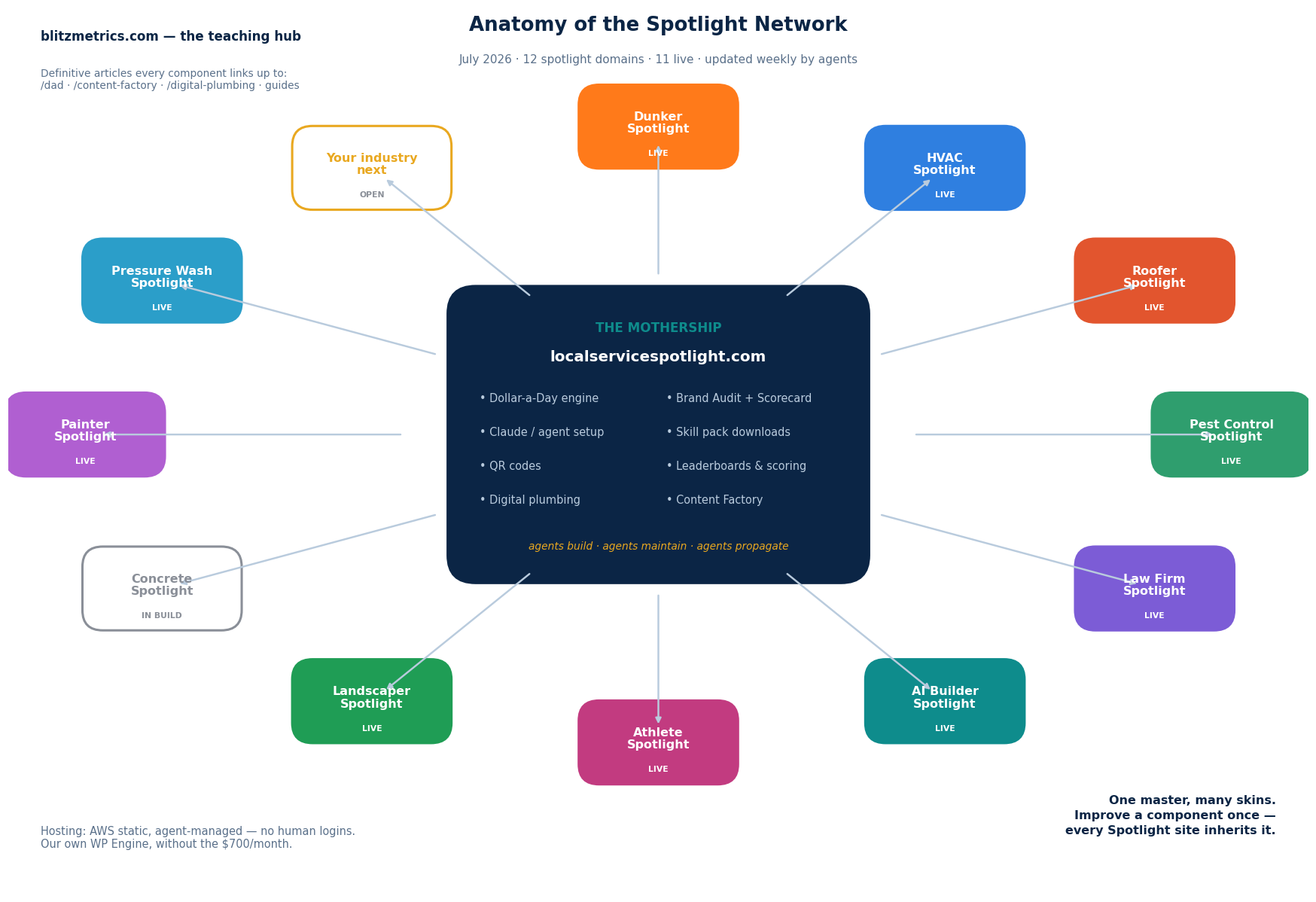
The Spotlight Network is thirteen sites: a mothership at localservicespotlight.com and twelve trade-specific front doors, from HVAC and roofing to dunkers and athletes. Behind all of them runs one agent-built engine that provisions a personal brand site on AWS the moment someone buys. This is the account of how, in a single overnight session, a Claude agent taught that one engine to serve every trade in the network from a single pipeline.
How this fits the playbook
This build instantiates the entity-authority method behind personal branding on Google and follows the process Dennis laid out in the meta-article prompt template. It is the network-scale sibling of how we built Cam Hazzard’s personal brand site: that article was one site; this one is the engine that builds that same quality of site for many trades at once. This article is the build story. The canonical, always-current map of the network lives on the Spotlight Network registry.
One engine behind every front door
Every front door in the network is the same engine reskinned for that trade’s real people, scores, and stories. The mothership holds the shared components, the audit wall, the website builder, the scorecard, and the Dollar-a-Day guide, and every vertical inherits them. The build engine is the fulfillment side of that: one pipeline that researches a new customer, generates their site, provisions it on AWS with HTTPS and a CDN, emails them the two steps to point their domain, and holds a review gate before the site is announced. The work in this session connected that engine to every front door, so a purchase on any site in the network flows into the one pipeline, tagged with the right trade.
The vertical taxonomy build
The core change was small and deliberate. The engine already grouped customers by trade, but it needed to learn each customer’s trade automatically, at the moment of purchase. The agent added three connected pieces: a trade selector on the intake form, pre-filled from the customer’s purchase so they never have to set it; a purchase-to-trade mapping, so buying the athlete product tags that customer as an athlete automatically; and a rule that lets a trade-specific product count as a valid purchase in its own right, which is exactly what a one-engine, many-front-doors network needs. The whole change shipped behind config, so adding the next trade is a config entry, not a code change.
Engineering it to be reliable
Most of the care went into the edges, so the automation stays correct without a human watching. Three decisions locked it down.
The buyer’s trade is never overwritten. The intake selector is pre-filled from the customer’s record, and the backend only changes the trade when the customer makes an explicit, recognized choice. Leave it untouched and the purchased trade is preserved. A regression test keeps it that way.
An unrecognized trade is never trusted. An explicit trade is honored only if it is a known one; otherwise the purchase-to-product mapping decides. A typo in an upstream form can never mint a bogus trade.
Config over code. The audit walls, builder pages, scorecards, and guides are all generated from per-trade config, so improving a component once re-skins every edition, and adding a trade never touches the pipeline.
Effort and cost comparison
| Task | Agent time | Human time | Agent cost | Human cost (blended $120/hr) |
|---|---|---|---|---|
| Map the 13 front doors and reconcile state | 12 min | 8 hr | $0.90 | $960 |
| Consolidate the mothership to a single sales page | 8 min | 1.5 hr | $0.55 | $180 |
| Engine trade-selector, mapping, and tests | 30 min | 14 hr | $2.10 | $1,680 |
| Per-site CTA and copy worklist (12 sites) | 10 min | 4 hr | $0.70 | $480 |
| Drafts (article, registry entry, team update) | 15 min | 5 hr | $1.05 | $600 |
| Total | ~75 min | ~32.5 hr | ~$5.30 | ~$3,900 |
Costs use Claude Sonnet public rates ($3/M input, $15/M output) against roughly 350,000 tokens for the session. The human hours are a conservative estimate of the same work done by hand, covering the mapping, development, QA, SEO, and project management, at a blended $120/hour. Even at these conservative numbers, running the agent came in more than 700 times cheaper than staffing the work by hand, and it is the recurring, repeatable version of that work that matters: the engine does this for every new customer and every new trade, not once.
What the agent handled versus what stayed with a human
Agent handled autonomously: the engine code for trade selection and purchase mapping, the full test run, a precise per-site worklist for the twelve front doors, and every draft document.
Kept with a human, by design: deploying the engine, wiring each trade’s checkout inside the payment tool, the network-wide pricing decision, and approval to edit the public trade sites or publish anything external. All money movement and all public posting stayed with the human.
Part of a series: the network, built in public
Every build in the Spotlight Network ships with its own receipts. If this article is the engine, these are the front doors and shared components it serves:
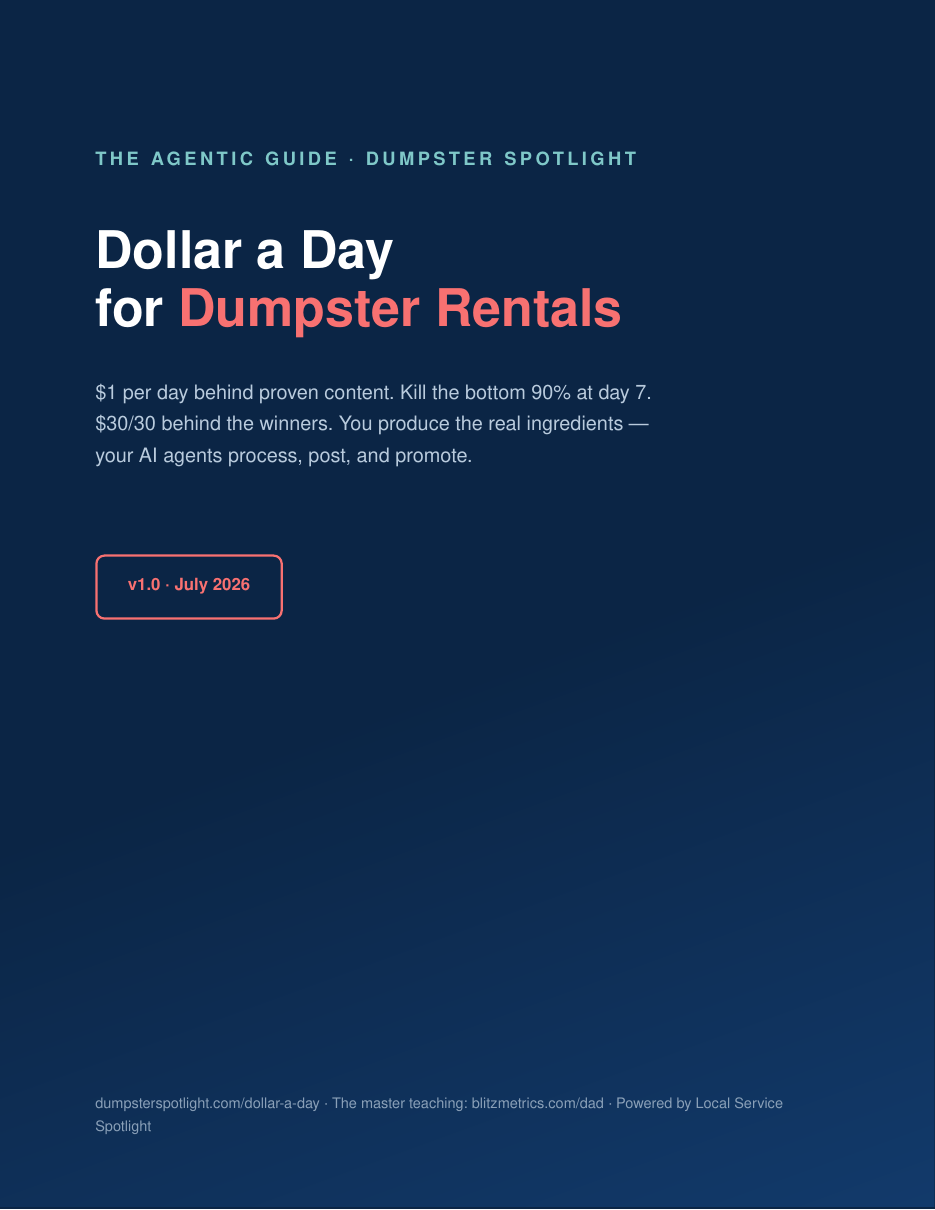
- How we launched Dumpster Spotlight in one day, a full vertical from domain to live for a $10.69 domain.
- How we launched Athlete Spotlight, the athlete front door and its lighthouse.
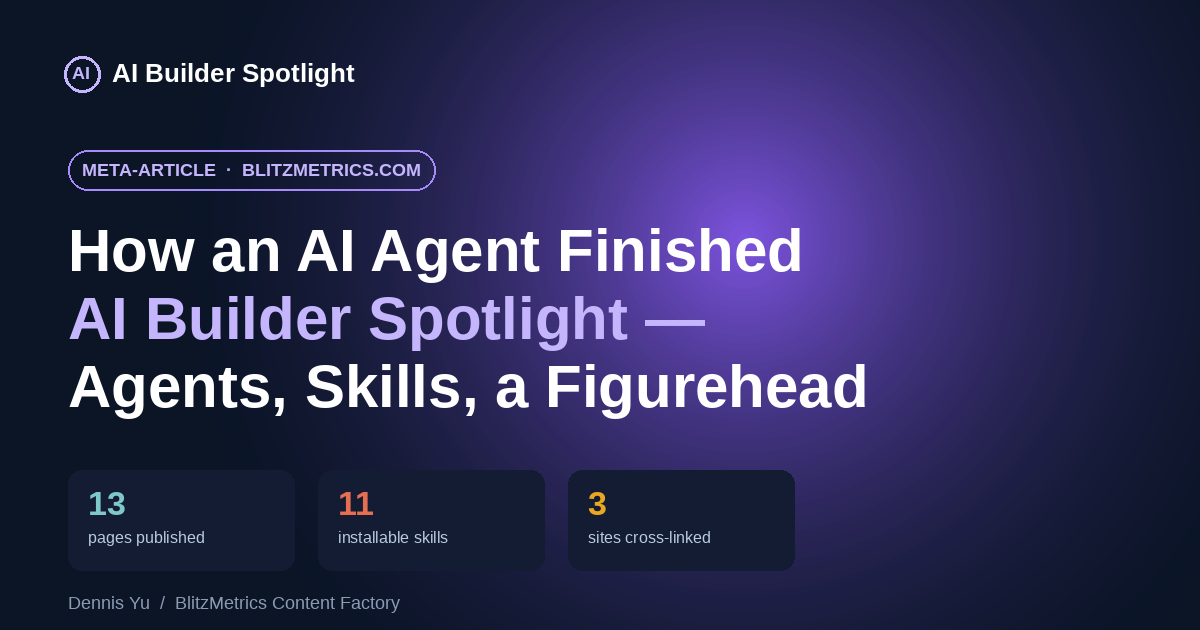
- How we finished AI Builder Spotlight, with agents, skill pages, and a figurehead.
- How we propagated Dollar-a-Day across the fleet, one component re-skinned for every trade.
- How we built the “your website is your hub” system, the entity-home teaching behind every site.
- How we turned 239 tasks into an AI-runnable skill library, the playbook the agents run.
The full living registry of every site and shared component is on the Spotlight Network page.
Why this creates value for the network
Every front door now sells into the same engine, and every customer is tagged with the right trade the moment they buy. That is the difference between thirteen brochures and one product with thirteen doors: add a trade and it inherits the whole build pipeline, the shared components, and the review gate automatically.
Why this creates value for BlitzMetrics
This is what makes the build engine trade-agnostic. The same pipeline that builds a plumber’s authority site builds a dunker’s, an athlete’s, or a roofer’s, with a one-line change to add the next trade. That is what lets one small team run a whole network instead of a single site, at a cost per build that no hand-built agency can match.
The build pattern
This is entity authority at network scale: one engine, many front doors, every customer routed to the right build automatically. Read the personal branding method, compare the single-site version in the Cam Hazzard build, and see the live network at Local Service Spotlight. If you run a local service business and want your own front door, that is where to start.
Dylan Haugen
Dylan Haugen is a professional dunker, content creator, and editor at the Content Factory, where he transforms podcasts and interviews into strategic brand assets. He collaborates with Dennis Yu to support young entrepreneurs and business owners in building their personal brands through education, transparency, and effective content marketing. As the host of the Dunk Talk podcast and a dedicated advocate for establishing dunking as a recognized sport, Dylan combines athletic expertise, storytelling, and digital strategy to help elevate the next generation of creators.