
 by
by
Last week, Google made the biggest change to search in twenty-five years. They released it at their Google I/O keynote in Mountain View, and while it’s exciting for business owners and people using AI agents, it’s going to disrupt over 95% of marketers, especially SEO consultants.
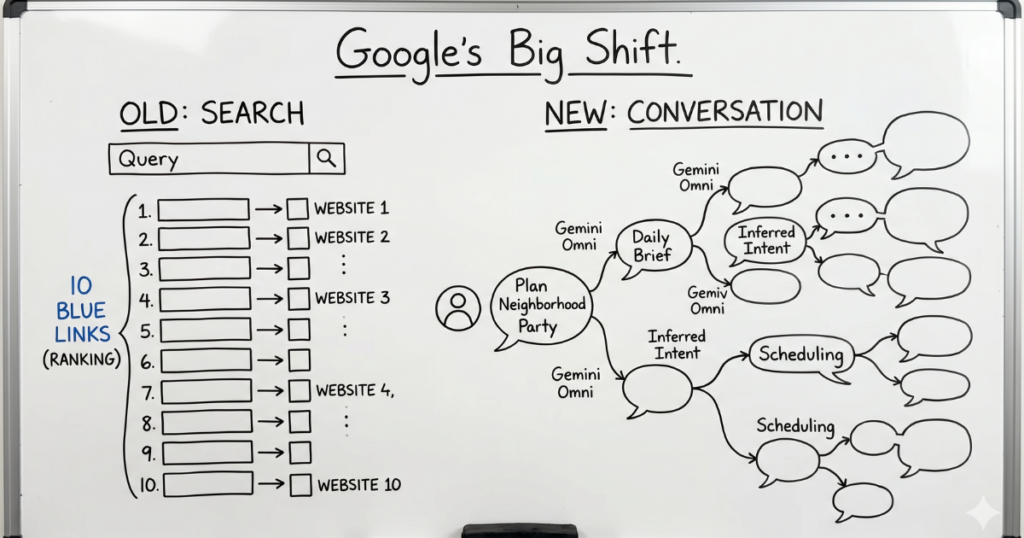
The end of ten blue links
For as long as we can remember, search has worked the same way: you type something in, you get ten blue links, and each one goes to a website. You try to rank number one, number two, and the whole game revolves around keywords and rankings.
That’s over.
The new search is a conversation. Instead of typing one or two words and starting fresh every session, Google now remembers your context. It expands the conversation based on your habits, your planning, and what you’re trying to accomplish. They’ve created Gemini Omni, combining every modality together, and they’re starting from a massive advantage as a manufacturer of TPUs and the owner of thirteen products with over a billion users each.

Instead of showing you search results, Google now goes straight into purchasing through their AP2 payments platform. If you ask how to teach your toddler to go from balancing on a bike to riding with pedals, instead of handing you a list of YouTube videos, it gives you real answers. A table, a chart, step-by-step videos, and even a custom-built interactive app. It skips your website entirely.
AI agents are replacing traditional SEO
This is where it gets real for business owners. Google’s new system uses what’s called Model Context Protocol (MCP), which is essentially the API for AI agents. Instead of trying to push content up to a website and fool an algorithm, your business now passes signals directly to AI agents through your CRM, your Google Business Profile, and tools like ServiceTitan.
Google has also released something called Antigravity, a harness that orchestrates multiple AI agents working in sequence or parallel. Think of it like a car engine: Antigravity is everything around the engine that makes it useful. The brakes, the steering wheel, all the pieces working together. Even a busy CEO who doesn’t write code can talk to it, and it spins up agents managed by the harness.
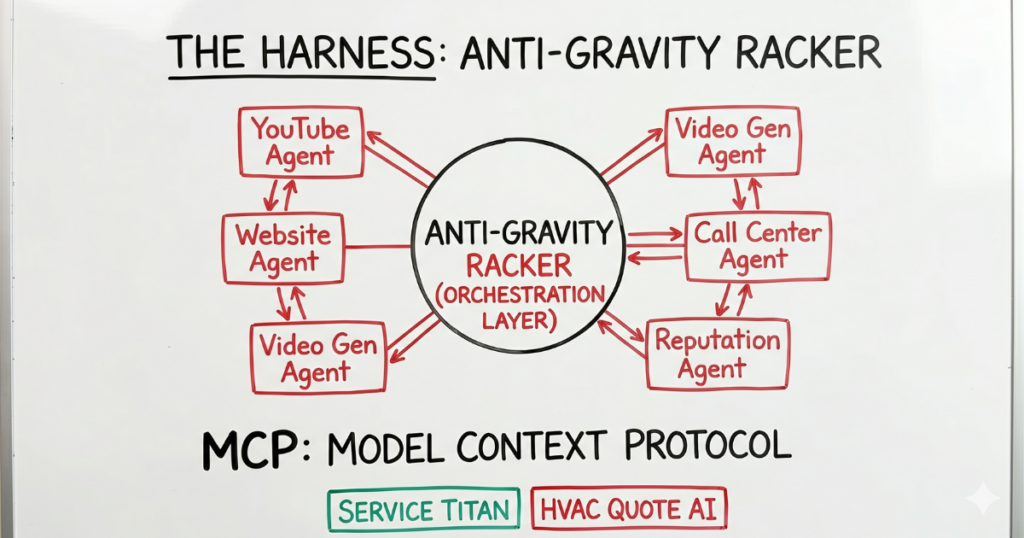
The fan-out query system is another game-changer. As you’re having a conversation, Google is inferring your intent and doing “thought ahead.” Not just predicting the next word, but predicting what you actually need. It can schedule appointments, reach out to people, and build apps on the fly, all within your guidelines.
What business owners need to do right now
If you actually have a great business with real signals, real customer reviews, real supplier relationships, real community presence, this update helps you. The businesses that win are the ones with genuine reputations that AI agents can verify and amplify.
Here’s what’s changing practically:
Your price list should be public. If you follow people like Jason Amato or businesses like Anytime Plumbing and AnyHour, you know transparency is key. Google’s agents are proactively checking prices, making restaurant reservations, contacting florists, all on behalf of users. If they know your price and reputation, you bypass the website layer entirely.

WordPress is on its way out. If you’re in the know, you’ll be off WordPress within six months. The traditional model of generating pages, buying backlinks, and driving fake traffic is dead. Agents are repurposing real signals, not generating fake content.
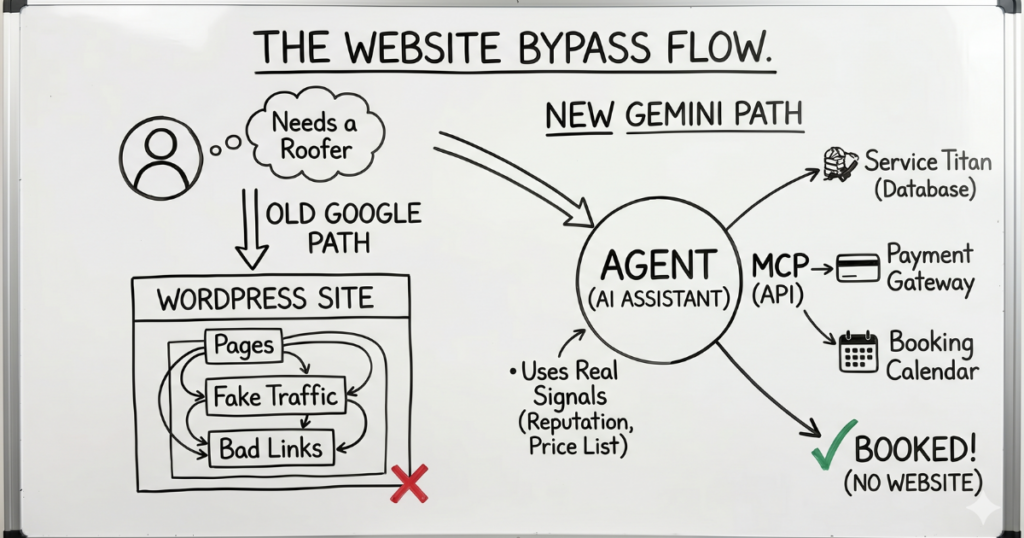
YouTube and Google Business Profile are your highest-value channels right now. Because YouTube is owned by Google, pushing content there carries a higher signal strength than traditional social media. Google’s new “Ask YouTube” and “Ask Google” features are consolidating answers and building responses on the fly.
The trickery is getting crushed. Black hat SEO, fake traffic, VA-generated content, none of that works in the agent-to-agent model. If you can’t sing, going from a hundred-watt amplifier to a thousand-watt amplifier isn’t going to help.
Take Anthony Hilb for example. He wears his green shirt everywhere he goes like a mascot. You don’t have to be like that, but there are clear signals that build real reputation.

If you’re a licensee of Brad Strawbridge‘s BuilderLync system opening up a roofing location following his framework, you just need to take care of customers.
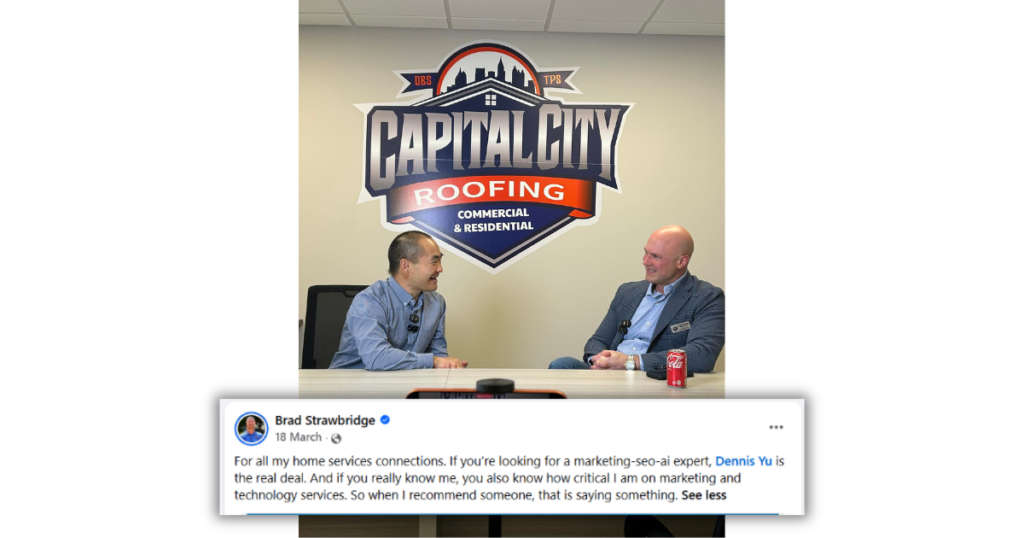
All the answering the phone, the marketing, the landing pages, the social media, your agents handle that.
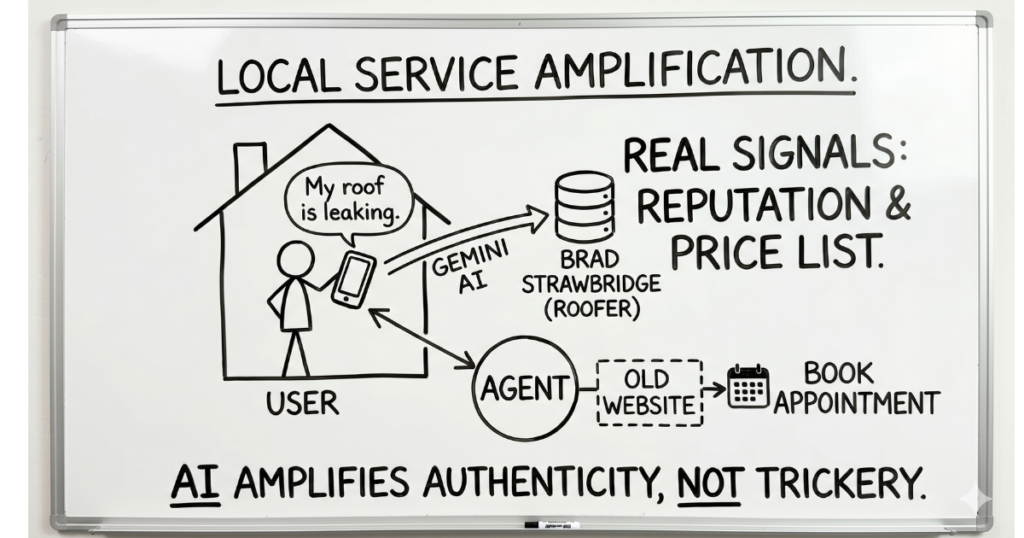
Tools like HVAC Quote are already showing how this works in practice. Your agents gather feedback from your CRM, pass signals through MCP, and interface with Google’s agents directly.

Lance Bachmann, who built one of the largest SEO agencies, saw where this was heading. He sold at the top and started buying roofing companies instead. Pretty smart.
People like Damon Burton, who runs SEO National, one of the largest SEO companies, agree. The underlying signals are never changing. If you have real reputation and real proof, these changes actually help you.
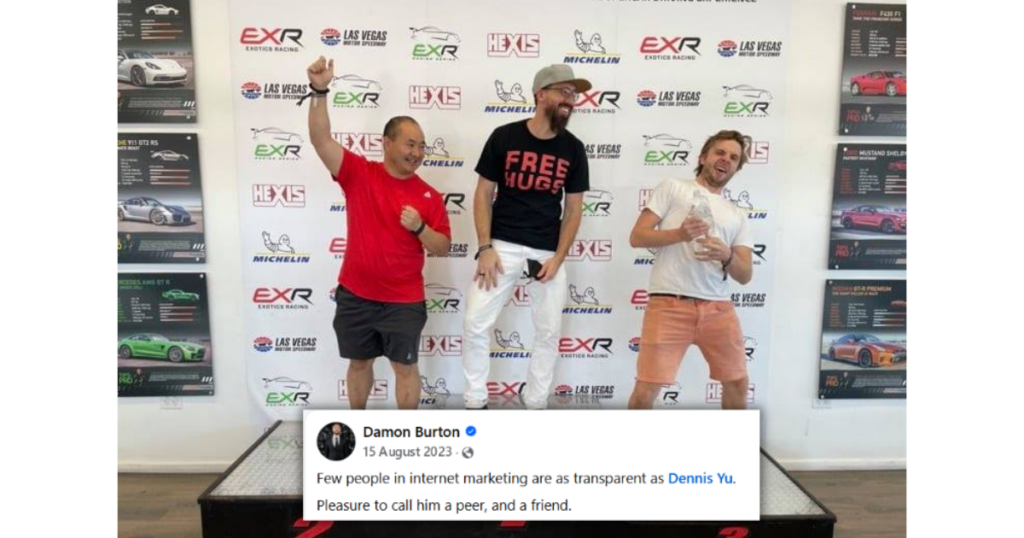
And with Trenton Sandler and I at Korean barbecue the other night, I showed how you can just say “generate a video” and watch it happen in real time. That’s how fast this is moving.
I’m Dennis Yu, former search engine engineer and your marketing mechanic. I make a video every week for you, one hundred percent real, no AI. The next six months are gonna be absolutely nuts. Let me know what you think.
Originally published .
Dennis Yu
Dennis Yu is the CEO of Local Service Spotlight, a platform that amplifies the reputations of contractors and local service businesses using the Content Factory process. He is a former search engine engineer who has spent a billion dollars on Google and Facebook ads for Nike, Quiznos, Ashley Furniture, Red Bull, State Farm, and other brands.
Dennis has achieved 25% of his goal of creating a million digital marketing jobs by partnering with universities, professional organizations, and agencies. Through Local Service Spotlight, he teaches the Dollar a Day strategy and Content Factory training to help local service businesses enhance their existing local reputation and make the phone ring.
Dennis coaches young adult agency owners serving plumbers, AC technicians, landscapers, roofers, electricians, and believes there should be a standard in measuring local marketing efforts, much like doctors and plumbers must be certified. He has appeared on 353 podcasts with 619 credited episodes — see the full list of his podcast appearances.