
 by /
by /
There is a category of claim you are structurally unable to make about yourself. You can list your certifications, your years, your client count, your awards. You cannot credibly say that the best people in your field respect you, because the moment you say it, it stops counting.
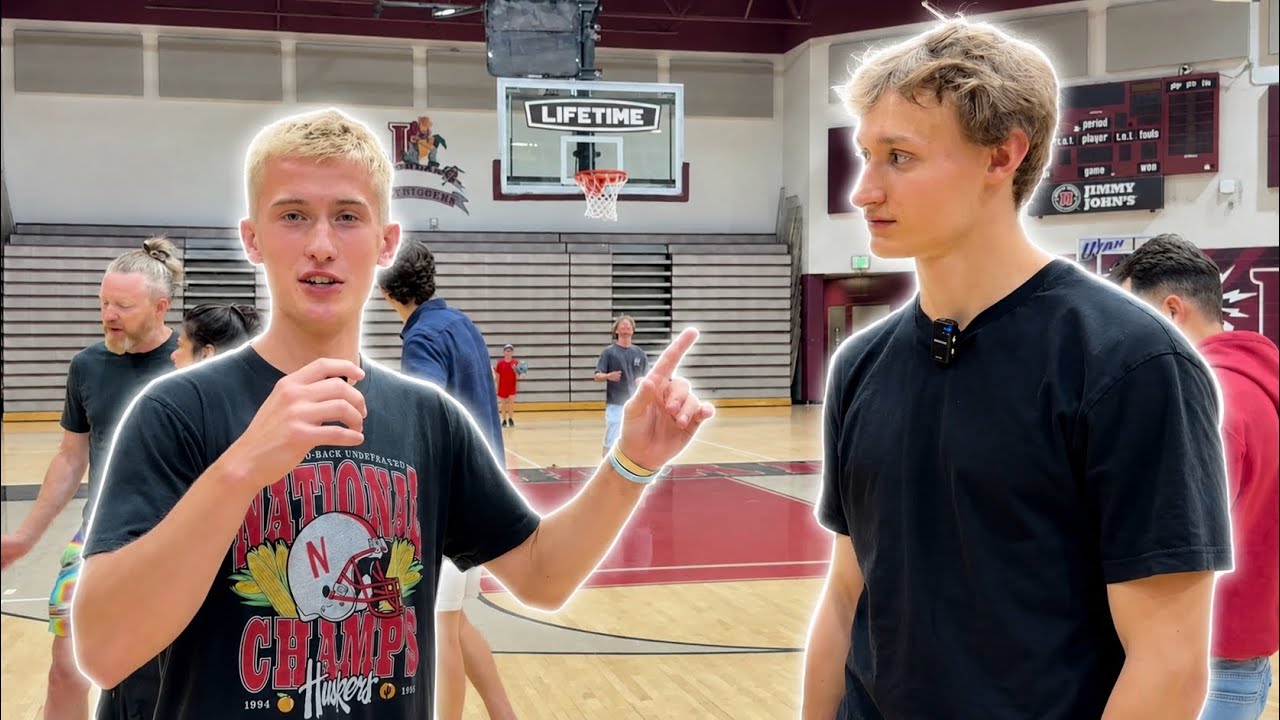
Somebody else has to say it. And the strongest version is when two people say it about each other in the same ninety seconds.
The video above is that, filmed in a gym in Salt Lake City. I am using athletes because the example is clean, and the mechanic transfers to consultants, contractors, doctors, and anybody else whose reputation is built in rooms instead of on the internet.
You Are Understood by Your Relationships
Dennis Yu, who founded BlitzMetrics, put it in one sentence on stage at The Dunk Camp in front of 76 athletes, two days before this footage was shot.
“You’re understood by your relationships, by the content that you have.”
Dennis Yu
That is a literal description of how a machine reads a person. Google does not store you as a paragraph. It stores you as a node with edges running to other nodes: employers, events, publications, co-authors, awards, and other people. Language models work from a similar shape. They have whatever text exists describing you, and specifically describing you in relation to things they already recognize.
A node with no edges is ambiguous, and ambiguity gets treated as noise. Add one edge to a well-established node and the whole entity inherits context. Add a second edge running the other direction and the connection stops being an assertion and starts being a confirmed relationship.
One Direction Is a Claim, Two Directions Is a Record
A one-way endorsement carries a built-in discount. The person receiving it has an obvious incentive to publish it. The person giving it usually gains nothing, which is what makes it worth something, and it also means only one party has any reason to keep it alive. Six months later the quote exists on exactly one website, owned by the person it flatters.
A reciprocal endorsement is different in kind. Both parties have a reason to publish. Both are exposed to the same risk of being wrong in public. Neither is doing the other a favor, so the usual objection about motive collapses.
The result is two independent sources describing the same event and the same relationship, which is the shape that both search engines and language models treat as corroborated rather than asserted.
Cross-Specialty Praise Is Harder to Discount
The two people in this video are not interchangeable. Polish dunker Piotr Zawiślak is eighteen and had just won the ten-foot contest at that camp on a regulation rim, one week before flying to a FIBA event. Nathaniel “Hoopin Nate” Kenney is a 5’7″ creator from Omaha with more than a billion views, widely considered the best low rim and mini hoop dunker alive.
Each one graded a discipline he does not own. Piotr, the ten-foot contest winner, said this about Nate’s specialty:
“That’s the best low rim dunker I’ve ever seen. He can do everything. Every dunk you can imagine, Hoopin Nate can do.”
Piotr Zawiślak
Nate returned it with a ranked credential and a checkable result rather than an adjective.
“Piotr is the youngest athlete to ever get a black band, which is the most prestigious level of dunking, and he’s the youngest to do it.”
Nathaniel “Hoopin Nate” Kenney
Two specialists who are not fighting over the same work have no reason to shade each other, and praise paid across a boundary reads as an assessment instead of a defense of shared territory.
The Sentence a Buyer Would Care About
Asked what he found most inspiring about Piotr’s technique, Nate skipped every impressive move and named an operational trait.
“The most inspiring thing is he can hit everything within like one or two tries, and that’s so important in the dunking world, especially with contests and to be exciting in shows.”
Nathaniel “Hoopin Nate” Kenney
Translate that out of sports. He said this person delivers on demand, under a clock, in front of an audience, on the first or second attempt. That is a procurement criterion dressed as a compliment, and it came from a peer who has watched him work rather than from a sales page.
Your clients have the same sentence about you and nobody has ever asked them for it. Not that you do good work. That you answer on Saturday. That the estimate matched the invoice on eleven straight jobs. Peers know the operational truth about you, and it beats any capability claim you can write.
The Structure That Makes It Count
Recording the exchange is not the finish line. A video is a weak signal on its own, because the relationship lives in audio, on a platform neither person owns.
Both of these athletes have personal brand sites our team built, each on their own name. Each published his half of this conversation on his own domain, in his own voice, and the two pages link to each other. Piotr wrote the best low rim dunker he has ever seen. Nate wrote why Piotr is the youngest black band ever.
Now the association exists as indexable text, attributed by name, on two domains with two owners, with the event and year stated. Anything crawling either site sees the same relationship confirmed from both ends. That is the difference between a nice moment and an entity association.
This Is Not a Link Exchange
Worth addressing directly, because reciprocal linking has a bad name for good reasons. Two sites agreeing to trade links for ranking purposes is a scheme, it is detectable, and it does not work.
What separates this is that the link is a byproduct rather than the point. There is a real event, at a named venue, on a specific date, with video, with two named people saying quotable things about each other’s actual work. The pages describe different experiences of the same ninety seconds. The anchor text is descriptive. Remove the links entirely and both articles still stand up as documentation.
Test any reciprocal setup against that. If both pages would still exist with no linking benefit at all, it is a relationship. If not, it is a scheme.
Running This Outside of Sports
The pairing you want is somebody adjacent, not identical. A structural engineer and a general contractor. A CPA and an estate attorney. A dentist and an orthodontist. You refer work to each other already and you have never once documented why.
Get on one call, record it, and ask each other a real question. The prompt that produced the best line here was what do you find most inspiring about his technique. It asks for an assessment of craft, and it forces a specific answer no marketing brief would have generated.
Then both of you publish. Same source, different angles, on your own domains, with the quotes as text and each of you naming the other. Two articles is the minimum viable version of this and it takes an afternoon.
What Ninety Seconds Turned Into
This clip exists because Dennis and I taught a session at that camp on how athletes show up on Google and in AI answers, audited all 76 campers, published the results on a public camp leaderboard, then offered to interview anybody who wanted it. Nate finished first on that audit with enormous reach and a thin structured record, which is the exact gap this closes. The system is in the 76 athlete repurposing writeup.
Six pages came out of those ninety seconds. Beyond the two first-person accounts, the sport-specific version is the youngest black band meeting the best low rim dunker, the argument for two-way endorsement is why mutual endorsement works, and the version for athletes in any sport is vouching for each other on camera.
Every one of those pages states in plain text that these two athletes endorsed each other at a named event in 2026. That is six independent confirmations of one relationship, from one conversation nobody planned.
You already know the person in your field whose respect would mean something to a buyer. You have never asked them on camera, and never offered to say it back. That exchange is free, takes ninety seconds, and produces the one claim you cannot make on your own.
Dylan Haugen
Dylan Haugen is a professional dunker, content creator, and editor at the Content Factory, where he transforms podcasts and interviews into strategic brand assets. He collaborates with Dennis Yu to support young entrepreneurs and business owners in building their personal brands through education, transparency, and effective content marketing. As the host of the Dunk Talk podcast and a dedicated advocate for establishing dunking as a recognized sport, Dylan combines athletic expertise, storytelling, and digital strategy to help elevate the next generation of creators.